The Cypresses of Saint-Rémy: Van Gogh, Motion, and the Summer of 1889
I. The Voluntary Prisoner
On the 8th of May, 1889, Vincent van Gogh walked through the gates of the Saint-Paul-de-Mausole asylum in Saint-Rémy-de-Provence and asked to be admitted. He was thirty-six years old. He had cut off part of his own ear four months earlier, during a crisis in Arles that had ended his turbulent friendship with Paul Gauguin and frightened the neighbors badly enough that they had petitioned for his removal from the city.

The admission was voluntary. Van Gogh was not committed; he committed himself. He understood, with the clarity that sometimes accompanies breakdown, that he needed containment — a structure, a routine, a place where the crises that had been overtaking him with increasing frequency might be managed, or at least survived.
What he found at Saint-Paul-de-Mausole was something he had not expected: one of the most productive periods of his life.
II. The Asylum and the Garden
Saint-Paul-de-Mausole was a former monastery converted into a private psychiatric institution, set in the hills of the Alpilles outside Saint-Rémy. The building was dilapidated, the food poor, the other patients disturbing. But Van Gogh was given two rooms — one to sleep in, one to paint in — and permission to work in the garden and, eventually, in the surrounding countryside.
He painted obsessively. In the twelve months he spent at Saint-Rémy, he produced more than 150 paintings and nearly as many drawings — an output that, even by his extraordinary standards, was remarkable. The crises continued — there were episodes in which he could not work at all, in which he was confined to his room, in which he lost weeks to a darkness he could not describe. But between the crises, the work poured out.
The subjects were those immediately available to him: the garden of the asylum, the wheat fields visible from his window, the olive groves on the hillsides, the mountains of the Alpilles in the distance. And, everywhere, the cypresses.
III. The Cypresses
Van Gogh had been thinking about cypresses for years. In a letter to his brother Theo written from Saint-Rémy in June 1889, he described them as “beautiful as regards line and proportion, like an Egyptian obelisk.” He was struck by their verticality — the way they rose from the horizontal landscape like dark exclamation marks, like flames, like the strokes of a brush moving upward against gravity.
He was also struck by their color. The cypress is not simply dark green; it is a complex, shifting green that moves toward black in shadow and toward silver in light, that changes with the time of day and the quality of the Provençal sun. Van Gogh was a colorist of extraordinary sensitivity, and the cypress presented him with a chromatic challenge that he returned to again and again.
“The cypresses are always occupying my thoughts,” he wrote to Theo. “I should like to make something of them like the canvases of the sunflowers, because it astonishes me that they have not yet been done as I see them.”
He was wrong, of course — cypresses had been painted before. But no one had painted them as Van Gogh saw them: as living things in motion, as participants in the same turbulent energy that animated the sky and the wheat and the air itself.
IV. Wheat Field with Cypresses
Wheat Field with Cypresses was painted in June 1889, during one of the periods of lucidity between crises. Van Gogh made three versions of the composition — a smaller study, a larger studio version now in the National Gallery in London, and the version now in the Metropolitan Museum of Art in New York, which is generally considered the finest.
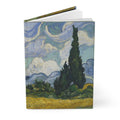
The painting shows a wheat field in full summer, the grain golden and ripe, moving in a wind that is also moving the clouds above and the olive trees to the left. Two cypresses rise from the right side of the composition, dark and vertical against the turbulent sky. The mountains of the Alpilles are visible in the distance, rendered in the same swirling brushwork as everything else.
What is immediately striking about the painting is its unity of motion. Everything moves — the wheat, the clouds, the trees, the mountains, even the sky itself. The brushstrokes that describe each element are different in direction and rhythm, but they are all part of the same visual energy, the same sense that the landscape is not a static backdrop but a living, breathing, turbulent presence.
This was Van Gogh’s great technical achievement at Saint-Rémy: the development of a brushstroke that could convey not just the appearance of things but their inner life, their energy, their participation in the larger rhythms of the natural world. The impasto — the thick, textured application of paint that gives his late work its characteristic surface — was not merely a stylistic choice. It was a way of making the paint itself move, of giving the surface of the canvas the same restless energy as the landscape it depicted.
V. The Post-Impressionist Revolution
To understand what Van Gogh was doing in Wheat Field with Cypresses, it helps to understand what he was reacting against.
The Impressionists — Monet, Renoir, Pissarro, Sisley — had revolutionized painting in the 1870s and 1880s by insisting on the primacy of visual sensation: the way light actually looked at a particular moment, in a particular place, under particular atmospheric conditions. They painted quickly, outdoors, in front of their subjects, capturing the fleeting impression of light on water, on snow, on the facades of cathedrals.
Van Gogh admired the Impressionists enormously — he had spent two years in Paris, from 1886 to 1888, absorbing their lessons and lightening his palette dramatically. But he wanted something more than the faithful recording of visual sensation. He wanted to paint not just what he saw but what he felt — the emotional charge of the landscape, the psychological weight of color, the inner life of things.
This was the Post-Impressionist project, shared in different ways by Van Gogh, Gauguin, Cézanne, and Seurat: to use the Impressionist liberation of color and brushwork as a starting point for a more expressive, more subjective, more emotionally charged art. Where the Impressionists asked “what does this look like?”, the Post-Impressionists asked “what does this feel like?”
Wheat Field with Cypresses is one of the purest answers to that question in the history of painting. It feels like summer heat and wind and the particular quality of Provençal light. It feels like the energy of a mind that is simultaneously lucid and overwhelmed. It feels like the effort to find beauty in a landscape that is also, for its painter, a kind of prison.
VI. The Letters
One of the remarkable things about Van Gogh is that he left an extraordinarily detailed record of his own thinking — in the letters he wrote to his brother Theo, to his sister Wil, to his fellow painters Gauguin and Émile Bernard. More than 800 letters survive, and they constitute one of the most extraordinary documents in the history of art: a running commentary on his own work, his intentions, his doubts, his discoveries.
The letters from Saint-Rémy are among the most moving. They record the crises with terrible clarity — the periods when he could not work, when he was afraid of himself, when the darkness was total. But they also record the periods of lucidity with an intensity that is almost painful: the excitement of a new subject, the satisfaction of a painting that had come out as he intended, the pleasure of the Provençal landscape in summer.
“I am working like one actually possessed,” he wrote to Theo in June 1889, “more than ever I am in a dumb fury of work.” The fury produced Wheat Field with Cypresses, The Starry Night, Irises, Olive Trees with the Alpilles in the Background — some of the most celebrated paintings in the history of Western art, all made within a few months, in a room in an asylum in the south of France.
VII. After Saint-Rémy
Van Gogh left Saint-Paul-de-Mausole in May 1890, a year after he had arrived. He went north, to Auvers-sur-Oise, where the physician and art lover Dr. Paul Gachet had agreed to look after him. He painted furiously for two months — another extraordinary burst of productivity, including the great series of wheat fields under threatening skies that are among his last works.
On the 27th of July, 1890, he shot himself in a wheat field. He died two days later, with Theo at his side. He was thirty-seven years old. He had sold one painting in his lifetime.
Within a decade of his death, his work was recognized as among the most significant in the history of modern art. Today, Wheat Field with Cypresses hangs in the Metropolitan Museum of Art in New York, where it has been since 1993. It is one of the most visited paintings in the world.
VIII. A Note on This Journal

The cover of this journal carries Van Gogh’s Wheat Field with Cypresses (1889) — painted in June of that year, during one of the periods of lucidity between crises at Saint-Paul-de-Mausole. For artists, writers, and anyone who finds in Van Gogh’s work a reminder that beauty and struggle are not opposites.
👉 Van Gogh Journal — Wheat Field with Cypresses 1889
References
- Van Gogh, V. (1889). Letters to Theo van Gogh, June–July 1889. Van Gogh Museum, Amsterdam.
- Naifeh, S. & Smith, G.W. (2011). Van Gogh: The Life. Random House.
- Gayford, M. (2006). The Yellow House: Van Gogh, Gauguin, and Nine Turbulent Weeks in Arles. Little, Brown.
- Druick, D.W. & Zegers, P.K. (2001). Van Gogh and Gauguin: The Studio of the South. Art Institute of Chicago.
- Pickvance, R. (1986). Van Gogh in Saint-Rémy and Auvers. Metropolitan Museum of Art.
- Van Gogh Museum. Wheat Field with Cypresses. vangoghmuseum.nl.