Charting the Heavens: Vintage Astronomical Educational Charts, 1705–1869
Before the photograph, there was the diagram. Before the telescope reached every household, there was the wall chart — printed, hand-colored, and hung in classrooms, observatories, and parlors across Europe and America. The history of astronomical education is, in large part, a history of images.
The tradition of the astronomical educational chart spans more than two centuries of scientific illustration, from the baroque celestial planispheres of the early eighteenth century to the chromolithographic school posters of the Victorian and Edwardian eras. These were not decorative objects in the first instance — they were pedagogical instruments, designed to make the invisible mechanics of the solar system legible to students who had never looked through a telescope and never would. Yet in their precision, their color, and their compositional ambition, they achieved something beyond instruction: they made the cosmos beautiful.
Nicolas de Fer and the Baroque Planisphere (1705)
Among the earliest charts in this tradition is the Planisphere Céleste of 1705, produced by the French cartographer Nicolas de Fer (1646–1720) with astronomical data supplied by Philippe La Hire (1640–1718), a member of the Académie Royale des Sciences. De Fer was one of the most prolific map publishers of his era, and his celestial planisphere — a projection of the night sky onto a flat surface — exemplifies the Baroque approach to scientific visualization: rigorous in its astronomical content, yet framed by allegorical figures and ornamental cartouches that situate knowledge within a broader cultural and theological order. La Hire's contributions ensured the chart's mathematical accuracy; de Fer's engravers ensured its visual authority.
James Reynolds, John Emslie, and the London Transparent Diagram (1846–1860)
The London publisher James Reynolds (active 1840s–1870s) developed a distinctive format for astronomical education: the transparent diagram, printed on thin paper or vellum and designed to be held up to the light, revealing layered celestial information invisible in ordinary viewing. His collaborator John Emslie produced a series of charts covering solar phenomena, planetary comparisons, and the mechanics of the seasons — works that combined scientific accuracy with the visual drama of the hold-to-light tradition. Reynolds's publications were aimed at the educated middle-class household as much as the schoolroom, reflecting the Victorian conviction that scientific literacy was a domestic as well as an institutional virtue.
Asa Smith and American Astronomical Pedagogy (1848)
In the United States, the astronomer and educator Asa Smith (1804–1877) published Illustrated Astronomy in 1848, a landmark work in American science education. Smith's woodcut engravings — including his celebrated diagram of Saturn — were designed for use in common schools and academies, and the book went through numerous editions throughout the mid-nineteenth century. The white-on-black woodcut technique Smith employed gave his planetary illustrations a dramatic, almost photographic quality that distinguished them from the hand-colored lithographs of their European contemporaries.
German and Swedish School Wall Charts (19th–20th century)
The German tradition of the Schulwandtafel — the school wall chart — produced some of the most ambitious astronomical educational images of the nineteenth and early twentieth centuries. Publishers such as Baur & Böhm (later Otto Maier Verlag, Ravensburg) and Rudolf Schmidt (Vienna, distributed by A. Pichlers Witwe & Sohn) produced large-format chromolithographic charts covering mathematical geography, constellation maps, and stellar phenomena, intended for display in secondary schools and Gymnasien across the German-speaking world. In Sweden, the equivalent skolplansch tradition yielded charts on solar and lunar eclipses (sol- och månförmörkelser) that combined Scandinavian graphic clarity with the pedagogical ambitions of the broader European educational reform movement.
Elias Colbert and the Late Victorian Survey (1869)
Elias Colbert (1831–1883), the Chicago-based astronomer and science journalist, published Astronomy Without a Telescope in 1869 — a work aimed at the general reader rather than the specialist, and illustrated with star maps and constellation diagrams designed for naked-eye observation. Colbert's charts represent the democratizing impulse of late Victorian science communication: the conviction that astronomical knowledge should be accessible to anyone willing to look up at the night sky.
The Visual Grammar of Pre-Photographic Astronomy
What unites these diverse traditions — French baroque cartography, London transparent diagrams, American woodcut engravings, German chromolithography, Swedish school posters — is a shared commitment to making the invisible visible through the resources of print. The hand-colored engraving, the lithographic wash, the woodcut line: each technique imposed its own aesthetic on the astronomical data it conveyed, and each produced images that remain visually compelling more than a century after their creation. The history of astronomical education is inseparable from the history of print technology, and the wall chart is its most ambitious expression.

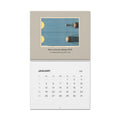
The 2026 Astronomy Wall Calendar from LeBonJournal brings together thirteen of these historical charts — from Nicolas de Fer's 1705 planisphere to Elias Colbert's 1869 star maps — in a format designed for the contemporary wall. Available in 11×8.5" (matte) and 14×11.5" (glossy). View the calendar →