Luminous Precision: Arentina Hendrica Arendsen and the Dutch Botanical Watercolour Tradition, 1872–1881
There is a particular quality of light in the finest Dutch botanical watercolours — a luminosity that seems to come from within the flower itself rather than from any external source, as if the painter had found a way to capture not just the appearance of the petal but its translucency, the way light passes through it and is transformed by the pigments within. This quality — achieved through the layering of transparent washes of colour, each one modifying and enriching the ones beneath — is the defining characteristic of the Dutch botanical watercolour tradition, and it is present throughout the work of Arentina Hendrica Arendsen. Her paintings of anemones and South African species, produced between 1872 and 1881, are among the finest examples of this tradition: images that are simultaneously scientific documents and works of quiet, enduring beauty.
Arendsen (1836–1915) worked in a tradition that stretched back to the great Dutch flower painters of the seventeenth century — to Jan van Huysum and Rachel Ruysch, whose elaborate floral compositions had established the Dutch reputation for botanical painting that would endure for two centuries. But where the seventeenth-century masters had painted flowers as symbols of wealth and transience, as demonstrations of painterly virtuosity in the service of aristocratic patronage, the nineteenth-century botanical watercolourists worked in the service of science: their images were designed to document species with sufficient accuracy to allow identification, to record the colours and forms of flowers that might otherwise be known only to those who had seen them growing. Beauty, in this tradition, was not an end in itself but a consequence of precision — the inevitable result of looking very carefully at a very beautiful thing.
Arentina Hendrica Arendsen: Life and Work
Arentina Hendrica Arendsen was born in Arnhem in 1836, into a Netherlands that was experiencing a significant revival of interest in botanical illustration. The great tradition of Dutch flower painting had declined in the eighteenth century, as the fashion for elaborate floral compositions gave way to other genres; but the nineteenth century saw a renewed interest in botanical documentation, driven by the expansion of European botanical gardens, the growth of amateur horticulture among the middle classes, and the continuing need for accurate illustrations of newly discovered species from the expanding frontiers of European botanical knowledge.
Arendsen trained as a watercolourist and devoted her career to botanical illustration, producing a body of work that documented garden flowers and exotic species with extraordinary fidelity. Her technique was rooted in the Dutch watercolour tradition: she worked with transparent washes of colour, building up tone and detail through successive layers, achieving the luminous quality that distinguishes the finest botanical watercolours from mere botanical diagrams. Her compositions were carefully designed to show the characteristic form of each species — the arrangement of petals, the structure of the stem and leaves, the details of the reproductive organs — while maintaining the visual coherence and aesthetic appeal that made her images satisfying to look at quite apart from their scientific content.
The works reproduced on our journal covers were produced between 1872 and 1881 — the period of Arendsen’s mature career, when her technique was at its most assured and her botanical knowledge at its deepest. They represent the full range of her subject matter: the Mediterranean garden flower, the exotic South African species, the careful documentation of botanical variety that was the hallmark of the Victorian botanical illustrator.
Anemone stellata: The Star Anemone of the Mediterranean
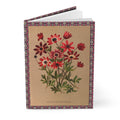
The flower shown on the front cover of our journal — Anemone stellata, the star anemone — is a species native to the Mediterranean basin, found from the Iberian Peninsula to the eastern Mediterranean and North Africa. It is a plant of considerable beauty: the flowers, which appear in early spring, range in colour from white through pink and lilac to deep purple, with a characteristic dark centre that gives the flower its distinctive appearance. The name stellata — from the Latin for “starry” — refers to the star-like arrangement of the petals, which spread outward from the dark centre in a regular pattern that has made the flower a favourite of botanical illustrators since the Renaissance.
Arendsen’s rendering of Anemone stellata is characteristic of her finest work. The petals are painted with the soft, luminous washes that are her signature technique — layers of transparent colour that build up to a rich, complex tone while maintaining the translucency that gives the flower its characteristic appearance in life. The dark centre is rendered with careful attention to its botanical structure; the foliage is painted with the same precision as the flower, each leaf showing the characteristic deeply divided form of the anemone. It is an image that rewards close examination — that reveals more the longer you look at it, that repays sustained attention with an ever-deeper appreciation of the botanical complexity it documents.
The anemone had a long history in European botanical illustration by the time Arendsen painted it. It had been documented by the great Flemish botanist Carolus Clusius in the sixteenth century, illustrated in the botanical publications of the seventeenth and eighteenth centuries, and grown in European gardens since the Renaissance. By the 1870s, it was a familiar garden plant — but Arendsen’s painting treats it with the same careful attention that the earliest botanical illustrators had brought to it, as if seeing it for the first time.
South African Flora in the Victorian Garden: Anomatheca and Vieusseuxia
The two species shown on the back cover of our journal — Anomatheca cruenta and Vieusseuxia pavonia — represent a different aspect of Victorian botanical culture: the passion for exotic species from the expanding frontiers of European botanical knowledge. Both are South African plants, introduced to European gardens during the nineteenth century as part of the great wave of botanical exploration that accompanied European expansion into southern Africa.
Anomatheca cruenta — now known as Freesia laxa — is a small bulbous plant of the iris family, native to southern and eastern Africa. Its flowers, which are typically blood-red with darker markings, have a delicate, almost translucent quality that makes them particularly suited to the watercolour technique: the colour seems to glow from within, as if lit by an internal light. Arendsen captures this quality with characteristic skill, rendering the flowers with the luminous washes that are her signature while maintaining the botanical accuracy that documents the species with scientific precision.
Vieusseuxia pavonia — now known as Moraea villosa, the peacock moraea — is one of the most spectacular of all South African bulbous plants. Its flowers, which are typically lilac or purple with distinctive peacock-eye markings at the base of each petal, have a jewel-like quality that made them a favourite of Victorian botanical illustrators. The species had been introduced to European cultivation in the early nineteenth century and had become a prized plant in botanical gardens and private collections by the time Arendsen painted it. Her rendering captures the extraordinary complexity of the flower — the subtle gradations of colour in the petals, the intricate markings of the peacock eye, the delicate texture of the surface — with a precision that reflects both deep botanical knowledge and exceptional painterly skill.
The Dutch Botanical Watercolour Tradition
The tradition within which Arendsen worked — the Dutch botanical watercolour — had its roots in the great flowering of Dutch art in the seventeenth century, but it had developed, over the course of two centuries, into something quite distinct from the elaborate floral compositions of the Golden Age. Where Jan van Huysum and Rachel Ruysch had painted flowers as demonstrations of painterly virtuosity — as images designed to display the painter’s ability to render the textures and colours of petals, leaves, and insects with trompe-l’oeil precision — the nineteenth-century botanical watercolourists worked in the service of science, producing images designed to document species with sufficient accuracy to allow identification and study.
This shift in purpose did not diminish the aesthetic quality of the images produced. On the contrary, the discipline of scientific accuracy — the requirement to render each species with sufficient precision to allow identification — imposed a kind of aesthetic rigour that the more decorative tradition lacked. The botanical watercolourist could not simplify or idealise; she had to paint what was actually there, in all its complexity and particularity. The result, at its best, was an image of extraordinary beauty — beauty that arose not from the imposition of aesthetic conventions but from the careful observation of natural forms.
Arendsen’s work represents this tradition at its finest. Her images are scientifically accurate — they document the species they represent with sufficient precision to allow identification — but they are also, quite simply, beautiful: images that reward sustained attention, that reveal more the longer you look at them, that carry within them the luminous quality of the finest Dutch watercolour painting.
A Journal for Those Who Find Poetry in Petals

Our Arentina Arendsen Botanical Journal carries these 1872–1881 watercolours across its full wraparound cover — the Anemone stellata on the front, the South African species on the back, rendered with the luminous precision that is Arendsen’s signature. It is a journal for those who find beauty in botanical illustration, who understand that a watercolour of a flower is also a document of the natural world, who appreciate the Dutch tradition of botanical painting that produced these images.
Inside, 150 perforated lined pages await your garden notes, botanical sketches, watercolour observations, or whatever form your engagement with the natural world takes. The casewrap sewn binding opens completely flat — ideal for sketching. The matte laminated cover preserves every detail of Arendsen’s watercolours in a finish that rewards close examination.
Between 1872 and 1881, Arentina Arendsen looked very carefully at flowers and painted what she saw. Perhaps the pages inside will help you look a little more carefully too.
References & Further Reading
- Blunt, Wilfrid & Stearn, William T. The Art of Botanical Illustration. Antique Collectors’ Club, 1994. [The standard history of botanical illustration as an art form.]
- Clusius, Carolus. Rariorum Plantarum Historia. Antwerp, 1601. [The foundational work of early modern botanical documentation, which first described many of the species Arendsen later painted.]
- Goldgar, Anne. Tulipmania: Money, Honor, and Knowledge in the Dutch Golden Age. University of Chicago Press, 2007. [On the Dutch culture of botanical curiosity that shaped the tradition Arendsen inherited.]
- Lack, H. Walter. Garden Eden: Masterpieces of Botanical Illustration. Taschen, 2008. [A comprehensive survey of botanical illustration from the Renaissance to the twentieth century.]
- Pavord, Anna. The Naming of Names: The Search for Order in the World of Plants. Bloomsbury, 2005. [On the history of botanical classification and the role of illustration in plant documentation.]
- Saunders, Gill. Picturing Plants: An Analytical History of Botanical Illustration. University of California Press, 1995.
- Stearn, William T. Botanical Latin. David & Charles, 1983. [On the language of botanical description and the naming of species.]