The Circle and the Gourd: Yerba Mate, Guaraní Heritage, and the Ritual That Defines the Rioplatense World
There is a gesture so common in Argentina and Uruguay that it has become almost invisible — the extension of a hand holding a gourd, the offer of a sip, the acceptance that creates a moment of connection between two people. The mate circle is one of the oldest social rituals in the Americas, rooted in Guaraní culture and carried forward through five centuries of colonial history, independence, immigration, and urbanization without ever losing its essential character: the shared gourd, the shared silence, the shared warmth.

The Guaraní Origins
The story of mate begins in the subtropical forests of what is now northeastern Argentina, Paraguay, and southern Brazil — the territory of the Guaraní people, one of the most widespread indigenous groups in South America. The Guaraní had been cultivating and consuming Ilex paraguariensis — the holly plant whose dried and ground leaves become yerba mate — for centuries before any European arrived in the region.
In Guaraní cosmology, the mate plant was a gift from the gods. The legend tells of Yací, the moon goddess, and Araí, the cloud goddess, who descended to Earth in human form and were saved from a jaguar by an old man. In gratitude, Yací gave the old man a new plant — the caá — whose leaves, when dried and steeped, would produce a drink that would bring people together and sustain them through hardship. The word mate itself comes from the Quechua mati, meaning gourd — the vessel in which the drink was traditionally prepared and shared.
The Guaraní consumed mate not merely as a beverage but as a ritual — a practice embedded in social life, in ceremony, in the rhythms of daily existence. The gourd was passed from hand to hand in a circle, each person drinking through the same bombilla, the shared vessel creating a bond of trust and intimacy that no other social practice quite replicated.
The Colonial Encounter
When the Spanish arrived in the Río de la Plata region in the 16th century, they encountered the mate ritual and immediately recognized its power — and its threat. The colonial authorities attempted to suppress mate consumption, associating it with indigenous practices they sought to eradicate. They failed comprehensively. The mate ritual was too deeply embedded in the social fabric of the region, too necessary to the daily life of both indigenous and mestizo populations, to be suppressed by decree.
By the 17th century, the Jesuit missionaries who had established their famous reducciones — the mission communities where Guaraní people lived under Jesuit protection — had recognized that mate was not merely a habit but a cultural institution. The Jesuits began cultivating yerba mate systematically in their missions, developing the agricultural techniques that would eventually make the Río de la Plata region the world’s primary producer of the plant. When the Jesuits were expelled from Spanish America in 1767, they left behind a mate culture that had spread far beyond its Guaraní origins.
The Rioplatense Ritual
By the 19th century, mate had become the defining social ritual of the Rioplatense world — the region centered on the Río de la Plata and encompassing what is now Argentina, Uruguay, and Paraguay. The independence movements that swept the region in the early 19th century did not diminish the mate ritual; if anything, they elevated it, as the new nations sought cultural practices that distinguished them from Spain and connected them to the land they inhabited.
The mate circle became a symbol of Rioplatense identity — a practice that cut across class lines, that united the gaucho on the pampa with the urban intellectual in Buenos Aires, that was shared by immigrants from Italy, Spain, and Eastern Europe who arrived in the late 19th and early 20th centuries and were absorbed into a culture where the offer of a mate was the first gesture of welcome.
The objects of the ritual became iconic: the mate gourd, traditionally made from a dried calabash but increasingly crafted from wood, leather, or metal; the bombilla, the metal straw with a filtered end that allows the liquid to be drunk without consuming the yerba leaves; the pava, the kettle kept at a precise temperature — hot but never boiling — that is the mark of the serious matero.
The Golden Age of Mate Advertising
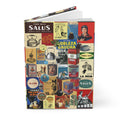
In the 1930s, 1940s, and 1950s, Argentina’s golden age of commercial illustration gave yerba mate its most vibrant visual identity. The yerba mate industry had grown into one of Argentina’s most important agricultural sectors, with dozens of brands competing for the loyalty of consumers who drank mate multiple times a day. The brand labels and promotional art of this period — bold colors, confident typography, joyful graphic energy — celebrated the mate ritual with an aesthetic confidence that reflected the optimism of mid-century Argentine culture.
The graphic designers who created these labels drew on both the indigenous heritage of the mate tradition and the modern commercial aesthetic of their era. The result was a visual language that was uniquely and unmistakably Rioplatense — neither purely indigenous nor purely European, but something new that belonged to the Río de la Plata and nowhere else.
The Mate Circle Today
The mate ritual has survived everything — colonialism, urbanization, globalization, the smartphone. In Argentina and Uruguay, mate consumption remains one of the highest per capita in the world. The gourd and the bombilla are as present in the 21st-century city as they were on the 19th-century pampa. The ritual has spread beyond its Rioplatense heartland — to southern Brazil, to Chile, to the Guaraní diaspora, and increasingly to Europe and North America, where mate has found new devotees who recognize in the shared gourd something that the coffee shop and the energy drink cannot provide: a reason to slow down, to sit together, to pass something between hands and share a moment of warmth.

Our Mate Journal carries a collage of mid-century Argentine yerba mate advertising from the 1930s–1950s — the golden age of Rioplatense graphic design, celebrating a ritual that the Guaraní people gave to the world and that the Río de la Plata made its own.
References
- Folch, Christine. “Stimulating Consumption: Yerba Mate Myths, Markets, and Meanings from Conquest to Present.” Comparative Studies in Society and History, 2010.
- Garavaglia, Juan Carlos. “El Río de la Plata en sus relaciones atlánticas.” Historia Argentina, 1999.
- Linhares, Temístocles. História econômica do mate. José Olympio, 1969.
- Wilde, Guillermo. Religión y poder en las misiones de Guaraníes. SB Editorial, 2009.