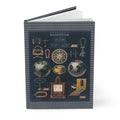
When Electricity Stopped Being Magic: John Emslie's 1850 Atlas of Victorian Physics
In 1850, John Emslie drew two plates for London publisher James Reynolds that captured an extraordinary moment: the instant when electricity and magnetism ceased to be cabinet curiosities and became the infrastructure of the modern world. This is the story of those plates — and of the scientific revolution they made visible.

In the spring of 1850, a draughtsman named John Emslie sat down to illustrate the invisible.
His brief, from London publisher James Reynolds, was deceptively simple: produce two large-format educational plates summarising the current state of knowledge on magnetism and electricity. The result was something far more remarkable — a visual encyclopaedia of a science in the act of becoming, captured at the precise moment when the forces that had fascinated natural philosophers for centuries were being harnessed, measured, and put to work.
Those two plates are among the most extraordinary documents of Victorian scientific culture. And they are the covers of this journal.
The World Emslie Drew
To understand what Emslie was illustrating in 1850, it helps to understand how recently everything had changed.
Just two decades earlier, electricity was still largely a phenomenon of the salon and the lecture theatre — spectacular, mysterious, and practically useless. Experimenters generated static charges with glass cylinders and silk pads, stored them in Leyden jars (the first capacitors, invented in 1745), and discharged them through chains of hand-holding volunteers to the delight of aristocratic audiences. Magnetism was the province of navigators and their compasses, and of natural philosophers who marvelled at the way iron filings arranged themselves around a lodestone into patterns of uncanny beauty.
Then, between roughly 1820 and 1850, everything accelerated.
In 1820, Hans Christian Ørsted discovered that an electric current deflects a magnetic needle — the first experimental proof that electricity and magnetism were related phenomena. In 1831, Michael Faraday demonstrated electromagnetic induction, showing that a changing magnetic field could generate an electric current. By the 1840s, Faraday had developed his concept of lines of force — the invisible field structures that would eventually become the foundation of Maxwell's equations and, ultimately, of all modern electrical engineering.
Meanwhile, in 1837, William Fothergill Cooke and Charles Wheatstone had patented the electric telegraph — the first practical application of electromagnetism at scale. By 1850, telegraph lines were spreading across Britain and Europe. The invisible force was becoming infrastructure.
This is the world John Emslie drew.
Reading the Plates
Emslie's genius was taxonomic. His plates do not tell a story sequentially — they present a state of knowledge, arranged with the clarity of a well-organised library. Every instrument, every phenomenon, every apparatus is numbered, labelled, and placed in relation to the others.
On the Magnetism plate (the front cover of this journal), the eye moves from the simplest phenomena — bar magnets, iron filing patterns, pivoting needles — to the most complex instruments of the age. A marine compass on gimbal suspension sits beside a dipping needle for measuring terrestrial magnetic inclination. Terrestrial globes show isoclinic lines and magnetic poles. A horseshoe electromagnet lifts weights, referencing the experiments of William Sturgeon and Joseph Henry. And at the far edge of the plate, almost as a glimpse of the future, the Cooke and Wheatstone two-needle telegraph appears — the moment magnetism became communication.
The Electricity plate (the back cover) is equally encyclopaedic, and perhaps even more dramatic. At its centre stands Armstrong's hydroelectric machine — a towering apparatus capable of generating sparks of over half a metre from pressurised steam, which had astonished audiences across Britain in the 1840s. Around it: Leyden jars, electroscopes, static electricity machines, a lightning rod referencing Benjamin Franklin, a galvanic trough battery (ancestor of every modern cell), and — in a moment of almost comic humanity — the celebrated figure of a man with his hair standing on end from static charge.
Emslie also included something quietly remarkable: educational lists of Conductors (gold, silver, copper, animals, vegetables) and Non-Conductors (glass, silk, resin, sulphur, dry air). In 1850, these categories were still being established. The plate is not just illustration — it is pedagogy, taxonomy, and wonder simultaneously.
The Deep Navy Background
One of the most striking features of this journal is the deep navy background against which Emslie's instruments are rendered. In the original Reynolds plates, the illustrations appeared on cream paper in the manner of technical diagrams. The navy transformation — which gives the copper, brass, and steel instruments the quality of luminous blueprints — evokes something that Emslie himself could not have anticipated: the aesthetic of technical drawing as art object, the scientific diagram as something worth framing.
It is a fitting tribute. Victorian scientific illustration occupied a peculiar and beautiful position between art and science, between the engraver's craft and the natural philosopher's precision. Emslie was not a scientist — he was a draughtsman of extraordinary skill who made science legible, and in doing so, made it beautiful.
1850: The Hinge Year
There is something almost poignant about the date 1850. It sits at the exact hinge between two worlds.
The electricity of 1830 was magic — spectacular, inexplicable, and useless. The electricity of 1870 was infrastructure — telegraphs, arc lamps, electroplating, the first experiments with electric motors. By 1882, Thomas Edison would open the Pearl Street Station in New York, the world's first commercial electrical power station, and the age of magic would be definitively over.
Emslie drew his plates in the decade between those two worlds. He drew them at the moment when Faraday's lines of force were still a controversial theoretical concept, when the telegraph was new enough to seem miraculous, when Armstrong's hydroelectric machine could still fill a lecture hall with gasps.
He drew the moment when electricity stopped being magic — and started being ours.
A Note on John Emslie and James Reynolds
John Emslie (1813–1875) was one of the most prolific scientific illustrators of the Victorian era, producing educational plates on subjects ranging from geology and astronomy to physiology and natural history for the London publisher James Reynolds. Reynolds specialised in large-format educational diagrams intended for schools, lecture halls, and the growing Victorian market for popular science — a market that Faraday himself had helped create through his celebrated Christmas Lectures at the Royal Institution, which began in 1825 and continue to this day.
The magnetism and electricity plates of 1850 represent Emslie and Reynolds at the height of their collaboration: ambitious in scope, rigorous in detail, and designed to make the invisible visible for an audience hungry to understand the forces that were remaking their world.
The Magnetism & Electricity Journal — John Emslie 1850 is available in the LeBonJournal shop in Ruled Line, Graph (dotted), and Blank variants. Write in the company of telegraphs and electromagnets, Leyden jars and lightning rods — illustrated by John Emslie and preserved across nearly two centuries of scientific discovery.