The Garden of the Hesperides: Johann Christoph Volkamer and the Golden Age of German Botanical Publishing
In Greek mythology, the Hesperides were the nymphs who tended a garden at the western edge of the world, where golden apples grew on trees guarded by a serpent that never slept. The garden was a place of extraordinary beauty and abundance, beyond the reach of ordinary mortals — a paradise of fruit and flower that existed at the boundary between the known world and the divine. When the Nuremberg physician and botanist Johann Christoph Volkamer named his great botanical work the Nürnbergische Hesperides, he was making a claim: that his gardens in Nuremberg were, in their own way, a garden of the Hesperides — a place where rare and beautiful plants grew in abundance, tended with the care and knowledge of a man who understood that beauty and healing were inseparable.

Johann Christoph Volkamer (1644–1720) was a Nuremberg physician, botanist, and passionate plant collector who devoted much of his life and considerable fortune to the cultivation of exotic and medicinal plants in his gardens outside the city walls. Nuremberg in the late seventeenth and early eighteenth centuries was one of the great centres of German commercial and intellectual life — a free imperial city with strong trading connections to Italy, the Netherlands, and the wider world, and a tradition of scientific and artistic achievement that made it a natural home for a man of Volkamer’s interests and ambitions.
The Nürnbergische Hesperides, published in two volumes between 1708 and 1714, was the culmination of Volkamer’s botanical work. It documented the plants of his gardens — citrus fruits above all, but also a wide range of medicinal and ornamental plants — with hand-colored copper engravings produced by some of the finest engravers working in Germany at the time. The result was a work of extraordinary beauty: one of the most celebrated botanical books of the eighteenth century, and one that has never entirely lost its reputation as among the most beautiful botanical books ever created.
The Tradition of German Botanical Publishing
Volkamer’s Hesperides stood within a long and distinguished tradition of German botanical publishing that stretched back to the great herbals of the sixteenth century. The works of Leonhart Fuchs, Otto Brunfels, and Hieronymus Bock — the three founding figures of German botanical illustration — had established in the 1530s and 1540s the convention of combining precise plant illustration with practical information about medicinal use, and this convention had been maintained and developed through the seventeenth century by a succession of German botanists and publishers.
By Volkamer’s time, the tradition had been enriched by the development of copper engraving as the dominant medium for botanical illustration — a technique that allowed a finer line and a greater range of tonal variation than the woodcuts of the earlier herbals — and by the practice of hand-coloring the printed engravings, which gave the best botanical books of the late seventeenth and early eighteenth centuries a chromatic richness that would not be surpassed until the development of chromolithography in the nineteenth century. The Nürnbergische Hesperides represents this tradition at its height: the copper engraving technique used with extraordinary skill, the hand-coloring applied with a precision and delicacy that makes the best plates seem almost to glow from within.
Medicinal Flowers and the Apothecary Tradition
Among the most striking plates in the Nürnbergische Hesperides are those documenting medicinal flowering plants — the healing plants that formed the basis of European pharmacy from antiquity through the early modern period. The relationship between botany and medicine in early modern Europe was intimate and practical: the physician was expected to know his plants, to be able to identify them in the field and in the apothecary’s shop, and to understand their therapeutic properties and their interactions. Volkamer, as a physician as well as a botanist, brought both kinds of knowledge to his documentation of medicinal plants.
The medicinal flower plates of the Hesperides combine the precision of the physician’s eye with the aesthetic sensibility of the collector and the technical skill of the engraver. Each plant is rendered with the botanical detail that identification requires — the form of the leaves, the structure of the flower, the arrangement of the petals and stamens — and with the chromatic richness that hand-coloring at its best could achieve. The result is a documentation of the healing garden that is also, unmistakably, a work of art.
A Garden Beyond the World
Volkamer’s choice of the Hesperides as the name for his botanical masterwork was not merely decorative. It reflected a genuine conviction — shared by many of the great botanical collectors of the early modern period — that the cultivation of rare and beautiful plants was a form of participation in something larger than individual pleasure or scientific curiosity: a recovery, however partial, of the paradise that mythology placed at the edge of the world. The garden was a place where the beauty of the natural world could be preserved and studied, where the healing properties of plants could be documented and transmitted, where art and science and medicine could meet in a single act of careful attention.
That conviction — that the garden is a place of knowledge as well as beauty, that the careful documentation of plants is a form of respect for the natural world — is as relevant now as it was when Volkamer published his Hesperides more than three centuries ago.

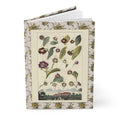
If Johann Christoph Volkamer and the golden age of German botanical publishing resonate with you, the Medicinal Flowers Journal brings the hand-colored copper engravings of the Nürnbergische Hesperides to a hardcover journal — 150 lined pages, ready for herbal notes, plant observations, or whatever the healing garden inspires.
References
- Volkamer, J.C. Nürnbergische Hesperides. Nuremberg, 1708–1714.
- Lack, H.W. Garden Eden: Masterpieces of Botanical Illustration. Taschen, Cologne, 2008.
- Blunt, W. & Stearn, W.T. The Art of Botanical Illustration. Antique Collectors’ Club, Woodbridge, 1994.
- Ogilvie, B.W. The Science of Describing: Natural History in Renaissance Europe. University of Chicago Press, 2006.
- Pavord, A. The Naming of Names: The Search for Order in the World of Plants. Bloomsbury, London, 2005.