The Mushroom Hunters: Victorian Mycology and the Science of the Forest Floor
For most of human history, the mushroom occupied an ambiguous position in the natural world — neither plant nor animal, appearing overnight and vanishing as quickly, capable of nourishing or killing with equal indifference. The ancient Greeks knew that some mushrooms were edible and some were deadly, but they had no reliable system for telling them apart. Medieval herbalists included fungi in their catalogues with varying degrees of accuracy. The great botanists of the Renaissance — Fuchs, Dodoens, Clusius — described and illustrated mushrooms alongside flowering plants, but fungi resisted the classificatory systems that worked so well for the plant kingdom. They had no flowers, no seeds, no obvious reproductive structures. They seemed to arise spontaneously from rotting wood or damp earth, as if generated by decay rather than by life.

It was not until the nineteenth century that mycology — the scientific study of fungi — became a discipline in its own right, with its own methods, its own vocabulary, and its own illustrated atlases. And it was not until the second half of the nineteenth century that mushroom foraging became, in France and across Europe, a respectable and widely practised pursuit — a form of natural history that anyone with a basket and a good atlas could participate in.
The Birth of Mycology
The foundations of modern mycology were laid in the late eighteenth and early nineteenth centuries by a series of naturalists who brought to fungi the same systematic attention that Linnaeus had brought to flowering plants. Christiaan Hendrik Persoon, working in the 1790s and 1800s, produced the first comprehensive classification of fungi based on morphological characteristics — the shape of the cap, the arrangement of the gills, the colour of the spore print — that could be observed in the field. Elias Magnus Fries, the Swedish mycologist who is often called the father of mycology, built on Persoon's work in his monumental Systema Mycologicum (1821–1832), a three-volume classification of fungi that remained the standard reference for decades.
What Persoon and Fries established was a language for talking about fungi — a set of descriptive categories precise enough to distinguish one species from another with reasonable reliability. This language was the prerequisite for the illustrated atlas: a book that could show the reader what a mushroom looked like and tell them, with scientific authority, whether it was safe to eat.
The Illustrated Atlas and the Forager
The illustrated mycological atlas was a product of the mid-nineteenth century, made possible by the same advances in chromolithography that were transforming botanical illustration across the natural sciences. The ability to print in multiple colours with sufficient accuracy to reproduce the subtle gradations of a mushroom's cap — the russet of a Boletus, the ivory of an Amanita, the glistening particles of a Coprinus micaceus — was essential to a form of illustration whose primary purpose was identification. A black-and-white woodcut could show the shape of a mushroom; only colour could show what it actually looked like in the field.
The great French mycological atlases of the second half of the nineteenth century — by Gillet, Quélet, Roze, and others — were produced for an audience that was simultaneously scientific and practical: naturalists who wanted to understand fungi taxonomically, and foragers who wanted to know what they could safely eat. This dual audience shaped the form of the atlas: the illustrations had to be scientifically accurate enough to satisfy the naturalist and visually clear enough to be useful to the forager standing in a forest with a basket in one hand and a book in the other.
Léon Dufour and the Atlas of 1891
Léon Dufour's Atlas des champignons comestibles et vénéneux, published in 1891, belongs to this tradition at its most refined. Dufour — a French naturalist working in the final decades of the nineteenth century, when French mycology was at its most productive — produced an atlas that combined scientific rigour with the kind of visual clarity that made it genuinely useful to the forager. The illustrations, rendered in the chromolithographic technique that had become the standard for natural history illustration, captured the morphological characteristics essential for species identification with a precision and beauty that placed them among the finest mycological illustrations of the century.
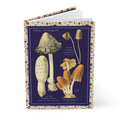
The two plates reproduced on the covers of our journal represent the range of Dufour's subject matter. Planche 46 documents three species of Coprinus — the ink caps — a genus whose most extraordinary characteristic is deliquescence: as the mushroom matures, its cap and gills dissolve from the edges inward into a black inky liquid, a process so dramatic and so unlike anything in the plant kingdom that it fascinated Victorian naturalists and foragers alike. Coprinus comatus, the Shaggy Mane, is the largest and most prized of the edible ink caps, its shaggy white scales and cylindrical cap making it one of the most distinctive mushrooms of the European countryside; it must be harvested while the gills are still white and firm, before deliquescence begins. Coprinus micaceus, the Mica Cap, is smaller and more delicate, its cap covered with glistening particles that give it its name; Coprinus congregatus, the Grouped Inkcap, grows in dense clusters on buried wood.
Planche 49 documents three polypore species — fungi that produce their spores in pores rather than gills, and that tend to grow on wood in bracket or shelf forms. Polyporus confluens (now Albatrellus confluens) is a terrestrial polypore with overlapping caps; Polyporus lucidus (now Ganoderma lucidum, the Reishi) is the most celebrated medicinal mushroom in the world, its glossy varnished cap and reddish-brown colour making it immediately recognisable; Polyporus perennis (now Coltricia perennis, the Tiger's Eye) is distinguished by its distinctive concentric rings of colour.
Foraging as Natural History
The popularity of mushroom foraging in nineteenth-century France was part of a broader democratisation of natural history — the process by which the scientific study of the natural world moved from the exclusive domain of the educated elite into the everyday practice of the middle and working classes. The illustrated atlas was the key instrument of this democratisation: a book cheap enough to be widely owned, clear enough to be used without specialist training, and authoritative enough to be trusted in the field.
The forager with Dufour's atlas in hand was participating, however modestly, in the same project as the professional mycologist: the project of knowing the natural world, of being able to name what grew in the forest and understand its place in the larger system of living things. This is the spirit that animates the best Victorian natural history — the conviction that the world is knowable, that knowledge is worth having, and that the forest floor, examined with sufficient attention, is as rich and strange as any laboratory.

Our Mushroom Journal reproduces two plates from Dufour's 1891 Atlas des champignons comestibles et vénéneux — the ink caps of Planche 46 on the front cover and the polypores of Planche 49 on the back — on a contemporary navy background that gives the Victorian illustrations a new and striking visual life.
References
Dufour, L. (1891). Atlas des champignons comestibles et vénéneux. Paris: Paul Klincksieck.
Fries, E. M. (1821–1832). Systema Mycologicum. Greifswald: Ernestus Mauritius.
Hawksworth, D. L. & Lücking, R. (2017). Fungal Diversity Revisited. Microbiology Spectrum, 5(4).
Ramsbottom, J. (1953). Mushrooms and Toadstools. Collins New Naturalist.
Watling, R. (2003). Fungi. Natural History Museum, London.