The Victorian Cheese Board: Stilton, Roquefort, and the Art of the Cheese Course
In the Victorian dining room, the cheese course occupied a precise and honoured position. It came after the pudding and before the dessert — or, in some households, after the dessert, as a savoury counterpoint to the sweetness that had preceded it. It was served with biscuits, with celery, with butter, and with the kind of quiet ceremony that the Victorians brought to every aspect of the table. And it was, above all, an opportunity for the hostess to demonstrate her knowledge of the world beyond Britain — to show that she knew the difference between a Stilton and a Gorgonzola, between a Camembert and a Brie, between a Gruyère and a Parmesan.
The Victorian cheese board was, in other words, a social performance. And like every social performance of the Victorian era, it had its authoritative guide: Isabella Beeton's Book of Household Management.
Isabella Beeton and the Codification of Domestic Life
Isabella Beeton (1836–1865) published her Book of Household Management in 1861, when she was twenty-four years old. It was, and remains, one of the most remarkable publishing achievements of the nineteenth century: a comprehensive guide to every aspect of domestic life — cooking, household management, the duties of servants, the care of children, the treatment of illness, the management of finances — that ran to nearly a thousand pages and sold sixty thousand copies in its first year. Beeton had compiled it from her own experience, from contributions to The Englishwoman's Domestic Magazine (which her husband Samuel Beeton published), and from a vast reading of existing culinary and domestic literature, synthesising everything into a single authoritative reference that the Victorian middle-class household could not do without.
Beeton died of puerperal fever in 1865, aged twenty-eight, four years after the publication of the book that would make her name immortal. She did not live to see the dozens of revised and expanded editions that her publishers produced over the following six decades, each updating the recipes and illustrations to reflect the changing tastes of British domestic life. The 1868 edition added chromolithographic plates of extraordinary quality; subsequent editions through to the final revision of 1923 continued to expand and refine the visual record of British culinary culture that Beeton had begun.
The Cheese Lithograph
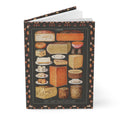
The celebrated cheese lithograph from the Book of Household Management — reproduced on the front cover of our journal — is one of the finest examples of Victorian food illustration. Twenty European cheeses are depicted with the chromolithographic precision that defined the best Victorian scientific and culinary illustration: each cheese rendered in its characteristic form, with its distinctive rind, texture, and cross-section visible, so that the Victorian housewife could identify it at a glance and serve it with confidence.
The cheeses documented in the plate represent the full range of European cheese culture as the Victorians understood it. Stilton, the king of English cheeses, had been produced in the villages of Leicestershire since the early eighteenth century and was already, by Beeton's time, the cheese that every well-appointed English table was expected to offer. Roquefort, the great French blue, had been produced in the caves of the Combalou plateau near Roquefort-sur-Soulzon since the Middle Ages and was the most celebrated foreign cheese in the Victorian repertoire. Cheddar, produced in the Somerset village of the same name, was the most widely consumed cheese in Britain. Gorgonzola, from the town of the same name near Milan, was the Italian answer to Stilton and Roquefort. Parmesan, the great aged cheese of Emilia-Romagna, was used both as a table cheese and as a cooking ingredient. Camembert, the soft Norman cheese that Marie Harel had supposedly perfected in the 1790s, was the most fashionable French cheese of the Victorian era.
The Geography of the Victorian Cheese Board
What is striking about the Victorian cheese board, as documented by Beeton, is its internationalism. The Victorian middle class, for all its insularity in some respects, was remarkably cosmopolitan in its culinary aspirations. The ability to serve a Roquefort alongside a Stilton, to offer a Camembert as well as a Cheddar, was a mark of sophistication — a demonstration that the hostess had not only the knowledge but the access to the network of importers, cheesemongers, and provision merchants who could supply these foreign delicacies to a London or provincial household.
This network was itself a product of the Victorian era's extraordinary expansion of trade and transport. The railways had made it possible to move perishable goods across Britain with a speed that would have been unimaginable a generation earlier; the steamship had made regular imports from France, Italy, and the Netherlands practical and affordable. The Victorian cheese board was, in a very direct sense, a product of the Industrial Revolution — a demonstration that the same forces that were transforming British manufacturing and commerce were also transforming the British table.
Serving Cheese the Victorian Way
Beeton was precise about how cheese should be served. It should be brought to the table at the right temperature — not too cold, which would dull the flavour, not too warm, which would cause it to sweat. It should be accompanied by the right biscuits — plain water biscuits for the milder cheeses, oatcakes for the stronger ones. Celery was the traditional accompaniment to Stilton; walnuts were considered an appropriate partner for most hard cheeses. The cheese knife should be sharp and clean, and each cheese should have its own knife to prevent the flavours from mingling.
These instructions reflect the Victorian conviction that every aspect of domestic life could be improved by the application of knowledge and method — that the difference between a good cheese course and a mediocre one was not a matter of luck or instinct but of information, properly applied. This is the spirit that animates the Book of Household Management from its first page to its last: the belief that domestic life is a serious undertaking, worthy of the same systematic attention that the Victorians brought to science, commerce, and empire.
Our Mrs. Beeton Journal reproduces the celebrated Victorian cheese lithograph from the Book of Household Management on the front cover and the 1923 Hors d'Oeuvre and Savouries plate on the back, set against a dramatic dark background that transforms Victorian culinary illustration into gallery-quality art.
References
Beeton, I. (1861). Book of Household Management. S. O. Beeton Publishing.
Hughes, K. (2005). The Short Life and Long Times of Mrs Beeton. Fourth Estate.
Mason, L. & Brown, C. (1999). Traditional Foods of Britain: An Inventory. Prospect Books.
Tannahill, R. (1988). Food in History. Crown Publishers.
Wilson, B. (2012). Consider the Fork: A History of How We Cook and Eat. Basic Books.