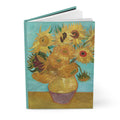
Vase with Twelve Sunflowers: Van Gogh, Cadmium Yellow, and the Life Cycle of a Painting
In August 1888, Vincent van Gogh wrote to his brother Theo from Arlés: "I am working with the enthusiasm of a Marseillais eating bouillabaisse, which won't surprise you when it's a question of painting sunflowers." He was working fast — in the heat of the Provençal summer, with the urgency of a man who knew that Paul Gauguin's arrival was imminent — and the paintings he produced in those weeks have a quality of concentrated energy that is unlike anything else in his career. Among them, Vase with Twelve Sunflowers stands apart: a canvas of extraordinary technical ambition, in which Van Gogh pushed his handling of cadmium yellow to its limits, documented the complete life cycle of the sunflower from tight bud to drooping seed head, and produced what many consider the most fully realised of all his flower paintings. It was painted to hang in the room he had prepared for Gauguin — a gesture of friendship that would outlast the friendship it celebrated by more than a century.

Cadmium Yellow: The Colour of the Sun
Van Gogh's relationship with yellow was one of the defining obsessions of his Arlés period. He had arrived in Provence in February 1888 partly in search of the light he associated with Japan — the clear, intense light of the south that he believed would transform his painting as it had transformed the woodblock prints he had been collecting for years. What he found was a landscape saturated with yellow: the yellow of the wheat fields, the yellow of the sunflowers, the yellow of the summer sun at its most intense. And he found, in cadmium yellow, the pigment that could hold that intensity on canvas.
Cadmium yellow was a relatively new pigment in 1888 — it had been available to artists since the 1840s, but it was expensive and not yet in common use. Van Gogh used it with a freedom and a confidence that few of his contemporaries matched: applying it thickly, in the impasto technique that was becoming his signature, building up the surface of the canvas into a texture that caught the light and gave the paint a physical presence that flat, smooth painting could not achieve. In Vase with Twelve Sunflowers, the yellow is not a single tone but a range — from the warm, almost orange yellow of the fully open flowers to the cooler, greener yellow of the buds, from the bright yellow of the background to the deeper, more complex yellow of the vase. It is a painting about yellow in the way that a symphony is about a key: the colour is not merely descriptive but structural, the element that holds the entire composition together.
The Life Cycle of the Sunflower
What distinguishes Vase with Twelve Sunflowers from most flower paintings is Van Gogh's insistence on showing the sunflower's complete life cycle — not merely the flower at its most beautiful, but the flower at every stage of its existence. The twelve sunflowers in the vase are not all in full bloom: some are tight buds, their petals not yet open; some are fully open, their faces turned toward the light; some are past their peak, their petals beginning to droop and their centres darkening toward the brown of the seed head. It is a composition that encompasses birth, fullness, and decline — the complete arc of a life — in a single vase.
This was not accidental. Van Gogh was deeply interested in the symbolism of the sunflower — in its association with gratitude, loyalty, and the life-giving power of the sun — and he understood the life cycle of the flower as a meditation on impermanence and on the dignity of every stage of existence. The drooping seed head is not a failure of beauty but a different kind of beauty: the beauty of a life fully lived, of a flower that has given everything it had to give. In painting all twelve sunflowers at different stages of their cycle, Van Gogh was making a philosophical as much as a botanical statement — and producing, in the process, a composition of extraordinary visual richness, in which the eye moves from bud to bloom to seed head and back again, never settling, always discovering something new.
The Impasto and the Brushwork
The technical ambition of Vase with Twelve Sunflowers is most visible in the impasto — the thick, textured application of paint that gives the surface of the canvas its characteristic relief. Van Gogh applied the paint with a loaded brush, building up the petals of the sunflowers in strokes that follow the direction of growth, so that the painted surface echoes the structure of the flower itself. The centres of the flowers are built up into dense, almost sculptural masses of paint; the petals radiate outward in strokes of varying thickness and direction, creating a sense of movement and vitality that flat painting could not achieve.
This technique was not merely decorative. Van Gogh believed that the physical texture of the paint could carry emotional meaning — that the energy of the brushstroke was a direct expression of the energy of the painter, and that the viewer who looked closely at the surface of the canvas could feel, in the texture of the paint, something of the intensity with which it had been applied. In Vase with Twelve Sunflowers, the impasto is at its most expressive: the paint is thick enough to cast shadows, the brushstrokes energetic enough to suggest the vitality of the flowers themselves, the surface rich enough to reward the kind of close, sustained attention that Van Gogh believed great painting deserved.
The Final Sketch: A Different Kind of Sunflower
In the last year of his life — after his breakdown in Arlés, his voluntary admission to the asylum at Saint-Rémy, and his move to Auvers-sur-Oise, where he would die in July 1890 — Van Gogh returned to the sunflower in his sketchbook. The drawing now in the Van Gogh Museum in Amsterdam, made around 1890, is a very different kind of sunflower from the painted versions: a pencil sketch of a single flower, rendered with the economy and directness of a draughtsman who has nothing to prove and everything to say. The lines are confident and spare; the flower is shown in three-quarter view, its petals slightly irregular, its centre dense with the marks of a pencil moving quickly and surely across the page.
The negative interpretation of this sketch — white lines on a turquoise ground drawn from Van Gogh's own palette — transforms the intimate pencil drawing into a graphic composition of striking modernity. The inversion reveals the structural confidence of Van Gogh's draughtsmanship: the lines that seemed, in the original, to be describing a flower are revealed, in the negative, to be constructing one — building it up from nothing, line by line, with the assurance of an artist who has spent a lifetime looking at sunflowers and has finally understood them completely. Together, the oil painting and the sketch offer a complete portrait of Van Gogh's relationship with the sunflower: the celebrated canvas in all its golden abundance, and the quiet, essential drawing that shows the artist's hand at its most direct and most free.
A Journal for Van Gogh Admirers

Our Van Gogh Sunflowers Journal carries both images across its full wraparound cover: Vase with Twelve Sunflowers (1888) on the front, in the full luminosity of its cadmium yellow palette, and the negative interpretation of the final sunflower sketch (c. 1890) on the back — white lines on turquoise, the last word Van Gogh had to say about the flower he had made his own.
Inside, 150 perforated lined pages await your art notes, travel journals, creative writing, or daily reflections. The casewrap sewn binding opens completely flat. The matte laminated cover preserves every detail of the impasto and the sketch in a finish that rewards close examination.
Van Gogh wrote to Theo: "I am working with the enthusiasm of a Marseillais eating bouillabaisse." Some enthusiasms leave a mark on the world that lasts longer than the summer that produced them.
References & Further Reading
- Van Gogh, Vincent. The Letters of Vincent van Gogh. Ed. Ronald de Leeuw. Penguin, 1997. [The primary source: Van Gogh's own account of the sunflower paintings, the Yellow House, and the Gauguin collaboration.]
- Naifeh, Steven & Smith, Gregory White. Van Gogh: The Life. Random House, 2011. [The most comprehensive modern biography, covering the Arlés period and the sunflower series in exceptional detail.]
- Gayford, Martin. The Yellow House: Van Gogh, Gauguin, and Nine Turbulent Weeks in Arles. Fig Tree, 2006. [The definitive account of the context in which the sunflower series was created.]
- National Gallery, London. Van Gogh: Sunflowers. National Gallery Publications, 2019. [Technical analysis of the sunflower canvases, including pigment studies and X-ray examination of the paint layers.]
- Van Gogh Museum, Amsterdam. Van Gogh's Studio Practice. Mercatorfonds, 2013. [On Van Gogh's materials and techniques, including his use of cadmium yellow and his impasto method.]
- Hendriks, Ella & van Tilborgh, Louis. Van Gogh's Sunflowers Illuminated. Amsterdam University Press, 2019. [The most detailed technical study of the sunflower series, covering pigment degradation, canvas preparation, and the sequence of the paintings.]
- Pickvance, Ronald. Van Gogh in Arles. Metropolitan Museum of Art, 1984. [The catalogue of the Metropolitan Museum's landmark exhibition, the most detailed scholarly account of the Arlés period.]