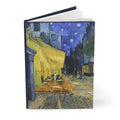
The Sketch and the Painting: How Van Gogh Built Café Terrace at Night
In September 1888, Vincent van Gogh sat outside a café on the Place du Forum in Arles and drew what he saw. He had a reed pen and ink. The night was warm. The gas lamps were lit. He worked quickly, as he always did, building the scene from the inside out — the awning first, then the tables, then the cobblestones receding toward the dark street beyond.

The drawing came before the painting. This is easy to forget when looking at Café Terrace at Night, one of the most recognisable images in Western art — a canvas so saturated with colour, so alive with the contrast between warm yellow light and deep blue sky, that it seems to have arrived fully formed. But Van Gogh was a draughtsman before he was a colourist, and the ink sketch he made that September evening is not a study for the painting so much as a parallel work: the same scene, the same composition, the same eye — but a completely different language.
The Reed Pen and the Night
Van Gogh had discovered the reed pen in Arles, and it transformed his drawing practice. Unlike a metal nib, the reed pen produces a line that varies with pressure — thick and blunt when pressed hard, fine and scratchy when held lightly. It suited his hand perfectly. In the Café Terrace sketch, you can see him using this range: the heavy strokes that define the awning and the building facade, the lighter, more agitated marks that suggest the cobblestones, the almost calligraphic dots and dashes that render the figures seated at the tables.
The composition is already complete in the drawing. The strong diagonal of the street pulls the eye from the lower right toward the upper left, where the dark buildings frame a narrow strip of sky. The café terrace occupies the right half of the image, its tables and chairs arranged with a precision that is almost architectural. The figures are present but subordinate — suggestions of human presence rather than portraits. Van Gogh was interested in the scene as a whole, in the relationship between light and space, not in the individuals who happened to be sitting there.
From Monochrome to Colour
When Van Gogh returned to the same scene with oil paint, he did not simply add colour to the drawing. He transformed it. The painting is not a coloured version of the sketch — it is a different argument about the same subject.
In the sketch, the café terrace is defined by contrast: the bright area of the awning and tables against the darker street and buildings. In the painting, this contrast becomes chromatic: the warm yellows and oranges of the gas-lit terrace against the deep Prussian blue of the night sky. Van Gogh wrote to his brother Theo about this painting with unusual excitement: "Here you have a night painting without black, with nothing but beautiful blue and violet and green, and in these surroundings the lighted square acquires a pale sulphur and greenish citron-yellow colour."
This was a deliberate programme. Van Gogh believed that night could be painted without black — that darkness was not the absence of colour but its transformation. The sketch, working in monochrome, could only gesture toward this idea. The painting made it literal.
The Cyanotype and the Negative
There is something fitting about the fact that Van Gogh's ink sketch, when inverted — white lines on deep blue — resembles a cyanotype print. The cyanotype was a photographic process invented in 1842, used by botanists and architects to make contact prints of specimens and blueprints. It produces images in Prussian blue and white, the same blue that Van Gogh used in the painted sky of Café Terrace at Night.
The inversion reveals something that the original drawing conceals: the structure beneath the surface. In the negative, the lines that Van Gogh used to build the scene — the strokes that define the awning, the cobblestones, the receding street — become luminous, almost architectural. The sketch, which in its original form reads as a record of observation, becomes in its negative form something closer to a diagram: the underlying geometry of the scene, the compositional logic that Van Gogh had worked out before he ever picked up a brush.
Arles, 1888
Van Gogh arrived in Arles in February 1888, fleeing the grey winters of Paris and looking for the light he had read about in Japanese woodblock prints. He found it. In the fourteen months he spent in Arles before his breakdown in December, he produced more than two hundred paintings and over a hundred drawings — a rate of output that remains almost incomprehensible.
The Café Terrace at Night was painted in September, during what Van Gogh himself described as his happiest period. He was living in the Yellow House, corresponding daily with Theo, waiting for Gauguin to arrive. The painting was made on the spot, at night, in front of the subject — an unusual practice at the time, when most painters worked from sketches made outdoors and finished their canvases in the studio.
The café on the Place du Forum still exists. It is now called Le Café Van Gogh, and it has been painted yellow to match the painting. Tourists photograph it from the same angle Van Gogh used. The cobblestones are still there. The sky above Arles is still, on clear September nights, the same deep blue.
Two Works, One Vision
The sketch and the painting are not the same work in different media. They are two different ways of seeing the same thing — two different answers to the question of how to represent a lit café terrace on a dark night in a provincial French town in 1888.
The sketch is immediate, structural, analytical. It records what is there. The painting is interpretive, chromatic, emotional. It records what it felt like to be there. Together, they show something that neither could show alone: the distance between observation and expression, and the particular genius that Van Gogh brought to crossing it.

If you want to carry something of that double vision — the draughtsman's line and the painter's colour — our Van Gogh Café Terrace at Night Journal places both on its covers: the original painting on the front, the ink sketch inverted into cyanotype blue on the back.
References
van Gogh, V. (1888). Letter to Theo van Gogh, September 1888. Van Gogh Museum, Amsterdam.
Naifeh, S. & Smith, G. W. (2011). Van Gogh: The Life. Random House.
Hulsker, J. (1980). The Complete Van Gogh: Paintings, Drawings, Sketches. Abrams.
Van Gogh Museum. (2024). Café Terrace at Night. vangoghmuseum.nl.