The Women Who Painted America's Strawberries: Mary Daisy Arnold, Elsie E. Lower, and the USDA Pomological Watercolor Collection
Between 1886 and 1942, a quiet revolution unfolded in the offices and studios of the United States Department of Agriculture. Dozens of artists — most of them women — bent over watercolor paper and rendered, with extraordinary precision, the fruits of American agriculture. Apples, pears, peaches, cherries, grapes, and strawberries: thousands of varieties, each one documented as if it might disappear tomorrow. Because many of them did.

A Nation Cataloguing Its Orchards
The late nineteenth century was a period of agricultural anxiety in the United States. The rapid expansion of commercial farming, the introduction of new varieties from Europe and Asia, and the rise of nursery catalogues — often illustrated with idealized, unreliable engravings — created a pressing need for accurate, standardized documentation of fruit varieties. Farmers needed to know what they were growing. Scientists needed to compare specimens across regions. And the USDA, newly empowered as a federal institution, needed to establish authority over the nation's agricultural knowledge.
The solution was elegant and ambitious: commission a corps of botanical artists to paint every significant fruit variety in cultivation. The result was the USDA Pomological Watercolor Collection — a visual archive of over 7,000 paintings, now held at the National Agricultural Library in Beltsville, Maryland, and digitized for public access. It is one of the largest and most significant collections of botanical art ever assembled in North America.
The paintings were not decorative. They were scientific instruments. Each illustration was expected to capture the precise color, shape, surface texture, and internal structure of a fruit — information that could not be conveyed by the black-and-white engravings of the era. Artists worked from fresh specimens, often racing against ripening and decay. They painted cross-sections alongside whole fruits, leaves alongside blossoms, roots alongside berries. The result was something that transcended both science and art: a record of living things at the peak of their existence.
The Artists Behind the Collection
It is a historical irony — and a historical injustice — that the USDA Pomological Collection was created largely by women at a time when women were systematically excluded from most scientific and artistic institutions. The USDA's Division of Pomology, which oversaw the project, employed female illustrators as a matter of practical economy: women could be paid less than men for equivalent work. But the artists who accepted these positions brought to them a level of skill, dedication, and scientific literacy that transformed the project into something far greater than its bureaucratic origins.
Among the most prolific contributors were Deborah Griscom Passmore, Amanda Almira Newton, and — the two artists whose work graces our strawberry journal — Mary Daisy Arnold and Elsie E. Lower.
Mary Daisy Arnold (active early 20th century)
Mary Daisy Arnold worked for the USDA during the first decades of the twentieth century, contributing hundreds of illustrations to the Pomological Collection. Her work is characterized by a luminous quality — a mastery of watercolor transparency that allows light to seem to pass through the skin of a fruit, giving her berries and apples an almost photographic depth. Yet her paintings never sacrifice botanical accuracy for aesthetic effect. Every leaf vein, every seed, every surface marking is rendered with the precision of a scientist who also happened to be a gifted painter.
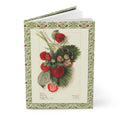
Her 1912 illustration of Fragaria: Nanticoke — the Nanticoke strawberry variety — is a masterwork of the genre. The composition shows the plant in multiple stages: ripe berries, unripe fruit, blossoms, and leaves, all arranged with a naturalist's eye for completeness and an artist's eye for balance. The Nanticoke was a variety prized for its size and flavor, and Arnold's painting captures both its commercial appeal and its botanical particularity. The berries glow with a deep, saturated red that no engraving of the era could have reproduced.
Elsie E. Lower (active early 20th century)
Elsie E. Lower was another of the USDA's skilled botanical illustrators, working in the same tradition of scientific watercolor that defined the Pomological Collection. Her 1910 illustration of Fragaria: Pink Tea demonstrates a slightly different sensibility — a delicacy of touch that suits the Pink Tea variety's more subtle coloring. Where Arnold's Nanticoke is bold and saturated, Lower's Pink Tea is nuanced, its paler berries rendered with careful attention to the gradations of color that distinguish a ripe fruit from an unripe one.
The Pink Tea strawberry was a variety notable for its distinctive pale color and mild flavor — unusual enough to warrant careful documentation, and beautiful enough to reward it. Lower's illustration captures both qualities, presenting the plant with the same comprehensive approach as Arnold's: berries, leaves, blossoms, and runners, all rendered in their natural relationships.
The Strawberry in American Pomology
The strawberry occupies a special place in the history of American horticulture. Unlike apples or pears, which could be stored and shipped over long distances, strawberries were intensely local fruits — perishable, seasonal, and deeply tied to the communities that grew them. The development of new strawberry varieties in the nineteenth and early twentieth centuries was driven by a combination of scientific breeding and practical necessity: farmers needed varieties that could withstand the climate of their particular region, ripen at the right moment for local markets, and survive the rigors of even short-distance transport.
The USDA's documentation of strawberry varieties was therefore not merely an aesthetic project. It was an act of agricultural preservation — a recognition that the diversity of cultivated strawberries represented centuries of accumulated horticultural knowledge, and that this knowledge was at risk of being lost as commercial agriculture consolidated around a smaller number of high-yield varieties.
The Nanticoke strawberry, painted by Arnold in 1912, takes its name from the Nanticoke River region of Maryland and Delaware — a reminder that American fruit varieties were often deeply rooted in specific landscapes and communities. The Pink Tea, illustrated by Lower in 1910, represents a different strand of strawberry history: varieties bred for flavor and appearance rather than yield, cultivated by gardeners who valued quality over quantity.
Both varieties have largely disappeared from commercial cultivation. They survive today primarily in the records of the USDA Pomological Collection — in the paintings of Arnold and Lower, preserved in watercolor long after the plants themselves have vanished from most American gardens.
Science, Art, and the Act of Looking
What makes the USDA Pomological Watercolor Collection remarkable — what elevates it above a mere scientific archive — is the quality of attention it embodies. To paint a strawberry with the precision these artists brought to their work is to look at it more carefully than almost any other act of observation requires. It is to notice the exact angle at which a leaf attaches to its stem, the precise distribution of seeds across a berry's surface, the subtle difference in color between the shaded and sunlit sides of a fruit.
This quality of attention is, in a sense, the deepest subject of botanical illustration. The paintings in the Pomological Collection are not just records of fruit varieties. They are records of looking — of the sustained, disciplined, loving attention that these artists brought to the natural world. In an era before color photography, before digital imaging, before any of the technologies we now use to capture and transmit visual information, the only way to preserve what a Nanticoke strawberry looked like was to find someone who could really see it, and give them the time and materials to render what they saw.
Mary Daisy Arnold and Elsie E. Lower were such people. Their paintings are acts of witness — testimony to the existence of varieties that might otherwise have left no visual record at all.
The Collection Today
The USDA Pomological Watercolor Collection is held by the National Agricultural Library and has been digitized in its entirety, making these extraordinary paintings freely available to researchers, artists, educators, and anyone curious about the history of American agriculture and botanical art. The collection spans over 7,000 works, covering hundreds of fruit species and thousands of individual varieties — a visual encyclopedia of American pomology that took more than five decades to assemble.
In recent years, the collection has attracted growing attention from historians of science, art historians interested in the role of women in scientific illustration, and a broader public drawn to the beauty and historical resonance of these paintings. They have been reproduced in books, exhibited in galleries, and used as the basis for a wide range of artistic and educational projects.
They have also, we think, found a natural home on the covers of journals — objects designed for the kind of sustained attention and careful observation that the paintings themselves embody.
A Journal for Those Who Look Closely

Our USDA Strawberry Varieties Journal brings together Arnold's 1912 Fragaria: Nanticoke on the front cover and Lower's 1910 Fragaria: Pink Tea on the back — two masterworks of American botanical illustration, united in a hardcover journal designed for those who share these artists' commitment to careful observation.
Inside, 150 perforated ruled pages await your notes, sketches, garden observations, or whatever form your own attention takes. The casewrap sewn binding opens completely flat. The matte laminated cover protects the illustrations while preserving their subtle, luminous quality.
It is, we hope, a fitting tribute to Mary Daisy Arnold, Elsie E. Lower, and the extraordinary project they contributed to — a project that preserved, in watercolor, the faces of fruits that might otherwise have been forgotten entirely.
Some things are worth looking at carefully. These artists knew it. We think you do too.
References & Further Reading
- Busco, Marie T. & Seavey, Judith A. The Art of Natural History: Illustrated Treatises and Botanical Paintings, 1400–1850. National Gallery of Art / Yale University Press, 2008.
- Fussell, Betty Harper. The Story of Corn. University of New Mexico Press, 2004. [For context on USDA agricultural documentation programs.]
- Kimmerer, Robin Wall. Gathering Moss: A Natural and Cultural History of Mosses. Oregon State University Press, 2003. [On the tradition of scientific observation as a form of attention.]
- National Agricultural Library, USDA. Pomological Watercolor Collection. Digitized archive, available at nal.usda.gov.
- Pavord, Anna. The Naming of Names: The Search for Order in the World of Plants. Bloomsbury, 2005.
- Schiebinger, Londa & Swan, Claudia (eds.). Colonial Botany: Science, Commerce, and Politics in the Early Modern World. University of Pennsylvania Press, 2005. [On women in botanical illustration.]
- Stoll, Steven. The Fruits of Natural Advantage: Making the Industrial Countryside in California. University of California Press, 1998. [On the commercialization of American fruit cultivation.]