The Art of Going Somewhere: Travel Posters and the Golden Age of Wanderlust
There is a particular kind of optimism encoded in the travel poster. It is not the cautious optimism of someone who has read the reviews and checked the weather forecast — it is the absolute, unqualified optimism of a world that believes, with complete conviction, that the place in the poster is exactly as beautiful as it looks, that the journey will be exactly as smooth as the streamlined locomotive or ocean liner suggests, and that you, specifically you, will be transformed by the experience of going there. The travel poster does not hedge. It promises. And for about seventy years, from the 1890s to the 1960s, it was one of the most sophisticated and widely distributed art forms in the world.

The Railway Poster and the Birth of a Form
The travel poster was born with the railway. Before the railways, travel was slow, expensive, and uncomfortable enough that it required no advertising — people travelled when they had to, not when they wanted to. The railways changed this: they made travel fast, relatively affordable, and, for the first time, genuinely pleasurable, and they needed to tell people about it. The earliest railway posters, produced in Britain and France in the 1870s and 1880s, were typographic — lists of destinations and departure times, printed in dense columns of text. But as colour lithography became cheaper and more sophisticated, the posters became images: landscapes, seascapes, and cityscapes rendered in vivid colour, designed to make the viewer want to be there.
The British railway companies were the pioneers. The Midland Railway, the Great Western Railway, the London and North Eastern Railway — all commissioned artists of genuine talent to produce posters that were, in effect, advertisements for the British landscape. The LNER's posters of the 1920s and 1930s, many of them designed by Tom Purvis and Frank Newbould, are among the finest examples of the form: bold, simplified, graphically sophisticated, and entirely convincing in their argument that the Yorkshire Dales or the Scottish Highlands were exactly where you needed to be.
Art Déco and the Geometry of Aspiration
The travel poster reached its aesthetic peak in the Art Déco period, roughly 1920 to 1940. Art Déco — the style that took its name from the Exposition Internationale des Arts Décoratifs et Industriels Modernes of 1925 — was perfectly suited to the travel poster. Its vocabulary of geometric forms, bold colours, streamlined shapes, and confident typography translated naturally into images of speed, modernity, and aspiration. The ocean liner rendered in Art Déco style became a symbol of glamour and technological achievement; the city skyline, reduced to its essential geometric forms, became an icon of modernity and ambition.
The great Art Déco travel poster artists — Cassandre in France, Edward McKnight Kauffer in Britain, Otis Shepard in America — were graphic designers of the highest order, working at the intersection of fine art and commercial communication. Cassandre's posters for the Normandie ocean liner and the Nord Express railway are among the most celebrated graphic works of the twentieth century: images of such formal perfection and emotional power that they transcend their commercial origins entirely. They are not advertisements. They are arguments — arguments that speed is beautiful, that modernity is exciting, and that the world is a place worth moving through.
New York: The Wonder City
No city was a more natural subject for the Art Déco travel poster than New York. The city's skyline — which transformed itself more dramatically in the 1920s and 1930s than at any other period in its history — was itself an Art Déco composition: a collection of geometric towers, each competing to be taller and more ornate than the last, rising from the grid of Manhattan's streets in a display of vertical ambition that had no precedent in the history of cities.
The Empire State Building, completed in 1931, was the tallest building in the world for forty years — a 443-metre tower of limestone, granite, and steel that rose from Midtown Manhattan with a simplicity and elegance that made it immediately iconic. The Chrysler Building, completed in 1930, was its great rival: slightly shorter but arguably more beautiful, with its distinctive stainless steel crown of eagle gargoyles and sunburst arches that caught the light of the New York sky and threw it back in all directions. The Brooklyn Bridge, completed in 1883, was already a legend by the time the Art Déco era began — a Gothic-arched suspension bridge of such beauty and engineering audacity that it had been inspiring artists and writers since the day it opened. The Statue of Liberty, a gift from France completed in 1886, stood at the entrance to New York Harbour as the most recognisable symbol of American aspiration in the world.
Together, these landmarks made New York the most photogenic city on earth — and the most poster-worthy. Travel posters proclaimed it “The Wonder City,” “The City of Skyscrapers,” “The Gateway to America,” and they were not wrong. New York in the 1930s was the most exciting city in the world: the centre of American finance, culture, entertainment, and ambition, a city that had absorbed millions of immigrants from every corner of the globe and turned them into New Yorkers, a city that built the tallest buildings in the world because it could, and because it wanted to, and because the sky was the only limit it recognised.
The Airline Poster and the Jet Age
The travel poster survived the Second World War and entered a new phase with the rise of commercial aviation. The airline poster — produced by Pan American, TWA, BOAC, Air France, and dozens of other carriers — brought a new subject to the form: the world seen from above, the globe as a network of routes connecting cities that had previously been weeks apart and were now hours away. The jet age, which began in earnest in the late 1950s, democratised long-distance travel in a way that the railways and ocean liners had never quite managed, and the airline posters of the 1950s and 1960s reflected this new accessibility with images of exotic destinations rendered in the bright, optimistic colours of the post-war world.
The style of the airline poster was different from the Art Déco railway poster — lighter, more colourful, more playful, influenced by the graphic design innovations of the Swiss school and the American advertising industry. But the essential promise was the same: that travel was transformative, that the world was beautiful, and that wherever the poster was pointing, you needed to go.
The End of the Golden Age
The travel poster as an art form declined in the 1960s and 1970s, as photography replaced illustration in advertising and the graphic design industry moved toward photographic imagery and typographic minimalism. The great poster artists retired or moved into other fields; the railway and airline companies replaced their illustrated posters with photographic campaigns. The posters themselves — millions of them, produced over seventy years — were discarded, pasted over, or simply lost.
Those that survived became collectibles, and then icons. The Art Déco travel poster is now recognised as one of the great graphic art forms of the twentieth century — a body of work that combined commercial purpose with genuine artistic ambition, that made the world look more beautiful than it was and, in doing so, made people want to go and see for themselves. Which is, when you think about it, exactly what art is supposed to do.

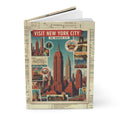
Our New York Wonder City Journal celebrates the golden age of the travel poster with a vintage-style Art Déco illustration of New York's most iconic landmarks — the Empire State Building, the Chrysler Building, the Brooklyn Bridge, the Statue of Liberty, and Radio City Music Hall — in the bold colours and geometric forms that made the travel poster the most optimistic art form of the twentieth century.
References
Brody, D. (1999). Visualizing American Empire: Orientalism and Imperialism in the Philippines. University of Chicago Press.
Haworth-Booth, M. (2010). E. McKnight Kauffer: A Designer and His Public. V&A Publishing.
Hollis, R. (2001). Graphic Design: A Concise History. Thames & Hudson.
Mouron, H. (1985). Cassandre. Rizzoli.
Williamson, J. (1978). Decoding Advertisements: Ideology and Meaning in Advertising. Marion Boyars.