The Great White Way: How Electric Light Transformed Times Square in the 1930s
On a winter evening in 1938, a visitor arriving at Times Square for the first time would have experienced something that had no precedent in human history. The electric billboards that lined Broadway between 42nd and 47th Streets blazed with a light so intense that the intersection was visible from miles away — a beacon in the darkness of the surrounding city, a place where night had been abolished by the combined power of thousands of incandescent bulbs, neon tubes, and animated signs. They called it The Great White Way, and it was the most spectacular urban spectacle on Earth.

The Birth of The Great White Way
The name predated the electric age. Broadway had been called The Great White Way since the 1880s, when the first arc lamps were installed along its length and the street became one of the first in New York to be lit by electricity. But the name acquired its full meaning only in the 1910s and 1920s, when the development of large-scale electric advertising signs transformed Times Square from a merely well-lit street into a landscape of light that was qualitatively different from anything that had existed before.
The technology that made this possible was the spectacular sign — a large-format advertising display that used thousands of individual light bulbs, arranged in patterns that could be switched on and off in sequence to create the illusion of movement. The first spectacular signs had appeared in Times Square in the 1890s, but it was in the 1910s and 1920s that they reached their full development: signs that covered entire building facades, that animated figures in motion, that spelled out messages in letters ten feet high. By the 1930s, Times Square had become a laboratory of electric spectacle, a place where the advertising industry and the entertainment industry competed to produce ever more elaborate and eye-catching displays.
The Architecture of Light
The buildings that lined Times Square in the 1930s were designed with their electric signs in mind. The Hotel Astor — which had opened in 1904 and had become one of the great gathering places of Broadway society, a hotel where theater stars, politicians, and journalists mingled in its famous roof garden and ballroom — was surrounded by the electric spectacle of the square. The Capitol Theatre, which had opened in 1919 as one of the world's first grand movie palaces, drew audiences with a facade that blazed with light. These buildings were not merely the backdrop for the signs; they were part of the spectacle, their architecture designed to be seen at night, in the context of the electric landscape that surrounded them.
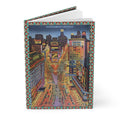
The vintage illustration of Times Square circa 1938 that appears on the front cover of our journal captures this landscape at its peak. The Hotel Astor and the Capitol Theatre are visible among the landmarks of the district; the street is alive with pedestrians and vintage automobiles; and above everything, the electric signs blaze with the light that had made Times Square the most photographed intersection on Earth. It is a document of a specific moment — the late 1930s, when Times Square had reached the height of its pre-war glory and before the disruptions of the Second World War would begin to change the character of the district.
Broadway and the Entertainment Industry
Times Square in the 1930s was not just a spectacle of light; it was the centre of the American entertainment industry. The Broadway theaters that lined the side streets between 42nd and 57th Streets were the most prestigious venues in the country, the places where the most ambitious productions opened and where the careers of the most celebrated performers were made. The 1930s were a golden age of Broadway musical theater — the decade of Cole Porter, Rodgers and Hart, and the Gershwins, of productions that would define the American musical for generations.
The movie palaces of Times Square — the Capitol, the Roxy, the Paramount — were the cathedrals of the new mass entertainment culture, buildings designed on a scale and with a grandeur that was intended to make the experience of going to the movies feel like a special occasion. The Capitol Theatre, which could seat over 5,000 people, was one of the largest theaters in the world; its interior was decorated in a style that combined classical architecture with the latest in electric lighting technology, creating an environment that was simultaneously luxurious and modern.
The Crossroads of the World
Times Square's claim to be the Crossroads of the World was not merely promotional hyperbole. In the 1930s, it was genuinely the place where the currents of American culture — entertainment, commerce, journalism, politics — converged most visibly. The electric zipper sign that ran around the base of the Times Tower had been installed in 1928 and had become the primary means by which New Yorkers received breaking news; the New Year's Eve ball drop, which had begun in 1907, had made Times Square the symbolic centre of the American calendar. The square was a place where the private and the public merged, where the individual experience of the city — the pedestrian navigating the crowds, the theatergoer arriving for an evening performance — was inseparable from the collective experience of a nation.
C.E. Millard's 1933 pictorial map of Manhattan — reproduced on the back cover of our journal — captures this confidence in a different register. Where the Times Square illustration documents the electric spectacle of the street, Millard's map celebrates Manhattan as a whole: its history, its landmarks, its claim to be the First City in America. Together, they offer a portrait of New York in the 1930s that is both specific and panoramic — the intimate detail of a single intersection and the broad sweep of an entire island, united by the energy and ambition of a city at the height of its powers.
Our New York Journal reproduces the Times Square circa 1938 illustration on the front cover and Millard's Manhattan map on the back — two images that together capture the electric energy and cultural confidence of 1930s New York.
References
Broadway League (2019). The History of Broadway. New York: Broadway League Publications.
Cockrell, D. (2012). Everybody's Doin' It: Sex, Music, and Dance in New York, 1840–1917. Norton.
Immerso, M. (2004). Coney Island: The People's Playground. Rutgers University Press.
Sandoval-Strausz, A.K. (2007). Hotel: An American History. Yale University Press.
Taylor, W.R. (ed.) (1991). Inventing Times Square: Commerce and Culture at the Crossroads of the World. Russell Sage Foundation.