The Sacred Flora of Scripture: Thomas C. Jack’s Bible Natural History and the Victorian Botanical Imagination
Share
In the middle decades of the 19th century, the Victorian world was engaged in one of its most characteristic intellectual projects: the reconciliation of faith and science. Darwin had not yet published the Origin of Species; the great geological controversies were still unresolved; and the educated reading public of Britain was hungry for works that could help them understand the natural world described in Scripture with the same rigour and precision that they brought to the study of geology, botany, and zoology.
It was into this world that Thomas C. Jack, Edinburgh publisher, released Bible Natural History in 1850.
McFarlane & Erskine and the Art of Chromolithography
The chromolithographic plates that illustrate Bible Natural History were produced by McFarlane & Erskine, one of Edinburgh’s most prestigious printing houses — a firm whose work represented the state of the art in Victorian scientific illustration. Chromolithography, which had reached its technical peak in the 1840s and 1850s, allowed for the mechanical reproduction of colour with a fidelity that hand-colouring could never achieve: the subtle gradations of a leaf’s surface, the precise colouration of a flower, the characteristic form of a seed or fruit — all could be rendered with a botanical accuracy that made chromolithographic plates the essential reference works of their era.
The plates in Bible Natural History are among the finest examples of this tradition applied to sacred subject matter. Each species is numbered and rendered in vivid botanical colour, with the scientific precision prized by Victorian naturalists and the reverential care appropriate to plants that had witnessed the stories of prophets, kings, and the birth of faith.
Forty Plants of Scripture
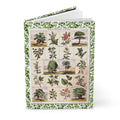
The two plates that appear on this journal document forty species mentioned throughout the Old and New Testaments. Plate III presents twenty trees, herbs, and shrubs: the Cedar of Lebanon, whose timber was used to build Solomon’s Temple; the Olive, whose branch the dove brought back to Noah and whose oil anointed the kings of Israel; the Hyssop, used in the purification rituals described in Leviticus and Psalms; the Pomegranate, whose image decorated the hem of the High Priest’s robe; the Vine, central to the wine of the Last Supper and the parables of the Kingdom; the Sycamore Fig, climbed by Zacchaeus to see Jesus pass; the Palm, whose branches were laid before Christ on his entry into Jerusalem.
The companion plate adds twenty more: Wheat and Barley, the staple grains of ancient agriculture; Spikenard, the precious anointing oil that Mary of Bethany poured over Christ’s feet; Mustard, the smallest of seeds that grows into the greatest of shrubs in the parable of the Kingdom; Flax, source of the linen used for priestly garments and the burial shroud; Myrrh, one of the three gifts of the Magi; Wormwood, the bitter plant of lamentation.
Together, they are a complete botanical companion to the Bible — forty species that appear throughout Scripture, documented with Victorian chromolithographic precision and the loving care of a tradition that believed the natural world and the sacred world were, ultimately, one.