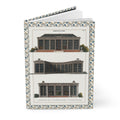
The Victorian Greenhouse: Architecture, Glass, and the Garden Revolution
In 1845, the British government repealed the glass tax — a duty on window glass that had been levied since 1746 and that had made large expanses of glazing prohibitively expensive for all but the wealthiest landowners. The repeal transformed British architecture and horticulture almost overnight. Within a decade, the greenhouse — previously a luxury confined to the great estates — had become accessible to the prosperous middle classes, and the conservatory had become the defining domestic addition of the Victorian age. By 1900, there were an estimated 100,000 conservatories attached to British houses, ranging from the modest lean-to structures of suburban villas to the great glass palaces of the aristocracy.

The Regency Foundations
The Victorian greenhouse revolution had its roots in the Regency era, when the Encyclopaedia Londinensis (1796–1829) documented the state of horticultural knowledge and greenhouse design with the same encyclopaedic ambition that it brought to horology, natural history, and the mechanical arts. The horticulture plates — engraved in the copper-plate tradition that had served British scientific publishing since the 17th century — documented the range of greenhouse structures available to the Regency gardener: the modern greenhouse with its elegant curved roof, the circular conservatory designed for display as much as cultivation, the forcing-frames and graperies that extended the growing season and brought exotic fruits to the tables of the English gentry.
These structures were the product of a century of horticultural innovation that had transformed the English garden from a formal, geometry-driven space into a more naturalistic, plant-centered environment in which the greenhouse played an increasingly central role. The introduction of exotic plants from the Americas, Asia, and Africa — accelerated by the voyages of botanical collectors like Joseph Banks, who accompanied Cook on his first voyage in 1768 — created a demand for controlled growing environments that the English climate could not provide outdoors. The greenhouse was the answer: a technology that extended the boundaries of what could be grown in Britain, and that made the cultivation of pineapples, orchids, and tropical ferns a mark of horticultural ambition and social distinction.
Glass and Iron: The Engineering of the Greenhouse
The architectural history of the greenhouse is inseparable from the history of two materials: glass and iron. Cast iron, which became widely available as a structural material in the late 18th century, made possible the slender, elegant frames that replaced the heavy timber construction of earlier greenhouses, allowing larger expanses of glass and more efficient use of light. The development of sheet glass — produced by the cylinder process that made large, flat panes available at reasonable cost — provided the glazing material that iron frames required.
The great greenhouse engineers of the early 19th century — among them John Claudius Loudon, whose Remarks on the Construction of Hothouses (1817) established the theoretical framework for greenhouse design, and Joseph Paxton, whose Great Conservatory at Chatsworth (1836–40) demonstrated what iron and glass could achieve at the largest scale — were working out the structural and thermal principles that would culminate in Paxton's Crystal Palace of 1851: the most celebrated glass building in history, and the direct descendant of the greenhouse tradition that the Encyclopaedia Londinensis had documented a generation earlier.
Loudon's contribution was particularly significant. His invention of the wrought-iron glazing bar — a curved, flexible bar that could follow the contours of a curvilinear roof — made possible the ridge-and-furrow roof system that maximized the angle of incidence of winter sunlight and became the standard form of Victorian greenhouse construction. His Encyclopaedia of Gardening (1822), the most comprehensive horticultural reference of the 19th century, devoted extensive attention to greenhouse design and management, establishing the principles that would guide a generation of gardeners and architects.
The Conservatory as Social Space
The Victorian conservatory was not merely a horticultural facility. It was a social space — an extension of the domestic interior into the natural world, a room in which the boundaries between inside and outside, between culture and nature, were deliberately blurred. The great conservatories of the Victorian country house — filled with exotic palms, tree ferns, and flowering orchids, furnished with cane chairs and wrought-iron tables, heated by hot-water pipes concealed beneath the tiled floor — were designed for promenading, for conversation, for the display of horticultural achievement and social refinement.
The conservatory was also a space of scientific activity. The Victorian enthusiasm for natural history — for the collection, classification, and cultivation of plants from every corner of the empire — found in the greenhouse its most practical expression. The Wardian case, invented by Nathaniel Bagshaw Ward in the 1830s, made it possible to transport living plants across oceans without loss, and the plants that arrived at Kew Gardens and the great private collections of the Victorian era were grown on in greenhouses that combined the functions of scientific laboratory, botanical archive, and aesthetic display.
Kew and the Public Greenhouse
The most celebrated greenhouse in Britain — and arguably in the world — is the Palm House at the Royal Botanic Gardens, Kew, designed by Decimus Burton and Richard Turner and completed in 1848. Built of wrought iron and sheet glass in a form that echoes the hull of an inverted ship, the Palm House was designed to house the tropical palms and tree ferns that required the highest temperatures and humidity of any plants in the Kew collection. Its curvilinear form — a direct descendant of Loudon's wrought-iron glazing bar technology — remains one of the most beautiful buildings in Britain, and a monument to the Victorian conviction that the cultivation of plants from every corner of the world was both a scientific imperative and an aesthetic achievement.
The Palm House was followed by the Temperate House (1859–1899), the largest Victorian glasshouse in the world, and by the Princess of Wales Conservatory (1987), which uses computer-controlled climate zones to replicate ten different tropical and dry environments under a single roof. Together, these buildings trace the history of greenhouse technology from the Regency era to the present — a history that begins with the copper-plate engravings of the Encyclopaedia Londinensis and continues in the climate-controlled glasshouses of the 21st century.

If the art and science of the Victorian greenhouse inspires you, our Greenhouse Journal — Encyclopaedia Londinensis 1820 Horticulture brings the conservatory and greenhouse engravings of the Encyclopaedia Londinensis to the cover of a hardcover journal.
References
- Hix, J. The Glass House. Phaidon, 1974.
- Loudon, J. C. Remarks on the Construction of Hothouses. London, 1817.
- Loudon, J. C. Encyclopaedia of Gardening. London, 1822.
- Elliott, B. Victorian Gardens. Batsford, 1986.
- Wilkes, J. (ed.) Encyclopaedia Londinensis. London, 1796–1829.