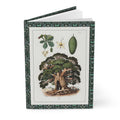
The Tree That Became a Book: Baobab and Beech in the Dictionnaire Pittoresque, 1833–1839
In the 1830s, a team of French naturalists, engravers, and colourists set out to document the entire natural world between the covers of nine volumes. The result was the Dictionnaire pittoresque d'histoire naturelle et des phénomènes de la nature — the Picturesque Dictionary of Natural History — published in Paris between 1833 and 1839 under the direction of Félix-Édouard Guérin-Méneville, entomologist, naturalist, and one of the great scientific editors of his generation. It was an encyclopaedia in the fullest sense: systematic, exhaustive, and extraordinarily beautiful, its plates engraved on steel or copper and coloured by hand with watercolour, so that each copy was, in a small but real sense, unique.
Two of those plates appear on the covers of our journal. They are separated by a continent and a climate — one depicts a tree of the African savanna, ancient and colossal; the other, a tree of the European forest, elegant and deep-rooted. Together, they tell a story about the natural world and about the act of writing itself.
The Baobab: The Tree at the Centre of the World
The front cover reproduces the Dictionnaire pittoresque's plate of the Baobab (Adansonia digitata) — one of the most immediately arresting images in the entire encyclopaedia. The composition is characteristic of the French natural history illustration of the period: meticulous botanical details of leaves, flowers, and fruit occupy the upper registers of the plate, while the lower portion opens into a landscape scene, figures gathered at the base of a trunk so massive it dwarfs everything around it. The engraving was based on specimens, drawings from expeditions, and the accumulated observations of naturalists who had travelled to Africa and Madagascar — rendered with the fine lines that only steel engraving could achieve, and brought to life with hand-applied watercolour.
The baobab is among the oldest and most extraordinary trees on earth. The genus Adansonia originated in Madagascar some 21 million years ago; individual trees of the African species can live for two to three thousand years, their trunks swelling over the centuries to store up to 120,000 litres of water — a living reservoir in the dry seasons of the savanna. It is called, with good reason, the pharmacist's tree: its fruit is rich in vitamin C; its leaves are eaten as vegetables and used in anti-inflammatory preparations; its bark yields fibres for rope and fishing nets. Almost nothing in a baobab is without use.
But the baobab is more than useful. In the cultures of sub-Saharan Africa, it is a tree of gathering and of memory — its hollow trunks have served as meeting places, shelters, and sacred sites for ceremonies across generations. A legend common to several African traditions explains its strange appearance — the roots-like branches reaching skyward — as divine punishment for the tree's pride: the gods, angered by its desire to be the tallest of all trees, uprooted it and replanted it upside down. It is a story that captures something true about the baobab: it looks like no other tree, and it has always demanded an explanation.
The Beech and the Owl: A Forest at Dusk
The back cover presents a very different world. The plate depicts the European Beech (Fagus sylvatica), identified in the caption as Hêtre, with botanical details of its fruit — the hayuco, a small triangular nut enclosed in a spiny cupule — and its leaves, including a variant of the copper beech (Hêtre rouge) that had become popular in ornamental planting by the nineteenth century. In the foreground, perched with the stillness of a creature entirely at home, is a Long-eared Owl (Asio otus), labelled Hibou moyen Duc.
The plate was the work of three hands: Acarie Baron, who engraved and composed the scene; Adolphe Fries, who drew the botanical details; and E. Guérin — the director himself — overseeing the whole. It is a collaboration characteristic of the great natural history publications of the period, in which the division of labour between artist, engraver, and scientist produced images of a precision and beauty that no single hand could have achieved alone.
The long-eared owl is one of the forest's great illusionists. The tufts on its head — which look like ears or horns — are in fact feather crests with no auditory function, raised when the bird is alert to break its silhouette and mimic a broken branch. Its flight feathers are fringed in a way that absorbs the sound of moving air, allowing it to approach prey in absolute silence. And unlike most owls, it is sociable in winter: dozens may roost together in a single dense tree — often a beech — sleeping through the daylight hours in a communal stillness that the forest keeps as its secret.
The Tree That Became a Book
There is a connection between the beech and the act of writing that runs deeper than metaphor. In the Germanic languages, the relationship is etymological: the German word for beech is Buche; the word for book is Buch. The English book shares the same ancient root. The connection is not accidental. Before the widespread use of paper in northern Europe, the beech was the preferred wood for writing tablets — its grain fine and uniform, its surface smooth enough to receive carved letters without splintering. The earliest runic inscriptions in the Germanic world were made on beech wood. The tree that shelters the owl in Guérin-Méneville's plate is, in a very literal sense, the ancestor of every book ever written in a northern European language.
The beech remains important in papermaking today. Its short fibres, mixed with the longer fibres of pine or spruce, produce papers of exceptional smoothness and opacity — the kind of paper preferred for art books and fine printing. The tree that gave us the word for book still helps to make them.
The Dictionnaire Pittoresque and the Art of Knowing
The Dictionnaire pittoresque d'histoire naturelle belongs to a tradition of encyclopaedic natural history publication that flourished in France and across Europe in the first half of the nineteenth century — a tradition animated by the conviction that the natural world could be known, classified, and illustrated in its entirety, and that this knowledge was worth communicating to the widest possible audience. Guérin-Méneville's nine volumes were designed not only for specialists but for the educated general reader: the pittoresque of the title signals an intention to be beautiful as well as accurate, to make the natural world visible and desirable as well as comprehensible.
The hand-coloured engravings that illustrate the Dictionnaire are the fullest expression of this intention. Each plate is a collaboration between science and art — between the naturalist's need for accuracy and the engraver's and colourist's commitment to beauty. To look at the baobab plate or the beech-and-owl plate is to understand why these encyclopaedias were treasured not only as reference works but as objects: things to be looked at, returned to, kept.
—

The baobab and beech plates from the Dictionnaire pittoresque d'histoire naturelle (Paris, 1833–1839) appear on the cover of our Baobab & Beech Journal — Dictionnaire Pittoresque 1833, a hardcover journal with casewrap sewn binding and matte laminated full-wrap cover.
References
- Guérin-Méneville, Félix-Édouard, ed. Dictionnaire pittoresque d'histoire naturelle et des phénomènes de la nature. 9 vols. Paris, 1833–1839.
- Nissen, Claus. Die botanische Buchillustration: ihre Geschichte und Bibliographie. Hiersemann, 1951.
- Blunt, Wilfrid, and William T. Stearn. The Art of Botanical Illustration. Antique Collectors' Club, 1994.
- Pakenham, Thomas. Remarkable Trees of the World. Norton, 2002.
- Watkins, Charles, and Ben Cowell. Uvedale Price (1747–1829): Decoding the Picturesque. Boydell Press, 2012.