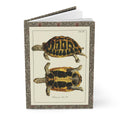
The Shell and the Scalpel: Schöpf’s Naturgeschichte der Schildkröten and the Birth of Herpetology
How a Prussian military surgeon turned the chaos of the American Revolutionary War into the most comprehensive study of turtles the world had ever seen
There is something fitting about the fact that the first great scientific work on turtle anatomy was written by a man who spent years moving between two worlds that had nothing obvious to do with each other: the world of war and the world of natural history. Johann David Schöpf arrived in North America in 1777 as a military surgeon attached to the Ansbach-Bayreuth troops — the German mercenaries hired by the British Crown to fight the American colonists — and spent the better part of a decade in a continent that was simultaneously tearing itself apart politically and revealing itself, to the naturalist’s eye, as one of the most biologically extraordinary places on earth.
Schöpf was a physician by training and a naturalist by vocation, and he pursued both callings with equal dedication. While attending to the medical needs of soldiers and prisoners, he collected plants, insects, fish, and reptiles with the systematic thoroughness of a man who understood that he was in the presence of a fauna that European science had barely begun to describe. When the war ended and he returned to Europe, he brought with him not just memories but specimens, notes, and the raw material for a series of scientific publications that would establish his reputation as one of the leading naturalists of the late eighteenth century.
The greatest of these publications was the Naturgeschichte der Schildkröten — the Natural History of Turtles — published in parts between 1792 and 1801, with engravings by Friedrich Wilhelm Wunder. It was the first comprehensive scientific treatment of the order Testudines, and it remains one of the foundational texts of herpetology.
A Surgeon in the New World
To understand what Schöpf achieved, it helps to understand the circumstances in which he worked. The Ansbach-Bayreuth troops arrived in North America at a moment when the war was going badly for the British, and Schöpf spent much of his time in the vicinity of New York and Philadelphia — cities that were, despite the war, centers of intellectual life and natural history collecting. He made contact with American naturalists, visited the collections of the American Philosophical Society, and corresponded with European colleagues who were hungry for information about the natural history of the New World.
The turtles of North America were, for a European naturalist of the 1770s and 1780s, objects of considerable scientific interest. Europe had its own chelonians — the Mediterranean tortoises of the genus Testudo, the European pond turtle Emys orbicularis — but North America had a diversity of turtle species that dwarfed anything the Old World could offer: snapping turtles, painted turtles, box turtles, map turtles, musk turtles, softshell turtles, and the great sea turtles of the Atlantic coast. Schöpf collected and observed as many of these as he could, building up a body of first-hand knowledge that no European naturalist had previously possessed.
After the war, he traveled through the newly independent United States before returning to Europe — a journey he later described in a two-volume account that remains a valuable document of American life in the 1780s. But it was the turtles that would occupy him most productively in the years that followed.
The Linnaean Framework and Its Limits
The scientific context in which Schöpf worked was defined by the Linnaean system of classification — the great taxonomic framework that Carl Linnaeus had developed in the mid-eighteenth century and that had, by the 1780s, become the organizing principle of natural history across Europe. Linnaeus had classified turtles within his system, but his treatment of the group was necessarily incomplete: he had worked primarily from specimens in European collections, many of them poorly preserved, and his descriptions of individual species were often inadequate for reliable identification.
Schöpf’s ambition was to do for turtles what Linnaeus had done for the natural world as a whole: to bring order to a group that was imperfectly understood, to establish reliable descriptions of known species, and to describe the new species that his American collections had revealed. This was a task that required not just taxonomic skill but anatomical knowledge — an understanding of the internal structure of the turtle, of the relationship between the shell and the skeleton, of the morphological features that distinguished one species from another at a level deeper than the superficial appearance of the carapace.
The Naturgeschichte der Schildkröten was the result of this ambition. It described and illustrated the known species of turtles with a thoroughness and accuracy that no previous work had approached, drawing on Schöpf’s own collections, on specimens in European museums, and on the published accounts of earlier naturalists. The engravings by Friedrich Wilhelm Wunder — depicting the carapace, the plastron, the anatomical details of individual species — were models of scientific illustration: precise, informative, and beautiful in the way that the best natural history illustration always is, where accuracy and aesthetic quality are not in tension but in productive alliance.
Testudo graeca and the Mediterranean Tortoise
Among the species that Schöpf treated with particular care was Testudo graeca — the Greek tortoise, or spur-thighed tortoise, one of the most familiar chelonians of the Mediterranean world. Known to Europeans since antiquity — Aristotle had observed it, Roman naturalists had described it, and it had been kept as a pet in European households for centuries — Testudo graeca was nonetheless imperfectly understood as a scientific object. The relationship between its various regional forms, the details of its anatomy, the precise characters that distinguished it from related species: these were questions that Linnaean taxonomy had raised but not fully answered.
Schöpf’s treatment of Testudo graeca and its relatives — including Testudo herrmanni, the Hermann’s tortoise, and Testudo picta, the painted turtle of North America — exemplifies the strengths of his approach. He brought to each species the same combination of careful observation, anatomical knowledge, and taxonomic precision, describing not just the external appearance of the shell but the internal structure of the animal, the details of the skull and limbs, the characteristics that placed each species in its proper relationship to the others.
The engravings that accompany these descriptions are among the finest in the book: detailed depictions of the carapace and plastron, rendered with the precision of a scientific instrument and the sensitivity of an artist who understood that the shell of a tortoise is not merely a protective structure but a thing of considerable beauty — a natural architecture of scutes and sutures, of growth rings and geometric pattern, that rewards close attention.
The Shell as Scientific Object
The turtle shell is one of the most remarkable structures in the natural world. It is not, as it might appear, a separate object that the turtle inhabits — a house that the animal carries on its back. It is an integral part of the turtle’s skeleton: the carapace is formed from the fusion of the vertebrae and ribs with a series of dermal bones, and the plastron from the fusion of the clavicles and gastralia. The shell and the turtle are, in the most literal sense, inseparable: to remove the shell would be to destroy the animal.
This anatomical reality — which Schöpf understood and described with clarity — has profound implications for the way we think about the turtle as a biological object. The shell is not armor in the conventional sense, a protective covering added to a pre-existing body plan. It is the body plan itself, modified over hundreds of millions of years of evolution into a structure of extraordinary functional elegance. The turtle is, in a sense, a vertebrate that has turned itself inside out — that has incorporated its protective structure into its own skeleton, making the boundary between self and armor impossible to draw.
For the natural history illustrator, the shell presents both a challenge and an opportunity. Its geometric complexity — the precise arrangement of scutes on the carapace, the symmetrical pattern of the plastron — demands the kind of careful, measured draftsmanship that the best scientific illustration requires. But it also rewards that draftsmanship with images of considerable visual power: the overhead view of a carapace, with its interlocking scutes and radiating growth lines, has an almost abstract beauty that transcends its scientific function.
A Foundational Text
The Naturgeschichte der Schildkröten was recognized immediately as a work of major scientific importance. It established the framework within which turtle taxonomy would be conducted for decades, and many of the species descriptions that Schöpf provided remain valid today — a remarkable achievement for a work published more than two centuries ago. His anatomical observations, grounded in direct examination of specimens rather than reliance on earlier authorities, gave the work a solidity that more derivative treatments lacked.
Schöpf did not live to see the full flowering of the herpetology he had helped to found. He died in 1800, before the final parts of the Naturgeschichte had been published, and the discipline he had helped to establish would be transformed in the nineteenth century by new methods, new collections, and new theoretical frameworks. But the work he produced — in the intervals between military service and medical practice, in the margins of a war that had nothing to do with natural history — remains one of the great achievements of Enlightenment science: a monument to the conviction that the careful observation of the natural world is, in itself, a form of human excellence.

If the world of 18th-century natural history and anatomical illustration resonates with you, the Turtle Anatomy Journal brings Schöpf’s 1792 engravings to a hardcover journal — a hardcover journal — 128 pages, available in lined, dotted, and blank — ready for notes, sketches, or whatever your days require.
References
- Schöpf, J.D. Naturgeschichte der Schildkröten. Erlangen, 1792–1801.
- Adler, K. (ed.) Contributions to the History of Herpetology. Society for the Study of Amphibians and Reptiles, 1989.
- Schöpf, J.D. Travels in the Confederation. Philadelphia, 1788 (trans. A.J. Morrison, 1911).
- Pritchard, P.C.H. Encyclopedia of Turtles. T.F.H. Publications, 1979.
- Bauer, A.M. & Adler, K. Herpetology: Current Research on the Biology of Amphibians and Reptiles. SSAR, 1994.