The Nordic Kitchen Garden: A History of Growing Food in the North
The kitchen garden — the kjøkkenhage in Norwegian, the köksträdgård in Swedish, the køkkenhave in Danish — has been at the heart of Nordic domestic life for over a thousand years. Long before the supermarket and the global food supply chain, the kitchen garden was not a hobby but a necessity: the primary source of vegetables, herbs, and roots that sustained families through the long Nordic winters.

Viking Roots: The First Nordic Gardens
Archaeological evidence from Viking-age settlements across Scandinavia reveals that cultivated kitchen gardens were already well established by the 9th and 10th centuries. Excavations at Hedeby (in present-day northern Germany, then a major Viking trading centre), Birka in Sweden, and Trondheim in Norway have uncovered seeds and plant remains indicating the deliberate cultivation of cabbage (Brassica oleracea), onions (Allium cepa), leeks (Allium porrum), parsnips (Pastinaca sativa), and various herbs including dill (Anethum graveolens) and angelica (Angelica archangelica).
These early gardens were typically enclosed — a practical necessity in a landscape grazed by livestock — and located close to the farmhouse for easy access during the short growing season. The emphasis was on root vegetables and brassicas: crops that could be harvested in autumn and stored through winter in root cellars, the jordkjeller, dug into the earth to maintain a stable cool temperature.
The Medieval Monastery Garden
The Christianisation of Scandinavia from the 10th century onwards brought with it the monastic tradition of the hortus conclusus — the enclosed garden — and with it a more systematic approach to cultivation. Benedictine and Cistercian monasteries across Sweden, Denmark, and Norway maintained kitchen gardens that served both practical and symbolic purposes: feeding the community while embodying the monastic ideal of ordered, purposeful labour.
The monasteries introduced new species to the Nordic kitchen garden, including carrots (in their original purple and yellow forms, long before the orange variety became dominant), beets (Beta vulgaris), turnips (Brassica rapa), and a wider range of culinary herbs. They also maintained written records — the earliest systematic documentation of Nordic horticulture — and served as centres of botanical knowledge in a largely illiterate agricultural society.
The 17th and 18th Centuries: The Garden as Status Symbol
By the 17th century, the kitchen garden had acquired a dual identity in Nordic culture: it remained an essential source of food for ordinary households, but among the nobility and the emerging merchant class it had also become a statement of cultivation and refinement. The great manor houses of Sweden and Denmark maintained elaborate trädgårdar — formal gardens — in which the kitchen garden was integrated with ornamental planting in the French and Dutch styles then fashionable across Europe.
The Swedish botanist Carl Linnaeus, whose Species Plantarum (1753) established the binomial nomenclature still used today, was himself a passionate kitchen gardener. His garden at Hammarby, his country estate outside Uppsala, was both a scientific laboratory and a practical kitchen garden, and his writings on horticulture helped to systematize and popularize vegetable cultivation among educated Swedes.
The 19th Century: The People's Kitchen Garden
The 19th century brought industrialization and urbanization to Scandinavia, and with them a new anxiety about the disconnection of the urban working class from the land. The response, pioneered in Sweden and Denmark, was the kolonitradgård — the allotment garden — a movement that gave urban families access to small plots of land where they could grow their own vegetables.
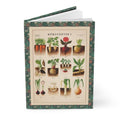
The Swedish allotment movement, formalized in the 1890s, was explicitly educational as well as practical: it was intended to teach urban children the skills and values of the kitchen garden, to maintain a connection to the agricultural traditions that industrialization threatened to sever. It was in this context that the skolplansch — the educational school poster — flourished as a pedagogical tool, bringing the kitchen garden into the classroom through the vivid, accurate illustrations of artists like Max Richter, whose 1936 Köksväxter series documented the root vegetables and brassicas of the Nordic kitchen garden with both scientific precision and visual beauty.
The 20th Century: From Necessity to Choice
The mid-20th century brought prosperity and the supermarket to Scandinavia, and the kitchen garden shifted from necessity to choice. Yet the tradition proved remarkably resilient. The kolonitradgård movement continued to thrive — today there are over 300,000 allotment plots in Sweden alone — and the kitchen garden remained a fixture of rural and suburban life across the Nordic countries.
The vegetables that had sustained Nordic families for centuries — the carrot, the turnip, the cabbage, the leek, the beet — remained central to Nordic cuisine even as the food supply diversified. The husmanskost — the traditional Swedish home cooking — is built on these kitchen garden staples, and the New Nordic cuisine movement of the early 21st century, pioneered by chefs like René Redzepi at Noma, drew explicitly on the heritage of the Nordic kitchen garden, celebrating root vegetables, wild herbs, and fermented brassicas as the foundation of a distinctively Northern culinary identity.
The Kitchen Garden Today
The contemporary Nordic kitchen garden is experiencing a revival, driven by interest in sustainability, food sovereignty, and the pleasures of growing one's own food. Community gardens, urban allotments, and domestic kitchen gardens are flourishing across Scandinavia, and the vegetables that Max Richter documented in his 1936 Köksväxter posters — the carrot, the parsnip, the cauliflower, the Brussels sprout — are being rediscovered by a new generation of Nordic gardeners.
The kitchen garden, in the Nordic tradition, has always been more than a source of food. It is a practice of attention — a way of observing the seasons, understanding the soil, and participating in the cycles of growth and harvest that connect the present to a thousand years of Nordic agricultural life.

If the Nordic kitchen garden inspires you, our Kitchen Garden Journal — Max Richter 1936 Köksväxter Skolplansch brings Richter's celebrated vegetable illustrations to the cover of a hardcover journal, ready to accompany your own garden notes and seasonal observations.
References
- Hansson, M. & Hansson, B. Medicinal Plants of the Nordic Countries. Norstedts, 2005.
- Fjærli, H. The Viking Garden: Archaeological Evidence for Horticulture in Early Medieval Scandinavia. University of Oslo Press, 2011.
- Linnaeus, C. Hortus Upsaliensis. Uppsala, 1748.
- Redzepi, R. Noma: Time and Place in Nordic Cuisine. Phaidon, 2010.
- Swedish Allotment Association (Förbundet Svensk Koloniträdgård). 100 Years of the Swedish Allotment. FSK, 1995.