The Most Fantastical Fish Ever Painted: Louis Renard’s Poissons, Écrevisses et Crabes (1719)
In 1719, a Franco-Dutch bookseller named Louis Renard published in Amsterdam what would become one of the most extraordinary — and most debated — works of natural history ever printed. Poissons, Écrevisses et Crabes was the first colour publication on fish ever known, and it remains, three centuries later, one of the most visually astonishing books in the history of science.
Its plates show fish with nearly human lips. Crabs with carapaces designed like ceremonial shields. A unicorn fish with a long black horn. A mermaid. And yet, modern ichthyologists have succeeded in identifying the genus — and often the species — of nearly every animal depicted.
Louis Renard and the World of the East Indies
Louis Renard (1678–1746) was not a naturalist. He was a bookseller, publisher, and, according to his own account, a spy in the service of the British Crown. His connection to the natural history of the East Indies came through a remarkable intermediary: Samuel Fallours, a soldier of the Dutch East India Company (VOC) stationed in the Moluccas — the fabled Spice Islands of what is today eastern Indonesia.
Fallours spent years in the Moluccas observing, catching, and drawing the extraordinary marine life of those waters. His drawings combined genuine scientific observation with vivid, almost psychedelic colour and a taste for the fantastical that reflected both the visual conventions of his time and, perhaps, a certain creative liberty taken with his subjects. He sold copies of his drawings to European collectors, and it was through this network that Renard acquired them.
The complete work comprises 100 plates with 460 hand-coloured engravings of fish, crustaceans, and other sea creatures — each identified by name in Old Dutch, French, and Latin, and accompanied by brief descriptions that often note, with colonial pragmatism, whether the animal in question is “delicious.”
Folio 5: The Emperor Angelfish of the Moluccas
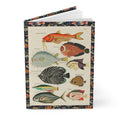
Among the most celebrated plates of the work is Folio 5, which appears on the front cover of our journal. It presents a luminous assembly of fish from the Moluccas Islands, named in Old Dutch with the precision of a merchant’s inventory.
The Baard Mannetje (31) — a bearded fish recalling a rock mullet. The Gravinne (33) — with circular patterns and earth tones. And the magnificent central specimen, the Douwing Farmolu (34) — a large fish with concentric black and white patterns that modern ichthyologists have identified as a juvenile Pomacanthus imperator, the Emperor Angelfish, one of the most recognisable fish of the Indo-Pacific reefs. Folio 5 is celebrated for the extraordinary chromatic intensity Fallours brought to these Moluccan species — colours so vivid they seem to belong more to a painter’s imagination than to the sea.
Plate XLVII: The Unicorn Fish and the Ceremonial Crab
If Folio 5 is luminous, Plate XLVII — from the second edition of 1754, reproduced on the back cover — is where Fallours’ fantastical imagination reaches its peak.
The Tafel-Kreeft (195) is a lobster from Ambon described as “quite common and delicious,” adorned with purely artistic yellow circular patterns on its head. The Eenhoorn Licorne (196) — the great unicorn fish — bears a long black horn, nearly human lips, and a highly stylised dorsal fin; it is described as “common on the Island of La Rique and of very good flavour.” Real unicorn fish of the genus Naso do exist, though none quite like this. The Catjang-radi (198) is a great crustacean from Ambon with turquoise blue claws and a carapace designed like a ceremonial shield — identified by scientists as a possible representation of Carpilius maculatus.
Almost every description in this plate notes whether the animal is “delicious” — a detail that reflects the 18th-century European colonial view of nature as primarily a commercial and gastronomic resource, even when the illustrations themselves transcend that view entirely.
Science, Fantasy, and the Limits of Observation
The question of how much Fallours invented and how much he observed has fascinated historians of science for generations. The answer is probably: both, inseparably. Working in the Moluccas without the tools of modern taxonomy, drawing from memory and from live specimens in conditions far from ideal, Fallours produced images that are simultaneously documentary and imaginative — a record of what he saw filtered through the visual conventions of Baroque natural history illustration and his own remarkable eye for colour and form.
Renard himself acknowledged in his preface that some of the images might seem incredible, but vouched for their authenticity — a claim that subsequent generations have found both credible and suspect in equal measure. The mermaid, for instance, remains unexplained.
A Legacy Across Three Centuries
The first edition of Poissons, Écrevisses et Crabes was published in Amsterdam in 1719. A second edition followed in 1754, eight years after Renard’s death. The work was reprinted in facsimile by Theatrum Orbis Terrarum in 1971, and has since been the subject of sustained scholarly attention from historians of science, art historians, and ichthyologists alike.
It remains one of the great monuments of the Dutch Golden Age of natural history illustration — a tradition that also produced the works of Maria Sibylla Merian, Jan Jonston, and Albert Seba — and one of the most vivid records of the European encounter with the biodiversity of the East Indies at the height of the VOC’s commercial empire.
—

The plates from Louis Renard’s Poissons, Écrevisses et Crabes appear on the cover of our Sea Life Journal — Renard 1719, a hardcover lined journal with 150 perforated pages, casewrap sewn binding, and matte laminated full-wrap cover.
References
- Renard, Louis. Poissons, Écrevisses et Crabes. Amsterdam, 1719. Second edition, 1754.
- Pietsch, Theodore W. Fishes, Crayfishes, and Crabs: Louis Renard’s Natural History of the Rarest Curiosities of the Seas of the Indies. Johns Hopkins University Press, 1995.
- Whitehead, P.J.P. “The Original Drawings for the Historia Naturalis of Albertus Seba.” Zoologische Mededelingen, 1969.
- Nuttall, P.A. The VOC and Natural History in the East Indies. Leiden, 2003.