The Honeybee as Scientific Object: From Swammerdam to Modern Apiculture
No insect has been studied more intensely, or with more wonder, than the honeybee. For three thousand years, from Aristotle's Historia Animalium to the genomic sequencing of Apis mellifera in 2006, the honeybee has occupied a unique position in the history of natural history: an organism so complex in its social organization, so precise in its architecture, and so essential to human agriculture that it has attracted the attention of philosophers, theologians, mathematicians, and biologists in every era. To study the honeybee was, for much of Western history, to study the deepest questions about the nature of society, the origins of intelligence, and the relationship between the individual and the collective.
Aristotle and the Ancient Tradition
The scientific study of the honeybee begins, like so much of Western natural history, with Aristotle. In the Historia Animalium (c. 350 BCE), Aristotle devoted more attention to the honeybee than to almost any other animal, documenting its social organization, its division of labor, its architectural achievements, and the mysterious process of reproduction that he could observe but not fully explain. He correctly identified the three castes of the colony — the large bees he called "kings" (later understood to be queens), the drones, and the workers — and he described the hexagonal geometry of the honeycomb with an accuracy that would not be surpassed for centuries.
What Aristotle could not explain — because he lacked the microscope — was the mechanism of bee reproduction. His account of how new bees were generated was necessarily speculative, and it remained so for two thousand years. The honeybee's reproductive biology — the queen's mating flight, the drone's single act of reproduction, the worker's sterility — was one of the great mysteries of natural history, and it was not fully resolved until the 18th century.
Jan Swammerdam and the Microscopic Revolution
The transformation of honeybee science began with the Dutch naturalist Jan Swammerdam (1637–1680), whose work with the microscope opened a new world of biological complexity that no previous observer had been able to see. Swammerdam was among the first naturalists to use the microscope systematically as a scientific instrument, and his observations of insect anatomy — published posthumously in the Biblia Naturae (1737–38) — remain among the most extraordinary achievements in the history of natural history illustration.
Swammerdam's dissections of the honeybee were revelatory. He was the first to demonstrate, by microscopic examination, that the large bee at the center of the colony was female — the queen, not the king — and that the drones were male. He described the queen's ovaries, the worker's sting apparatus, and the metamorphic stages of bee development — egg, larva, pupa, adult — with a precision that established the framework for all subsequent entomological study. His illustrations, engraved from his own drawings, set a standard of anatomical accuracy that the Georgian copper-plate engravers of the following century would strive to match.
The Georgian Entomologists and the 1792 Natural History of Insects
By the late 18th century, the study of insects had become one of the most fashionable branches of natural history in Britain and Europe. The publication of Linnaeus's Systema Naturae (1735) had provided a taxonomic framework that made the systematic study of insect diversity possible, and the development of copper-plate engraving as a reproductive technique had made it possible to distribute high-quality scientific illustrations to a wide audience.
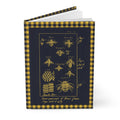
The Natural History of Insects (1792) was a product of this moment: a comprehensive illustrated reference that brought together the accumulated knowledge of Georgian entomology in a format accessible to the educated general reader as well as the specialist. Plates 14 and 15, engraved by J. Frazer in the copper-plate tradition that Swammerdam's illustrators had pioneered, documented the honeybee colony with a completeness and precision that reflected a century of accumulated observation.
Plate 14 presented the three castes of the colony — queen, drone, and worker — with the morphological distinctions between them rendered in meticulous detail: the queen's elongated abdomen, the drone's large compound eyes, the worker's pollen baskets and sting apparatus. The honeycomb cells were shown in cross-section, revealing the hexagonal geometry that had fascinated mathematicians since antiquity. The metamorphic stages — egg, larva, pupa — were documented alongside the adult forms, providing a complete portrait of the bee's life cycle that Swammerdam would have recognized and admired.
The Mathematics of the Honeycomb
The hexagonal geometry of the honeycomb has attracted mathematical attention since antiquity. Pappus of Alexandria (c. 290–350 CE) argued that the hexagonal cell was the most efficient possible shape for storing honey — that it enclosed the maximum area with the minimum perimeter, and therefore used the least wax for the greatest storage capacity. This claim — known as the Honeycomb Conjecture — was not rigorously proved until 1999, when the mathematician Thomas Hales published a formal proof using methods unavailable to Pappus.
The Georgian naturalists who studied the honeycomb were aware of this mathematical tradition, and they brought to their observations a dual sensibility — scientific and aesthetic — that is characteristic of the Enlightenment at its best. The honeycomb was not merely an engineering achievement: it was a proof that nature operated according to mathematical principles, that the bee's instinctive behavior was an expression of the same rational order that governed the movements of the planets and the growth of crystals. To study the honeycomb was to study the mind of nature itself.
From Georgian Science to Modern Apiculture
The Georgian entomologists who produced The Natural History of Insects were working at the beginning of a transformation in the human relationship with the honeybee. The invention of the movable-frame hive by Lorenzo Lorraine Langstroth in 1851 — which allowed beekeepers to inspect and manage individual frames without destroying the colony — made modern apiculture possible, and it was built directly on the scientific understanding of bee biology that Swammerdam and his successors had established.
Today, the honeybee is more intensely studied than ever — not merely as a source of honey and wax, but as a model organism for the study of social behavior, collective intelligence, and the neuroscience of navigation and communication. The discovery of the waggle dance by Karl von Frisch (Nobel Prize, 1973) — the bee's remarkable system for communicating the direction and distance of food sources through movement — revealed a form of symbolic communication in an invertebrate that challenged fundamental assumptions about the nature of language and intelligence.
From Aristotle's Historia Animalium to the genomic sequencing of Apis mellifera, the honeybee has been at the center of natural history's most ambitious questions. The Georgian copper-plate engravers of 1792 who documented the queen, the drone, and the worker with such meticulous precision were part of a tradition of wonder that continues today — and that shows no sign of exhausting its subject.

If the science and beauty of the honeybee inspire you, our Honeybee Journal — Natural History of Insects 1792 brings Plates 14 and 15 to the cover of a hardcover journal, set against a bold navy blue and golden yellow gingham design inspired by the geometry of the honeycomb itself.
References
- Aristotle. Historia Animalium. Trans. D'Arcy Wentworth Thompson. Oxford University Press, 1910.
- Swammerdam, J. Biblia Naturae. Leiden, 1737–38.
- Hales, T. C. “The Honeycomb Conjecture.” Discrete and Computational Geometry 25 (2001): 1–22.
- Von Frisch, K. The Dance Language and Orientation of Bees. Harvard University Press, 1967.
- Kritsky, G. The Quest for the Perfect Hive: A History of Innovation in Bee Culture. Oxford University Press, 2010.