The Hidden Anatomy of the Fig: Ehret, Macfarlane, and Two Centuries of Botanical Illustration
The fig holds a secret that eluded casual observation for centuries: it is not, in the strict botanical sense, a fruit at all. What we eat is a syconium — an inverted floral receptacle enclosing hundreds of tiny flowers within its fleshy walls. To reveal this hidden architecture, eighteenth-century botanical science turned to dissection. In 1750, Georg Dionysius Ehret made the invisible visible.
Georg Dionysius Ehret and the Art of Botanical Dissection
Georg Dionysius Ehret (1708–1770) was the most celebrated botanical illustrator of the eighteenth century — a German-born artist who trained as a gardener, taught himself to draw, and rose to become the preferred illustrator of the greatest botanists of his age, including Carl Linnaeus, with whom he collaborated in the years when the Linnaean system of plant classification was being established.
Ehret’s genius lay in his ability to fuse scientific precision with compositional elegance. His plates were not merely accurate — they were beautiful in a way that made accuracy itself seem like an aesthetic achievement. Working in watercolour, gouache, and engraving, he produced images that could serve simultaneously as scientific documents and as works of art, suitable for the libraries of physicians and the cabinets of collectors alike.
His most sustained collaboration was with the Nuremberg physician and botanist Christoph Jakob Trew (1695–1769), who commissioned the monumental Plantae Selectae — published in ten parts between 1750 and 1773 — as a comprehensive illustrated record of remarkable plants from botanical gardens across Europe. Ehret produced the majority of the plates, and the work stands as the fullest expression of his mature style.
Plate 74: Fructificatio Ficus carica Linn
Among the most remarkable plates in Plantae Selectae is Plate 74, titled “Fructificatio Ficus carica Linn” — Ehret’s anatomical study of the common fig. It is not a portrait of the fig as a fruit. It is a dissection: 57 distinct segments showing flowers and fruits at every stage of development, each opened, sectioned, and arranged on the page with the systematic rigour of an anatomical atlas.
The fig presented Ehret with a particular challenge. Unlike most flowering plants, Ficus carica conceals its reproductive structures entirely within the syconium — the fleshy, hollow receptacle that we recognise as the fruit. The flowers bloom inside, invisible from the exterior, pollinated by a specialised fig wasp (Blastophaga psenes) that enters through the ostiole, a small opening at the apex. To illustrate the fig’s reproductive biology, Ehret had to cut it open — to make visible what nature had hidden.
The result is a plate of extraordinary scientific and aesthetic complexity. The 57 segments are arranged with the precision of a taxonomic key, each labelled in Latin with morphological descriptions that reflect the Linnaean nomenclature being codified in those very years. The coloured engraving technique — in which a copper-plate print was hand-coloured by specialist colourists working from a master copy — allowed Ehret to render the subtle gradations of colour within the syconium: the pale green of the immature fruit, the deep purple of the ripe fig, the cream and amber of the internal chambers.
J. Macfarlane and the Victorian Zincograph (1872)
More than a century after Ehret completed his dissection, the fig attracted the attention of a different kind of botanical illustrator. J. Macfarlane’s coloured zincograph of Ficus carica, produced around 1872, represents a different moment in the history of botanical illustration — and a different relationship to the fig as a subject.
Where Ehret dissected, Macfarlane contemplated. His zincograph presents the fig as an object of cultivation and pleasure: a fruiting stem with whole teardrop-shaped fruit and a single halved cross-section revealing the honeyed interior of the syconium, framed by the ornate decorative borders characteristic of Victorian botanical art. The zincographic process — which transferred the image to a zinc plate rather than copper, allowing for faster and cheaper reproduction — had by the 1870s become the dominant technique for illustrated botanical publications aimed at the educated general reader.
Macfarlane’s fig is the Mediterranean fig of the kitchen garden and the market stall: ripe, abundant, beautiful in the way that cultivated things are beautiful. It is the fig of culinary tradition, of seasonal preserving, of the slow rhythms of Mediterranean agriculture. Where Ehret’s plate asks how does the fig work?, Macfarlane’s asks what is the fig for?
Two Centuries, Two Philosophies
The contrast between Ehret’s 1750 dissection and Macfarlane’s 1872 zincograph encapsulates a broader shift in the history of botanical illustration — from the Enlightenment project of systematic scientific knowledge to the Victorian celebration of natural abundance and cultivated beauty.
Ehret worked in an era when botanical illustration was primarily a scientific instrument: a means of documenting, classifying, and communicating knowledge about the plant world to a community of naturalists, physicians, and collectors. The beauty of his plates was inseparable from their scientific function — precision was the aesthetic.
Macfarlane worked in an era when botanical illustration had become, in part, a form of popular culture: a way of celebrating the natural world for an educated general audience that valued beauty and historical association as much as scientific accuracy. The Victorian botanical plate was as likely to appear in a cookbook or a gardening manual as in a scientific treatise.
Together, the two images offer a compressed history of how European culture has looked at the fig — and, by extension, at the natural world — across two centuries of scientific and aesthetic change.

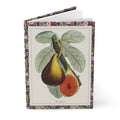
Georg Dionysius Ehret’s Plate 74 from Plantae Selectae (1750–1773) and J. Macfarlane’s coloured zincograph (1872) appear on the cover of our Fig Journal, a hardcover lined journal with 150 perforated pages, casewrap sewn binding, and matte laminated full-wrap cover.
References
- Ehret, Georg Dionysius, and Christoph Jakob Trew. Plantae Selectae. Nuremberg, 1750–1773.
- Lack, H. Walter. Georg Dionysius Ehret: Botanical Artist Extraordinary. Natural History Museum, 2015.
- Corner, E.J.H. The Natural History of Palms. Weidenfeld & Nicolson, 1966.
- Janzen, Daniel H. “How to Be a Fig.” Annual Review of Ecology and Systematics 10 (1979): 13–51.
- Blunt, Wilfrid, and William T. Stearn. The Art of Botanical Illustration. Antique Collectors’ Club, 1994.