The Golden Age of Canoes: Mail-Order Catalogs and the Making of North American Wilderness Culture
In the 1920s and 1930s, North American canoe manufacturers produced some of the most compelling commercial art of the interwar period: illustrated mail-order catalogs that sold not merely watercraft, but an entire philosophy of wilderness living. These catalogs — distributed by post to hundreds of thousands of homes — were among the primary instruments through which a generation of North Americans learned to imagine, desire, and pursue the outdoor life.
The Wilderness Movement and the Canoe
The cultural conditions that made the canoe catalog possible had been building since the late nineteenth century. Industrialisation had drawn millions of people to the cities, and with it had come a powerful counter-movement: the conviction, articulated by figures from Henry David Thoreau to Theodore Roosevelt and John Muir, that contact with wild nature was not merely pleasant but necessary — morally, physically, and spiritually necessary — for the health of the individual and the nation.
The canoe was the ideal instrument of this philosophy. Lightweight, silent, and capable of navigating both turbulent rivers and glassy lakes, it allowed the wilderness traveller to move through landscapes that no road or railway could reach. The great lake systems of Maine, Minnesota, Ontario, and Quebec — the Boundary Waters, the Adirondacks, the Algonquin — became the destinations of a new kind of tourism: not the grand hotel and the scenic railway, but the portage trail, the canvas tent, and the campfire.
By the 1910s and 1920s, canoeing had evolved from a utilitarian practice of Indigenous peoples and fur traders into a booming recreational industry. Canoe clubs organised multi-day expeditions and competitions. Families loaded their canoes with camping gear and set out for weeks at a time. The outdoor life had become, for a significant portion of the North American middle class, both an aspiration and an identity.
The Mail-Order Catalog as Cultural Document
Into this cultural moment came the illustrated mail-order catalog — one of the defining commercial forms of early twentieth-century North America. The catalog had been transforming retail since the 1870s, when companies like Sears, Roebuck & Co. and Montgomery Ward began distributing illustrated catalogues to rural customers who had no access to urban department stores. By the 1920s, the form had been adopted by specialist manufacturers across every sector of the consumer economy, including the rapidly growing outdoor recreation industry.
The canoe catalogs of the interwar period are remarkable documents. They were not simple price lists: they were carefully designed publications that combined technical information — hull dimensions, carrying capacity, construction materials, weight — with evocative imagery of the wilderness life that the canoes were meant to enable. A typical catalog spread might show a detailed cross-section of a cedar-canvas hull alongside a full-page illustration of a family paddling across a sunlit lake, or a lone figure portaging through a forest of birch and pine.
The illustrators who produced these images — most of them anonymous — worked in a graphic tradition that drew on both the precision of technical illustration and the romanticism of the wilderness painting. Their canoes were rendered with the accuracy of engineering drawings; their landscapes with the atmospheric warmth of the Hudson River School. The result was a visual language that was simultaneously practical and aspirational: here is the object, here is the life it makes possible.
The Craft of the Wooden Canoe
Central to the appeal of these catalogs was the craft of the canoes themselves. The dominant construction method of the period — the cedar-canvas canoe — was a North American invention of the late nineteenth century, developed from the birchbark canoe traditions of Indigenous peoples and refined by manufacturers into a form of remarkable elegance and durability.
The process was labour-intensive and highly skilled. Cedar ribs were steam-bent to shape over a wooden form, then planked with thin cedar strips, covered with treated canvas, and sealed with resin and paint. Each canoe required hundreds of hours of specialised work. The result was a vessel that was light enough to portage over long distances, strong enough to withstand the rigours of whitewater, and beautiful enough to be displayed as an object of craftsmanship in its own right.
The catalogs documented this craft in detail, listing the species of wood used for each component, the weight of the canvas, the number of coats of varnish. For buyers who would never visit the factory, the catalog was the primary means of understanding what they were purchasing — and the care with which manufacturers described their construction methods was itself a form of quality assurance, a demonstration that these were objects made with knowledge and pride.
A Visual Legacy
The graphic language of the interwar canoe catalog has proved remarkably durable. Nearly a century after these publications first reached their readers, the visual conventions they established — the technical diagram, the wilderness scene, the period typography, the warm palette of forest greens and lake blues — continue to resonate as shorthand for a particular idea of outdoor life: unhurried, skilled, connected to landscape and season.
This endurance is not merely nostalgic. The canoe catalogs of the 1920s and 1930s documented a genuine culture of outdoor recreation at a moment of particular vitality — before the automobile had fully transformed the relationship between North Americans and their wilderness, before the synthetic materials revolution had changed the craft of boat-building, before the great lake systems had been altered by a century of development and environmental change. They are primary sources for the history of outdoor recreation, of graphic design, of craft manufacturing, and of the complex cultural relationship between North American modernity and the idea of wilderness.

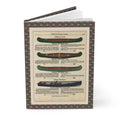
The visual tradition of the North American canoe catalog — its graphic conventions, its wilderness imagery, its celebration of craft and adventure — inspired the cover design of our Wilderness Journal, a hardcover lined journal with 150 perforated pages, casewrap sewn binding, and matte laminated full-wrap cover.
References
- Jennings, John. The Canoe: A Living Tradition. Firefly Books, 2002.
- Raffan, James. Bark, Skin and Cedar: Exploring the Canoe in Canadian Experience. HarperCollins Canada, 1999.
- Cronon, William. Uncommon Ground: Rethinking the Human Place in Nature. W. W. Norton, 1996.
- Stilgoe, John R. Outside Lies Magic: Regaining History and Awareness in Everyday Places. Walker & Company, 1998.
- Strung, Norman. The Complete Outdoorsman’s Handbook. Prentice Hall, 1974.