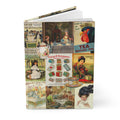
The Cup That Conquered the World: Tea, Empire, and the Golden Age of Advertising
How a leaf from the mountains of China became the defining ritual of Victorian civilization — and how the advertisers of 1900 turned it into art.

There is no beverage in history that has done more cultural work than tea. It has financed empires and started wars. It has defined social hierarchies and dissolved them. It has been the subject of philosophical treatises, the occasion for diplomatic crises, and the quiet companion of more ordinary human moments — grief, conversation, the pause between one thing and the next — than any other drink the world has known. And in the decades between 1880 and 1930, at the height of what we might call the Golden Age of Tea, it became something else as well: the subject of some of the most beautiful commercial art ever produced.
The advertising collages and illustrated trade cards of the early twentieth century are among the most vivid documents of their era. They tell us what tea meant to the people who drank it — not just as a beverage, but as a symbol, a ritual, a marker of civilization and refinement, a thread connecting the drawing rooms of London to the tea gardens of Assam and Ceylon and the ancient trade routes of China. They are, in their way, a portrait of a world in which a cup of tea carried more meaning than we might easily imagine today.
From Rarity to Ritual: The Long Journey of Tea
Tea arrived in Europe in the early seventeenth century, carried by Dutch and Portuguese traders from the ports of China and Japan. It was, at first, a curiosity — expensive, exotic, and consumed primarily by the wealthy as a demonstration of cosmopolitan taste. In England, it was introduced to the court of Charles II in the 1660s, partly through the influence of his Portuguese queen, Catherine of Braganza, who brought the tea-drinking habit with her from Lisbon. For the first century of its presence in Britain, tea remained a luxury item, taxed heavily and consumed in small quantities by those who could afford it.
The transformation came in the eighteenth century, driven by two forces: the expansion of the East India Company’s trade networks, which brought tea to Britain in ever-increasing quantities, and the gradual reduction of import duties, which made it accessible to a much wider population. By the end of the eighteenth century, tea had ceased to be a luxury and had become, for the British, a necessity — consumed at every level of society, from the aristocratic drawing room to the factory floor.
This democratization of tea was one of the great social transformations of the modern era. It created new rituals, new objects, new industries. The pottery towns of Staffordshire expanded to meet the demand for teacups and teapots. The sugar trade — with all its terrible human costs — was partly driven by the British appetite for sweetened tea. The East India Company’s tea trade became one of the most profitable commercial enterprises in history, and the routes along which tea traveled — from the gardens of China and India to the docks of London — shaped the geography of global commerce for two centuries.
The Afternoon Tea: A Victorian Invention
The ritual of afternoon tea — that most quintessentially English of institutions — was, in fact, a Victorian invention, attributed by tradition to Anna, the seventh Duchess of Bedford, who in the 1840s began taking tea and light refreshments in the late afternoon to bridge the long gap between the midday meal and the fashionably late dinner. The practice spread rapidly through the aristocracy and the upper middle classes, acquiring as it did so an elaborate apparatus of social convention: the correct china, the correct food, the correct hour, the correct dress, the correct conversation.
By the 1880s, afternoon tea had become one of the central rituals of Victorian social life — an occasion for the display of refinement, the maintenance of social networks, and the performance of femininity in a culture that assigned to women the management of domestic ceremony. The tea table was a woman’s domain: she presided over the teapot, she managed the conversation, she orchestrated the social choreography of the occasion. The illustrated advertisements of the period reflect this association constantly — elegant women in fashionable dress, presiding over gleaming tea services, surrounded by flowers and fine porcelain, embodying the ideal of domestic grace that the culture demanded of them.
The Global Cup: Tea, Trade, and Empire
Behind the drawing-room elegance of the Victorian tea table lay a global commercial system of extraordinary complexity. The tea in the cup had traveled thousands of miles — from the gardens of Assam or Ceylon, developed by British planters on land cleared from the Indian subcontinent, or from the ancient tea-growing regions of China, where the plant had been cultivated for millennia before European traders arrived to carry it westward.
The maps that appear in early twentieth-century tea advertising — showing the global reach of the trade, the routes along which tea traveled from garden to cup — are documents of this system. They make visible the imperial geography that underpinned the everyday ritual of the British tea break: the plantations, the shipping routes, the processing facilities, the blending houses, the distribution networks that connected a garden in the hills of Sri Lanka to a kitchen in Manchester or Edinburgh.
The great tea companies of the period — Lipton, Typhoo, Brooke Bond, Twinings — built their brands on this global reach, advertising the provenance of their teas as a guarantee of quality and authenticity. The illustrated trade cards and advertising posters of the era are full of images of tea gardens, of workers harvesting leaves in exotic landscapes, of ships laden with chests of tea crossing tropical seas. They sold not just a beverage but a story — the story of a world connected by commerce, of an empire that brought the best of the East to the tables of the West.
The Art of Tea Advertising
The commercial art of the Golden Age of Tea is remarkable for its ambition and its quality. The illustrated trade cards distributed by tea companies in the 1880s and 1890s — small, beautifully printed cards included in packets of tea, designed to be collected and kept — were among the most sophisticated examples of chromolithographic printing of their era. They depicted everything from botanical illustrations of the tea plant to scenes of tea-garden life, from portraits of elegant tea-drinkers to allegorical images of the global tea trade.
By the early twentieth century, tea advertising had expanded into posters, magazine illustrations, and elaborate packaging design. The aesthetic was eclectic — drawing on Victorian sentimentality, Orientalist fantasy, Art Nouveau decoration, and the emerging language of modern graphic design — but the underlying message was consistent: tea was civilized, tea was refined, tea was the beverage of a culture that valued beauty, tradition, and the pleasures of domestic life.
The collage aesthetic that brings together these diverse visual traditions — the Victorian portrait, the trade map, the decorative tin, the Oriental motif, the social gathering — captures something essential about the culture of tea in its Golden Age: its capacity to hold together, in a single cup, the domestic and the global, the intimate and the imperial, the everyday and the ceremonial.
A Ritual That Endures
The Golden Age of Tea advertising ended with the Second World War, which disrupted supply chains, imposed rationing, and swept away much of the elaborate social ritual that had surrounded the tea table. But tea itself endured — and endures still, as the most widely consumed beverage in the world after water, drunk daily by billions of people across every culture and continent.
What the early twentieth-century advertisers understood, and what their beautiful illustrated collages still communicate across more than a century, is that tea is never just tea. It is a ritual, a pause, a connection — to other people, to tradition, to the long and complicated history of a leaf that traveled from the mountains of China to become, somehow, the defining drink of the modern world.

If the world of Victorian tea culture and early twentieth-century advertising art resonates with you, the Tea Journal brings this golden age collage to a hardcover journal — 150 perforated lined pages, ready for tasting notes, recipes, or whatever your afternoons require.
References
- Pettigrew, J. A Social History of Tea. National Trust, 2001.
- Rappaport, E. A Thirst for Empire: How Tea Shaped the Modern World. Princeton University Press, 2017.
- Griffiths, J. Tea: A History of the Drink That Changed the World. André Deutsch, 2011.
- Hohenegger, B. Liquid Jade: The Story of Tea from East to West. St. Martin’s Press, 2006.
- Ukers, W.H. All About Tea. Tea and Coffee Trade Journal Company, 1935.