The Clock as Art Object in Georgian England
In Georgian England, the clock was never merely a machine. It was a philosophical statement, a status symbol, and a work of art — the most perfect expression of the age's conviction that beauty and precision were not opposites but partners, that the highest achievement of human ingenuity was a mechanism so well made that it was also, inevitably, beautiful. To own a fine clock in the 18th century was to participate in the Enlightenment itself: to demonstrate that you understood the orderly, rational universe that Newton had revealed, and that you could afford to have it measured in your drawing room.

The Clockmaker's Art
The great English clockmakers of the Georgian era — Thomas Tompion, George Graham, Thomas Mudge, John Harrison — were understood by their contemporaries not merely as craftsmen but as artists of the highest order. Their work combined the precision of the mathematician, the skill of the metalworker, the eye of the designer, and the patience of the philosopher. A fine longcase clock by Tompion or Graham was as much a cultural object as a painting by Reynolds or a piece of silver by Paul de Lamerie — and it was priced accordingly.
The aesthetic of the Georgian clock was inseparable from its mechanical logic. The case — whether in walnut, mahogany, or lacquered japanwork — was designed to display the movement within, to make visible the ordered complexity of wheels, escapements, and pendulums that kept time with such extraordinary accuracy. The dial — silvered, enamelled, or painted — was a composition in itself: the arrangement of chapter ring, subsidiary dials, and calendar apertures governed by the same principles of proportion and balance that governed the façade of a Palladian house.
The Encyclopaedia Londinensis and the Art of Horological Illustration
The conviction that clockmaking was an art as well as a science found one of its most beautiful expressions in the horological plates of the great Georgian encyclopaedias. John Wilkes's Encyclopaedia Londinensis, published in London between 1796 and 1829, was one of the most ambitious publishing projects of the Regency era: a comprehensive reference work that aimed to document the full range of human knowledge in text and image, with plates engraved to the highest standard of the London trade.
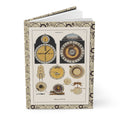
The horology plates — engraved by John Pass (active 1797–1832), one of the most accomplished scientific engravers of his generation — are among the finest examples of Georgian technical illustration. Pass brought to his copperplate engravings the same dual sensibility that the best clockmakers brought to their movements: a commitment to mechanical accuracy that was simultaneously a commitment to visual clarity and elegance. His plates of Improved Clocks (Plate XI) and Clock Work (Plate IV), dated 8 December 1809, document the state of horological knowledge at a decisive moment — the transition from the friction-based mechanisms of the 17th century to the refined escapements and compensation pendulums that would define modern precision timekeeping.
In luxury editions, Pass's engravings were hand-coloured with watercolour washes — amber for brass, steel blue for tempered steel, warm grey for iron — that transformed functional diagrams into compositions of quiet, geometric beauty. The colour was not decorative but analytical: it guided the eye through the complexity of the mechanism, distinguishing material from material, component from component, with the clarity of a master craftsman's blueprint rendered in the palette of a watercolourist.
Ferguson's 24-Hour Clock: Science as Spectacle
Among the instruments documented in Pass's Plate XI is James Ferguson's 24-hour clock — a mechanism designed not merely to tell the time but to model the relationship between the sun, the moon, and the tides. Ferguson (1710–1776), the self-taught Scottish astronomer who became one of the most popular scientific lecturers of the Georgian era, designed his tidal clock as a philosophical instrument: a machine that made visible the Newtonian mechanics of the solar system in the domestic space of the drawing room.
The 24-hour clock was, in this sense, the Georgian clock at its most ambitious: not merely a timekeeper but a cosmological model, a miniature orrery that placed the owner in relation to the movements of the heavens. Its elegant face — with its 24-hour chapter ring, its tidal indicator, and its subsidiary dials — was designed to be read as well as admired, to prompt reflection on the orderly universe that Newtonian science had revealed and that Georgian clockmaking had learned to measure with such extraordinary precision.
The Clock in the Georgian Interior
The placement of the clock in the Georgian interior was never accidental. The longcase clock — the grandfather clock, as it came to be known — stood in the hall or the staircase, marking the threshold between the domestic and the public, its measured tick the heartbeat of the household. The bracket clock sat on the chimneypiece of the drawing room, its case designed to complement the architectural ornament of the room, its movement visible through the glazed side panels to the curious and the knowledgeable.
The finest Georgian clocks were commissioned as furniture as much as instruments — their cases designed by architects, their dials painted by miniaturists, their movements made by the most celebrated craftsmen in London or Paris. They were objects of conversation, of display, of philosophical reflection — proof that their owners inhabited a world governed by rational order, and that they had the taste and the means to have that order measured in the most beautiful way possible.
A Legacy in Brass and Steel
The Georgian clock endures as one of the supreme achievements of English decorative art — a form in which mechanical ingenuity, aesthetic refinement, and philosophical ambition were fused into objects of extraordinary beauty and precision. The copperplate engravings of John Pass, with their hand-coloured washes and their meticulous documentation of escapements and pendulums, are the visual record of that achievement: a portrait of an age that believed, with complete conviction, that the most beautiful thing a human being could make was a machine that kept perfect time.
If the art of Georgian horology inspires you, our Horology Journal — John Pass 1809 Encyclopaedia Londinensis brings Pass's celebrated copperplate engravings to the cover of a hardcover journal, ready to accompany your own measured thoughts.
References
- Bruton, E. The History of Clocks and Watches. Orbis, 1979.
- Clutton, C. & Daniels, G. Clocks and Watches: The Collection of the Worshipful Company of Clockmakers. Sotheby Parke Bernet, 1975.
- Landes, D. S. Revolution in Time: Clocks and the Making of the Modern World. Harvard University Press, 1983.
- Wilkes, J. (ed.) Encyclopaedia Londinensis. London, 1796–1829.
- Henderson, E. Life of James Ferguson, F.R.S.. A. Fullarton & Co., 1867.