The City Between Two Worlds: Tokyo and the Art of the Travel Poster
How mid-century graphic design turned the world’s most paradoxical city into an icon — and why Tokyo has always been impossible to capture in a single image.
There is a particular kind of city that defeats the postcard. Cities that are too large, too layered, too contradictory to be reduced to a single image — cities where the ancient and the ultramodern exist not in opposition but in a kind of permanent, productive tension that defines the place more than any single landmark could. Tokyo is the supreme example of this kind of city. It is a place where an eighth-century wooden temple stands in the shadow of a broadcasting tower, where a Shinto shrine occupies a grove of ancient cedars surrounded by the most densely built urban environment on earth, where the world’s busiest pedestrian crossing empties every two minutes into streets of extraordinary quiet and order.
The travel poster artists of the mid-twentieth century understood this paradox intuitively. Their Tokyo posters — produced in the decades between the 1920s and the 1960s, when the graphic poster was at the height of its cultural authority — are among the most visually inventive of the genre, precisely because they had to solve a problem that no other city posed quite so acutely: how do you represent a place that is simultaneously the most traditional and the most modern city in the world?
The Golden Age of the Travel Poster
The travel poster as an art form emerged in the late nineteenth century, driven by the expansion of the railways and the steamship lines that were making long-distance travel accessible to a new middle-class public. The early posters were primarily informational — schedules, routes, prices — but by the 1900s, the leading railway and shipping companies had understood that the poster could do something more powerful than inform: it could create desire.
The great poster artists of the period — Cassandre in France, Tom Purvis in Britain, Ohchi Hiroshi in Japan — developed a visual language of extraordinary economy and force. Bold flat colors, simplified forms, dramatic perspectives, and a reduction of the complex to the iconic: these were the tools of the travel poster, and in the hands of the best practitioners they produced images of genuine artistic power. A Cassandre ocean liner poster is not merely an advertisement; it is a meditation on speed, scale, and the romance of departure. A Tom Purvis railway poster is not merely a schedule; it is an invitation to a world of leisure and light.
The travel poster was, in its way, the Instagram of its era — a curated, idealized image of a destination, designed to make the viewer want to be there. But where the Instagram image is personal and immediate, the travel poster was collective and monumental: a public art form, displayed in railway stations and shipping offices, addressed to the crowd rather than the individual.
Japonisme and the Western Eye
Tokyo’s place in the visual imagination of the West was shaped, long before the travel poster, by the phenomenon that nineteenth-century critics called Japonisme — the profound influence of Japanese visual art on European painting, design, and decorative arts in the second half of the nineteenth century. When Japan opened its ports to Western trade in the 1850s after two centuries of deliberate isolation, the woodblock prints of the ukiyo-e tradition — Hokusai’s waves, Hiroshige’s landscapes, Utamaro’s portraits — flooded into Europe and transformed the way Western artists thought about composition, color, and the relationship between figure and ground.
The influence was immediate and far-reaching. Monet collected Japanese prints obsessively and reorganized his garden at Giverny around a Japanese bridge. Van Gogh copied Hiroshige directly, translating woodblock prints into oil paint as a way of understanding their compositional logic. The Art Nouveau movement drew heavily on Japanese decorative motifs — the flowing line, the asymmetric composition, the integration of natural forms into abstract pattern.
What the ukiyo-e artists had understood, and what the Western artists who learned from them were discovering, was a principle of graphic design that the travel poster would later make its own: that the most powerful images are not those that show everything, but those that select ruthlessly, reducing the complex to the essential and the essential to the iconic. A Hiroshige landscape does not describe a place; it distills it. A travel poster does the same thing, with different tools and for different purposes, but with the same underlying logic.
Tokyo Tower, Skytree, and the Vertical City
The landmarks that define Tokyo in the visual imagination — Tokyo Tower, completed in 1958; Tokyo Skytree, opened in 2012; the great torii gates of Meiji Shrine and Nezu Shrine; the soaring roof of Senso-ji Temple in Asakusa — are, almost without exception, vertical. Tokyo is a city that reaches upward, that asserts itself against the sky, that measures its ambitions in height.
This verticality is partly practical — Tokyo is built on a narrow coastal plain, hemmed in by mountains and sea, and has expanded upward because it cannot easily expand outward. But it is also expressive. The towers and temples of Tokyo are statements about time as much as space: the ancient wooden structures of Senso-ji, rebuilt repeatedly after fire and war, assert the continuity of tradition; the steel and glass of Tokyo Tower and Skytree assert the ambitions of a city that has reinvented itself, dramatically and repeatedly, across the twentieth century.
For the travel poster artist, this verticality is a gift. The tall, narrow form of a tower or a torii gate is naturally suited to the poster format, which tends toward the vertical, and the contrast between ancient wood and modern steel — between the warm ochres and reds of a shrine gate and the cool greys and whites of a broadcasting tower — provides exactly the kind of visual tension that makes a poster memorable. The best Tokyo posters use this contrast deliberately, placing the ancient and the modern in the same frame and letting the viewer feel the city’s essential paradox without having to explain it.
Shibuya, Harajuku, and the Street as Stage
If Tokyo’s landmarks define its skyline, its neighborhoods define its character — and nowhere more vividly than in the districts that have become, in the global imagination, synonymous with a particular kind of urban energy. Shibuya, with its famous scramble crossing where thousands of pedestrians cross simultaneously from every direction, is perhaps the most photographed intersection in the world — a choreography of urban movement so precise and so improbable that it seems less like a traffic solution than a performance. Harajuku, with its Takeshita Street and its tradition of elaborate youth fashion, is a laboratory of self-invention, a place where the street itself becomes a stage for the performance of identity.
These neighborhoods resist the simplifications of the travel poster in a way that landmarks do not. A tower can be reduced to a silhouette; a scramble crossing cannot. What the mid-century poster artists found, and what the best contemporary graphic design in the Tokyo tradition continues to find, is that the energy of these places can be captured not through representation but through abstraction — through the bold colors and dynamic compositions that suggest movement and density without attempting to document them.
A City That Reinvents Itself
Tokyo has been destroyed and rebuilt so many times — by the Great Kanto Earthquake of 1923, by the firebombing of 1945, by the relentless pressure of economic growth and urban development — that impermanence is built into its DNA. The Japanese aesthetic concept of mono no aware — the bittersweet awareness of transience, the beauty of things precisely because they do not last — finds its urban expression in a city that treats its own fabric as perpetually provisional, always ready to be torn down and rebuilt in a new form.
This impermanence is, paradoxically, what makes Tokyo so visually rich. A city that never stops changing is a city that never stops offering new images, new juxtapositions, new contrasts between what was and what is. The travel poster captures a moment in this endless transformation — a particular configuration of towers and temples, of neon and cedar, of ancient ritual and contemporary spectacle — and holds it still long enough for the viewer to see it whole.
That is what the best travel posters do, and what the best images of Tokyo have always done: they stop time just long enough to let us see a city that is always, in every sense, in motion.

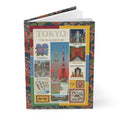
If Tokyo’s blend of ancient tradition and modern energy resonates with you, the Tokyo Journal brings this vintage travel poster aesthetic to a hardcover journal — 150 perforated lined pages, ready for travel notes, city observations, or whatever your adventures require.
References
- Wichmann, S. Japonisme: The Japanese Influence on Western Art Since 1858. Thames & Hudson, 1981.
- Richie, D. Tokyo. Reaktion Books, 1999.
- Jinnai, H. Tokyo: A Spatial Anthropology. University of California Press, 1995.
- Kerr, A. Lost Japan. Lonely Planet Publications, 1996.
- Weisenfeld, G. Imaging Disaster: Tokyo and the Visual Culture of Japan’s Great Earthquake of 1923. University of California Press, 2012.