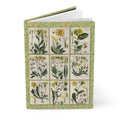
The Botanist's Hand: Christian Schkuhr and the Making of a Scientific Book in 1808
In the summer of 1808, a retired mechanic and self-taught naturalist named Christian Schkuhr completed the final volume of his Botanisches Handbuch in the Saxon city of Wittenberg. He was sixty-seven years old. He had written the text, drawn the plants, engraved the copper plates, and overseen the printing himself — a degree of personal involvement in the production of a scientific book that was, even by the standards of his time, extraordinary.
Schkuhr (1741–1811) had come to botany late and by an unusual route. Trained as a mechanic, he had worked for decades at the University of Wittenberg before the natural world claimed his full attention. He was largely self-educated in botany, and this outsider's formation may explain something of his character as an illustrator: meticulous, systematic, unwilling to delegate what he could do himself.
II. Why Botanical Books Were Written
The late eighteenth and early nineteenth centuries were the golden age of the flora — the systematic catalogue of the plants of a given region. The impulse behind these works was partly scientific, partly imperial, and partly economic. Linnaeus's taxonomic revolution had given botanists a shared language; what was needed now was the inventory. Which plants grew where? Which were useful — as medicines, as dyes, as foodstuffs? Which were dangerous? Which were new to science?
In the German-speaking lands, this project had particular urgency. The great herbals of the sixteenth century — Fuchs, Bock, Brunfels — had established a tradition of vernacular botanical writing, and the universities of the Holy Roman Empire had long maintained botanical gardens as sites of both research and teaching. By Schkuhr's time, the flora of central Europe was reasonably well known in outline, but the details remained contested. Species boundaries were disputed; synonyms proliferated; illustrations varied wildly in quality and accuracy. A reliable, well-illustrated manual was a genuine scientific need.
III. The Cost of a Plate
To understand what it meant to publish a botanical book in 1808, it is necessary to understand the economics of illustration — because illustration was not optional. A flora without plates was nearly useless. The reader needed to see the plant: its leaf shape, its flower structure, the arrangement of its stamens, the form of its seed. Words alone could not do this work.
The dominant technique for scientific illustration in this period was copper engraving. A skilled artist would first make a detailed drawing of the plant — usually from a fresh or carefully preserved specimen. This drawing would then be transferred to a polished copper plate, and a professional engraver would cut the image into the metal with a steel tool called a burin. The process was slow, demanding, and expensive. A single plate might take days or weeks to engrave. The copper itself was costly. And once the plate was worn — after perhaps a few hundred impressions — it had to be reworked or replaced.
For a work like the Botanisches Handbuch, with its hundreds of species and dozens of plates, the cost of illustration was the dominant expense of publication. This is why so many botanical works of the period were published by subscription, with the author soliciting advance payments from wealthy patrons, universities, and learned societies before a single sheet was printed.
IV. The Division of Labor — and Its Exceptions
In the typical botanical publication of the period, the work was divided among several specialists. The botanist identified and described the plants. The artist — often a trained painter or draughtsman with a scientific education — made the drawings. The engraver cut the plates. And the printer ran the press, mixing inks, dampening paper, and pulling each sheet through the heavy iron mechanism of the rolling press.
These were distinct professions, with distinct training and distinct social status. The artist occupied a peculiar middle position: too scientific to be a mere craftsman, too manual to be a gentleman of science. The engraver was generally considered a skilled artisan rather than an artist, though the best engravers — those who could render the delicate venation of a leaf or the precise geometry of a composite flower head — commanded considerable respect and considerable fees.
Schkuhr collapsed this division almost entirely. He drew his own plants and engraved his own plates — a combination that was rare even among the most dedicated botanical authors of his era. The result was a visual coherence unusual in the literature: every plate in the Botanisches Handbuch reflects the same eye, the same hand, the same set of priorities.
V. Hand-Coloring and the Luxury of Color
The plates of the Botanisches Handbuch were printed in black and white — as were most scientific illustrations of the period. Color was a luxury, and a considerable one. To produce a hand-colored botanical book, each printed sheet had to be passed to a colorist — often a team of colorists, working in an assembly line, each responsible for a single color or a single group of plants. The work was painstaking and the results variable: the quality of hand-coloring depended entirely on the skill and attention of the individual colorist, and on the quality of the watercolors used.
The great hand-colored botanical works of the period — Thornton's Temple of Flora, Redouté's Les Roses, the plates of Curtis's Botanical Magazine — were objects of extraordinary beauty, but also of extraordinary expense. A single hand-colored plate from Thornton's Temple of Flora might cost more than a laborer's weekly wage. These were books for the wealthy, for the aristocratic collector, for the botanical garden with a generous endowment.
Schkuhr's Botanisches Handbuch was not that kind of book. It was a working manual, designed for the student and the practicing naturalist, not the collector. Its uncolored plates were a deliberate choice as much as an economic necessity: what mattered was precision, not beauty. And yet the plates are beautiful — in the way that all precise things are beautiful, in the way that a well-made instrument is beautiful.
VI. The Asteraceae and the Problem of the Composite
Among the families that Schkuhr treated with particular care was the Asteraceae — the daisy family, one of the largest and most complex in the European flora. The difficulty with composites, as botanists of the period called them, was that what appeared to be a single flower was in fact a dense cluster of many small flowers — florets — arranged on a common receptacle. The outer florets, with their strap-shaped petals, were different in structure from the inner disc florets. The pappus — the feathery or bristly structure that replaced the petals in many species — was a key diagnostic character, but one that required careful dissection and magnification to observe properly.
Schkuhr's plates address this complexity directly. Each species is accompanied by marginal dissections: stamens, stigmas, pappus structures, cross-sections of the flower head, individual florets shown at magnification. These are not decorative additions — they are the scientific argument of the plate, the evidence that the illustration is not merely a picture but a demonstration.
VII. Wittenberg, 1808
The city in which Schkuhr worked was, by 1808, a place of some turbulence. Napoleon's armies had passed through Saxony; the old structures of the Holy Roman Empire had dissolved; the University of Wittenberg — where Schkuhr had spent his working life — was struggling. And yet the work of natural history continued, as it always does, in the margins of political upheaval. Schkuhr completed his Handbuch, sent it to the press, and died three years later, in 1811, leaving behind a body of work that would be consulted by botanists for decades.
VIII. What It Meant to Hold This Book
To hold a copy of the Botanisches Handbuch in 1808 was to hold the product of an extraordinary concentration of human labor: the years of fieldwork and specimen collection, the months of drawing and engraving, the days at the press, the hands of the paper-maker, the binder, the bookseller. Scientific knowledge, in this period, was inseparable from the physical object that carried it. The book was not a container for information — it was the information, in a form that could be carried into the field, consulted in the library, passed from teacher to student, annotated in the margins, and preserved across generations.
IX. A Note on This Journal
The two mosaic plates from Schkuhr's Botanisches Handbuch — dandelion and arnica, goldenrod and rudbeckia, hawkweed and sowthistle — are now the covers of a hardcover journal. A small homage to a man who drew, engraved, and printed his own book in Wittenberg in 1808.
👉 Schkuhr Wildflower Journal — Botanisches Handbuch 1808

References
- Schkuhr, C. (1808). Botanisches Handbuch der mehresten theils in Deutschland wildwachsenden, theils ausländischen Pflanzen. Wittenberg.
- Stafleu, F.A. & Cowan, R.S. (1985). Taxonomic Literature, Vol. V. Utrecht: Bohn, Scheltema & Holkema.
- Blunt, W. & Stearn, W.T. (1994). The Art of Botanical Illustration. Antique Collectors' Club.
- Thornton, R.J. (1799–1807). Temple of Flora. London.
- Mabberley, D.J. (2008). Mabberley's Plant-Book. Cambridge University Press.