The Birds of Goldsmith's World: Ornithology in 1825
Share
In 1825, Oliver Goldsmith's A History of the Earth and Animated Nature was already a beloved classic — first published in 1774, it had been reprinted and expanded for decades, becoming one of the most widely read natural history works in the English-speaking world. The 1825 edition brought new engravings re-engraved by F.P. Becker and R. Scott, based on illustrations by Sydenham Edwards, combining scientific ambition with genuine artistic beauty.
What made Goldsmith's approach distinctive was its encyclopedic generosity: rather than isolating a single species per plate, the engravings grouped multiple birds onto a single sheet — climbing birds (Picae) alongside perching birds (Passeres), exotic species from four continents sharing the same page. It was natural history as a cabinet of wonders, designed to astonish as much as to inform.
Sydenham Edwards and the Art of Scientific Illustration
Behind Goldsmith's engravings stood a tradition of scientific illustrators who understood that accuracy and beauty were not opposites. Sydenham Edwards, one of the principal illustrators whose work informed the plates, was a founding contributor to Curtis's Botanical Magazine and one of the most prolific natural history artists of his era. His approach — precise enough for the naturalist, beautiful enough for the drawing room — defined the visual language of early 19th-century natural history publishing. When Becker and Scott re-engraved his work for the 1825 edition, they preserved that dual ambition: these were images meant to be studied and admired in equal measure.
The Victorian Bird Book Tradition
Goldsmith's Animated Nature appeared at the height of a golden age of bird books. From Bewick's History of British Birds (1797) to Audubon's Birds of America (1827–1838), the early 19th century was obsessed with documenting avian life in exhaustive, illustrated detail. What set Goldsmith apart was his reach: where Audubon focused on North America and Bewick on Britain, Goldsmith's encyclopedic ambition was global. His plates gathered species from Australia, New Zealand, South Africa, Europe, the Americas, and South Asia onto a single page — a vision of the natural world as a unified, interconnected whole, at a time when such a vision was genuinely radical.
Picae and Passeres: Two Orders, One Plate
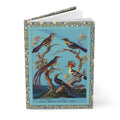
The front cover plate illustrates two of Goldsmith's ornithological groupings: Picae (climbing birds) and Passeres (perching birds). These Linnaean categories, though since revised by modern taxonomy, captured something real about avian behavior and morphology. The Hoopoe with its dramatic crest, the Common Bee-eater with its jewel-bright plumage, the Cape Sugarbird with its impossibly long tail, the Red Wattlebird of the Australian bush, the Tui of New Zealand with its white throat feathers — five species, five continents, united by their shared capacity to cling, climb, and perch in ways that fascinated Victorian naturalists. The back cover extends the vision to twelve species: Golden Oriole, Hummingbird, Whidaw Bunting, Baltimore Oriole, Broad Crested Cockatoo, Golden Crested Wren, Penduline Titmouse, Crossbill, Hoopoe, Green Toucan, Giant Kingfisher, and Alexandrine Parakeet — a roll call of avian diversity from every corner of the globe.
The contemporary turquoise background is our own addition: a deliberate choice to lift these Victorian engravings out of the sepia world of aged paper and into something vivid and present. The birds look as alive today as they did two centuries ago.
This journal carries that spirit — the conviction that the natural world, carefully observed and beautifully recorded, never goes out of date.