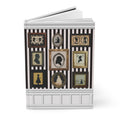
The Art of the Shadow: Silhouette Portraiture and the Democratization of the Likeness in 18th-Century Europe
Before photography, before the daguerreotype, before any mechanical means of capturing a human face, there was the portrait. And for most of history, the portrait was a luxury available only to the wealthy. A painted likeness required a skilled artist, multiple sittings, expensive pigments, and weeks of work. The result was a possession of extraordinary value — a record of a face that would otherwise be lost to time.
Then, in the middle of the eighteenth century, something changed. A new form of portraiture emerged that required no painter, no pigments, and no more than a few minutes of a subject's time. It needed only a candle, a steady hand, a sharp pair of scissors, and a sheet of black paper. The silhouette had arrived — and with it, the democratization of the human likeness.
Étienne de Silhouette and the Name of an Art Form
The word silhouette carries within it the name of a man who, in his own lifetime, was better known for his unpopular fiscal policies than for any contribution to the arts. Étienne de Silhouette (1709–1767) served as Controller-General of Finances under Louis XV of France in 1759, a tenure of barely eight months during which he attempted to impose sweeping austerity measures on the French nobility — taxing their estates, their carriages, their silverware, and their servants.
The nobility was not amused. His name became synonymous with cheapness, with reduction, with the stripped-back and the minimal. When the fashion for black paper profile portraits — already well established in France and Germany — reached its peak in the 1760s, the public attached his name to them. A silhouette was, in the popular imagination, a portrait à la Silhouette: a cheap substitute for the real thing, a likeness reduced to its bare outline.
The irony is that Silhouette himself was an enthusiastic practitioner of the art, cutting profile portraits as a hobby in his retirement at his Château de Bry-sur-Marne. His name, intended as a slight, became instead the permanent designation of one of the most enduring art forms in European history.
The Technique: Light, Shadow, and the Scissors
The method of creating a silhouette portrait was elegantly simple. The subject would sit in profile before a white screen or wall, with a candle or lamp positioned to cast a sharp shadow of their profile onto the surface. The artist — or the subject themselves, in many cases — would trace the outline of the shadow with a pencil, then cut the resulting profile from black paper and mount it on a white or cream background.
The most skilled practitioners could cut a profile freehand, without tracing, working directly with scissors as the subject sat before them. These coup de ciseaux artists — masters of the scissor-cut — could produce a recognizable likeness in under two minutes. At fairs, markets, and fashionable drawing rooms across Europe, they set up their chairs and their candles and offered portraits for a few pennies.
A more refined variant was the hollow-cut silhouette, in which the profile was cut from white paper and the resulting void — the negative space of the face — was mounted over black backing, so that the likeness appeared as a white outline against black. This technique, particularly popular in America in the early nineteenth century, produced portraits of extraordinary delicacy, the features suggested by the precise edge of the cut rather than by any positive mark.
The Parlor Gallery: Silhouettes as Social Currency
By the 1770s and 1780s, the silhouette had become one of the defining social rituals of European bourgeois life. To have one's profile taken was a mark of participation in polite society. To collect the profiles of friends, family members, and admired public figures was a form of social record-keeping — a way of assembling, on the walls of one's parlor or in the pages of one's album, a portrait gallery that would otherwise have been available only to the aristocracy.
The walls of middle-class homes across England, France, Germany, and the American colonies filled with framed silhouettes: oval gold-leafed frames typical of the period's presentation, simple black wood rectangles, silver-toned frames, and painted black borders. Men, women, and children in profile, arranged in curated groupings that reflected the collecting sensibility of the age — asymmetrical, eclectic, accumulated over time as family heirlooms and tokens of friendship.
Johann Caspar Lavater, the Swiss physiognomist whose Physiognomische Fragmente (1775–1778) argued that character could be read from the features of the face, gave the silhouette a quasi-scientific prestige. Lavater used profile silhouettes extensively in his work, arguing that the outline of the head — the forehead, the nose, the chin — revealed the inner nature of the subject with a clarity that painted portraits, with their colors and expressions, could obscure. His endorsement transformed the silhouette from a cheap novelty into a tool of serious inquiry.
The Great Practitioners
As the art form matured, a number of practitioners elevated it to a level of extraordinary refinement. In England, John Miers (1756–1821) established a studio in Leeds and later in London, producing miniature profile portraits of exceptional precision that were mounted in lockets, brooches, and small frames as intimate keepsakes. His work — painted in black on plaster or card, with fine details added in gold — blurred the boundary between the silhouette and the miniature portrait.
In Germany, the tradition of the Scherenschnitt — the scissor-cut — produced works of extraordinary complexity, with intricate lace-like borders and decorative elements cut from a single sheet of paper. In France, the court of Versailles had its own silhouette artists, and the profiles of the royal family circulated as popular prints.
In America, Charles Willson Peale — better known as a painter — installed a physiognotrace in his Philadelphia museum in 1802, a mechanical device that allowed visitors to trace their own profiles with a stylus connected to a reducing pantograph, producing a miniature silhouette in seconds. The democratization of the likeness had found its machine.
The Coming of Photography and the Silhouette's Afterlife
The daguerreotype, announced in 1839, might have been expected to end the silhouette's reign. A photographic portrait offered something the silhouette could not: the full face, the texture of skin, the precise record of every feature. And yet the silhouette did not disappear. It retreated, certainly — from the parlor wall to the fairground booth, from the drawing room to the seaside resort — but it retained a devoted following throughout the nineteenth century and into the twentieth.
The reason, perhaps, is that the silhouette offers something that photography cannot: abstraction. A silhouette is not a record of a face but an essence of it — the irreducible outline that makes a person recognizable even in the absence of all detail. It is the portrait reduced to its most fundamental element, and in that reduction it achieves a kind of timelessness that the photographic portrait, with its period clothing and its dated technology, cannot always match.
The Gallery Wall as Collecting Practice
The tradition of the silhouette gallery wall — the curated arrangement of framed profiles on a parlor wall — has never entirely left the European and American interior. In the twentieth century, it was absorbed into the broader practice of the gallery wall: the eclectic, asymmetrical arrangement of framed images that has become one of the defining features of the cultivated domestic interior.
What the grandmillennial aesthetic — that contemporary design sensibility that honors antique collecting, traditional craftsmanship, and the accumulated beauty of objects acquired over time — recognizes in the silhouette gallery is precisely its authenticity as a collecting practice. These were not decorations purchased as a set. They were gathered, one by one, from artists and friends and family members, framed according to the taste of the moment, and arranged on the wall as a record of a life lived in relationship with others.
The boiserie baseboard, the striped wallpaper, the varied frames in gold and silver and black and wood — these are not period affectations but the authentic vocabulary of an interior tradition that stretches from the parlors of Georgian England to the living rooms of the present day.
Further Reading
- Lavater, J. C. (1775–1778). Physiognomische Fragmente zur Beförderung der Menschenkenntnis und Menschenliebe. Leipzig and Winterthur: Weidmanns Erben und Reich.
- Hickman, P. (1968). Silhouettes: A Living Art. Newton Abbot: David & Charles.
- McKechnie, S. (1938). British Silhouettes. London: Country Life.
- Desmond, R. (1981). Silhouettes in the collection of the National Portrait Gallery. The Burlington Magazine, 123(934), 12–19.
- Bolton, E. S. (1914). Wax Portraits and Silhouettes. Boston: Massachusetts Society of the Colonial Dames of America.
- Rutledge, A. W. (1952). The silhouette in America. Antiques, 62(4), 318–321.

The Silhouette Gallery Journal from LeBonJournal features an original gallery wall composition of 19 framed 18th-century profile portraits on bold black-and-white striped wallpaper with boiserie molding. 150 lined pages, hardcover, 5.5 × 8.5 inches. Explore the journal →