The Art of the Orchard: Miss May Rivers and The Fruit Grower’s Guide, 1891–1894
In the early 1890s, a botanical artist known only as Miss May Rivers sat down to illustrate one of the most ambitious horticultural projects of the Victorian era. The result — a series of chromolithographs for John Wright’s The Fruit Grower’s Guide, published between 1891 and 1894 — became the definitive visual reference for English horticulture of the age, and some of the most celebrated fruit illustrations of the nineteenth century.

Like so many women artists of the period, Miss May Rivers left behind her work but almost nothing of her biography. Her name appears on the plates; the rest is silence. But the plates themselves are extraordinary — a testament to the precision, patience, and chromatic mastery that Victorian botanical illustration demanded at its highest level.
John Wright and the Project
John Wright was one of the leading horticultural writers of late Victorian England, and The Fruit Grower’s Guide was his most ambitious undertaking. Published in parts between 1891 and 1894, it was designed as a practical and visual reference for farmers, gardeners, and orchardists seeking to identify and cultivate the finest fruit varieties available in England.
The ambition of the project was considerable: to document, with scientific accuracy and visual richness, the full range of fruits grown in the English orchard and kitchen garden — from apples and pears to peaches, plums, cherries, strawberries, grapes, and citrus. Each variety was to be illustrated at the peak of ripeness, in the chromolithographic technique that had made Victorian botanical publishing the most visually spectacular in history.
Miss May Rivers: Precision and Chromatic Mastery
The chromolithographic process — printing in multiple layers of colour from separate lithographic stones — was the dominant technique for botanical illustration in the second half of the nineteenth century. At its best, it could reproduce the translucency of a ripe peach, the bloom on a grape, the subtle gradations of colour in an apple’s skin with a fidelity that no earlier printing technique could match.
Miss May Rivers worked at the highest level of this demanding craft. Her illustrations for The Fruit Grower’s Guide are remarkable for their combination of scientific accuracy and visual beauty — each fruit rendered with the precision of a botanical specimen and the warmth of a still life painting. The colours are rich but never garish; the forms are exact but never cold.
She was, in the fullest sense, a scientific illustrator: her work was designed to enable identification, not merely to please the eye. And yet the plates please the eye enormously.
The Convention: Fruit and Flower Together
The most distinctive feature of Miss May Rivers’ illustrations — and of Victorian botanical fruit illustration more generally — is the inclusion of both the ripe fruit and its corresponding flower in a single plate. This was not merely decorative. It was a rigorous scientific convention, enabling the reader to identify a variety at any stage of its annual cycle, from blossom to harvest.
For the orchardist consulting The Fruit Grower’s Guide in spring, the flower was as important as the fruit. For the gardener in autumn, the fruit confirmed what the flower had promised. Together, they constituted a complete botanical portrait — and it is this completeness that gives Miss May Rivers’ plates their particular authority and beauty.
The Mosaic: A Complete Portrait of the Victorian Orchard
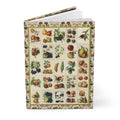
The mosaic plate that spans the cover of our journal presents the full abundance of the English orchard and kitchen garden in a single luminous composition. It is worth pausing over what it contains.
Pomes — apples and pears in multiple varieties, from the deep red of a Cox’s Orange Pippin to the pale gold of a Conference pear, each shown with its blossom. Stone fruits — peaches, plums, and cherries in their richest colours, the velvet skin of the peach rendered with particular care. Berries — strawberries, raspberries, gooseberries, and currants, the small fruits of the kitchen garden that Victorian cooks and preservers valued above all others. Vines — clusters of white and red grapes, a reminder that viticulture was a serious pursuit in Victorian England. And citrus — oranges, lemons, and their blossoms, the exotic fruits of the glasshouse that completed the Victorian ideal of horticultural abundance.
It is a portrait of a world in which the cultivation of fruit was both a science and an art — and in which the illustration of fruit was held to the same standard.
The Legacy
The Fruit Grower’s Guide remained a standard reference for English horticulture well into the twentieth century. Its plates — Miss May Rivers’ chromolithographs — were reproduced, copied, and admired long after the original publication had passed out of print. Today, individual plates appear regularly at auction and in specialist print dealers, valued both for their scientific interest and their extraordinary visual quality.
Miss May Rivers herself remains almost entirely unknown. No biography, no portrait, no archive. Only the plates — signed with her name, preserved across more than a century, still as vivid and precise as the day they were printed.
—

The chromolithographs of Miss May Rivers appear on the cover of our Fruit Grower’s Guide Journal — John Wright 1891, a hardcover journal with 128 pages, casewrap sewn binding, and matte laminated full-wrap cover.
References
- Wright, John. The Fruit Grower’s Guide. London, 1891–1894. Illustrated by Miss May Rivers.
- Blunt, Wilfrid, and William T. Stearn. The Art of Botanical Illustration. Antique Collectors’ Club, 1994.
- Lack, H. Walter. Garden Eden: Masterpieces of Botanical Illustration. Taschen, 2008.
- Shteir, Ann B. Cultivating Women, Cultivating Science: Flora’s Daughters and Botany in England, 1760–1860. Johns Hopkins University Press, 1996.