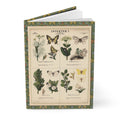
The Art of Teaching Nature: Max Richter's 1939 Swedish Butterfly Charts
How a set of school posters became enduring masterpieces of scientific illustration
In the late 1930s, Swedish classrooms were decorated with large, vivid charts depicting the natural world in extraordinary detail. These were not mere decorations — they were precision instruments of education, designed to bring the complexity of nature within reach of young minds. Among the most celebrated were the Insekter series, illustrated by Max Richter and published by Norstedts in Stockholm in 1939. Decades later, they remain some of the finest examples of scientific illustration ever produced for pedagogical purposes.

The Skolplansch Tradition
The Swedish skolplansch — literally "school chart" — emerged in the nineteenth century as a response to the growing belief that visual learning was essential to scientific education. Inspired by the natural history traditions of Linnaeus, Swedish educators developed a rich culture of illustrated teaching materials that combined artistic ambition with scientific rigor.
By the interwar period, the skolplansch had reached its artistic peak. Publishers like Norstedts, one of Sweden's oldest and most prestigious houses, commissioned skilled illustrators to produce charts that could hold a student's attention while conveying accurate biological information. The results were remarkable: images that functioned simultaneously as scientific documents and works of art.
Max Richter and the Insekter Plates
Little is widely documented about Max Richter as a biographical figure, which is not unusual for illustrators of his era — scientific artists were often overshadowed by the institutions that published their work. What survives, however, speaks clearly: his Insekter I and Insekter II plates are masterworks of entomological illustration.
The Insekter I — Fjärilar (Butterflies) plate documents several of Sweden's most iconic Lepidoptera, including:
- Papilio machaon — the Swallowtail, Sweden's largest butterfly
- Parnassius apollo — the Apollo, a high-altitude species of striking beauty
- Pieris brassicae — the Large White, familiar across European gardens
- Gonepteryx rhamni — the Brimstone, one of the first butterflies to emerge each spring
The Insekter II — Dagfjärilar plate extends this documentation to include Vanessa antiopa — the Mourning Cloak — among others, tracing life cycles from egg to adult with a clarity that remains impressive by contemporary standards.
What distinguished Richter's work was his ability to render metamorphosis — one of nature's most complex processes — in a single, readable image. Each plate shows multiple life stages simultaneously, inviting the viewer to understand not just what a butterfly looks like, but how it comes to be.
Scientific Illustration as Cultural Heritage
The Insekter charts belong to a broader tradition of European natural history illustration that includes the botanical watercolors of Georg Dionysius Ehret, the ornithological plates of John James Audubon, and the marine studies of Ernst Haeckel. What unites these works across centuries is a shared conviction: that the natural world, rendered with precision and care, is inherently beautiful.
In Sweden, this tradition had particular resonance. The legacy of Carl Linnaeus — who systematized the classification of living things in the eighteenth century — gave Swedish natural history a special cultural weight. To illustrate Swedish insects was, in some sense, to participate in a national scientific tradition stretching back nearly two centuries.
By 1939, that tradition was also under pressure. The Second World War would soon disrupt European cultural and scientific life profoundly. The Insekter plates, published on the eve of that disruption, carry with them something of a last flourish — a moment when the ambition to educate through beauty still felt entirely possible.
A Living Document
Today, Richter's charts are sought by collectors of vintage scientific illustration, natural history enthusiasts, and anyone drawn to the intersection of art and science. They appear in museum collections, antique markets, and — increasingly — in the hands of people who simply find them beautiful and want to live with them.
There is something quietly radical about that. An image made to teach Swedish schoolchildren about butterflies in 1939 continues, nearly ninety years later, to make people stop and look.

If the world of Richter's butterflies resonates with you, the Swedish Butterfly Journal brings the Insekter I & II plates to a hardcover journal — 150 perforated lined pages, ready for field notes, observations, or whatever your days require.
References
- Norstedts Förlag, Stockholm. Insekter I: Fjärilar and Insekter II: Dagfjärilar, illustrated by Max Richter, 1939.
- Wahlberg, N. et al. "Nymphalid butterflies diversify following near demise at the Cretaceous/Tertiary boundary." Proceedings of the Royal Society B, 2009.
- Linnaeus, C. Systema Naturae. 1st ed., 1735.
- Blunt, W. & Stearn, W.T. The Art of Botanical Illustration. Antique Collectors' Club, 1994.