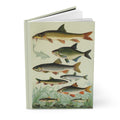
Cyprinids and Salmonids: The Golden Age of European Freshwater Fish Illustration, 1902–1913
In the first decade of the twentieth century, European naturalists faced a practical problem that had preoccupied ichthyologists since the Renaissance: how to teach ordinary people — anglers, students, rural physicians, schoolteachers — to distinguish one freshwater fish from another. The solution, refined over two centuries of natural history publishing, was the identification plate: a single lithographic sheet showing several species side by side, rendered with enough anatomical precision to allow comparison in the field.

By 1900, chromolithography had made these plates affordable, reproducible, and strikingly beautiful. Two publications from this period stand as particularly fine examples of the genre — and together, they form the covers of our Freshwater Fish Journal.
Emil Walter and Unsere Süßwasserfische (1913)
Emil Walter's Unsere Süßwasserfische — "Our Freshwater Fish" — was published in Stuttgart in 1913 as a practical guide to the freshwater species of Central Europe. Walter was working in a well-established tradition of German popular natural history: accessible in language, rigorous in taxonomy, and illustrated with the chromolithographic plates that had become the standard of the genre since the mid-nineteenth century.
The front cover of our journal reproduces one of Walter's identification plates, presenting five species from the family Cyprinidae — the largest family of freshwater fish in Europe, comprising carp, roach, bream, and their relatives. The plate shows:
- Bream (Abramis brama): the deep-bodied, laterally compressed fish of slow rivers and lakes, recognisable by its bronze flanks and arched back
- Bleak (Alburnus alburnus): slender and silvery, a surface-feeding species whose scales were once harvested to make artificial pearls
- Rudd (Scardinius erythrophthalmus): golden-scaled, with the distinctive red fins that give it its Latin name — erythrophthalmus, red-eyed
- Roach (Rutilus rutilus): one of the most common fish in European rivers, robust and adaptable, the quarry of generations of coarse anglers
- Ide (Leuciscus idus): a larger cyprinid of northern and eastern European rivers, prized both as a sport fish and, in its ornamental golden form, as a pond fish
Walter's plates combine the scientific accuracy required for field identification with the chromolithographic richness that made natural history books of this period genuinely beautiful objects. The cyprinids are rendered not as specimens pinned to a board, but as living fish — their scales catching light, their fins extended, their bodies in the postures of movement.
Our Country's Fishes and How to Know Them (1902)
The back cover draws from a different tradition: British popular ichthyology. Our Country's Fishes and How to Know Them was published in London in 1902, at the height of the Edwardian enthusiasm for field guides and natural history manuals aimed at the educated general reader. Where Walter's work was systematic and Central European in focus, this publication was oriented toward the rivers and lakes of Britain and Ireland — and toward the salmonids that had defined British angling culture since Izaak Walton.
The plate reproduced on the back cover presents the principal salmonid species of British waters:
- Brown Trout (Salmo trutta): shown with the dark and reddish spotting pattern that distinguishes it from the sea trout form of the same species — a distinction that puzzled naturalists for decades
- Atlantic Salmon (Salmo salar): depicted in multiple life stages, reflecting the complex migratory biology of a fish that moves between freshwater rivers and the open Atlantic
- Char (Salvelinus): including Dolly Varden (Salvelinus malma) and Windermere Char (Salvelinus willughbii), with the brilliant orange-red underbellies that make char among the most visually striking of European freshwater fish
The salmonids had a particular cultural resonance in Edwardian Britain. Fly fishing for trout and salmon was not merely a sport but a social institution, and the literature of angling — from Walton's Compleat Angler (1653) to the Victorian and Edwardian manuals that followed — formed one of the richest traditions in English natural history writing. A publication like Our Country's Fishes belonged to this tradition: scientifically grounded, but written for readers who fished as well as studied.
The Identification Plate as Art
What strikes the modern viewer about both of these publications is how completely the scientific and the aesthetic are fused. The chromolithographic process — which built up colour through multiple successive printings, each adding a layer of ink — allowed illustrators to achieve a richness and subtlety of colour that earlier engraving techniques could not match. The result was plates that functioned simultaneously as scientific documents and as works of art: precise enough to identify a species in the field, beautiful enough to frame on a wall.
This dual character — scientific instrument and aesthetic object — is what has given the natural history identification plate its enduring appeal. A century after Walter and the anonymous illustrators of Our Country's Fishes completed their work, these plates continue to be reproduced, collected, and admired — not only by ichthyologists and anglers, but by anyone drawn to the particular beauty of the natural world rendered with patient, exacting attention.

The lithographic plates from Emil Walter's Unsere Süßwasserfische (1913) and Our Country's Fishes and How to Know Them (1902) appear on the cover of our Freshwater Fish Journal, a hardcover lined journal with a hardcover journal — 128 pages, available in lined, dotted, and blank — ready for notes, sketches, or whatever your days require.
References
- Walter, Emil. Unsere Süßwasserfische. Stuttgart, 1913.
- Anon. Our Country's Fishes and How to Know Them. London, 1902.
- Kottelat, Maurice, and Jörg Freyhof. Handbook of European Freshwater Fishes. Publications Kottelat, 2007.
- Walton, Izaak. The Compleat Angler. London, 1653.
- Wheeler, Alwyne. The Fishes of the British Isles and North-West Europe. Macmillan, 1969.