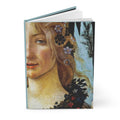
The 500 Species of La Primavera: Botticelli's Secret Botanical Garden
When Sandro Botticelli completed La Primavera sometime between 1477 and 1482, he did something no painter before him had attempted on such a scale: he turned a mythological allegory into a botanical document of extraordinary precision. Hidden within the meadow, the figures' garments, and the orange grove behind them are more than 500 plant species and nearly 200 individual flowers — each one identifiable, each one placed with deliberate intent.

A Painting as a Field Guide
The systematic botanical analysis of La Primavera began in earnest in the 20th century, when researchers started cross-referencing the flowers and plants depicted in the painting with the flora of the Tuscan countryside and the botanical knowledge available to a Florentine artist of the 1470s. The results were astonishing.
Botanist Mirella Levi d'Ancona, in her landmark 1983 study Botticelli's Primavera: A Botanical Interpretation Including Astrology, Alchemy and the Medici, identified 190 different plant species in the painting, representing 138 genera. Subsequent researchers have pushed the count higher, with some estimates reaching over 500 individual plants when the full meadow and background are included. Every species is rendered with sufficient accuracy to be identified — not as decorative convention, but as precise botanical portraiture.
The Meadow Beneath the Figures
The ground on which the mythological figures stand is not a generic green carpet. It is a specific, identifiable meadow — one that corresponds closely to the spring flora of the hills around Florence, particularly the meadows of the Mugello valley north of the city, where the Medici had their country estates.
Among the species documented in the meadow are cornflowers (Centaurea cyanus), daisies (Bellis perennis), plantain (Plantago lanceolata), clover (Trifolium spp.), dandelions (Taraxacum officinale), and wild strawberries (Fragaria vesca) — the same plants a Florentine nobleman would have walked through on a spring morning in the 1470s. The painting is, among other things, a portrait of a specific season in a specific landscape.
Flora's Dress: A Garden in Tempera
The most botanically dense area of the painting is the dress and crown of Flora, the goddess of flowers who scatters roses from her gathered skirt. Botticelli embroidered her white gown with dozens of identifiable species, each rendered in the fine detail that tempera on panel allows.
Researchers have identified in Flora's dress and crown: roses (Rosa spp., multiple varieties), cornflowers, pinks (Dianthus spp.), anemones (Anemone coronaria), violets (Viola spp.), periwinkle (Vinca minor), and myrtle (Myrtus communis) — the plant sacred to Venus and a recurring symbol throughout the painting. The roses she scatters are identifiable as Rosa canina, the dog rose, and Rosa gallica, the French rose, both common in Tuscany and both carrying specific symbolic weight in the Neoplatonic iconography of the Medici circle.
The Orange Grove: Sacred and Symbolic
Behind the figures stands a dense grove of orange trees (Citrus sinensis), their fruit glowing gold against the dark background. The oranges are not merely decorative: they are a direct reference to the Medici family, whose heraldic symbol — the palle, or balls — was visually associated with oranges in Florentine popular culture. The grove is, in effect, a Medici garden, placing the mythological scene within the family's symbolic domain.
The orange trees are rendered with botanical accuracy: the leaves, the fruit, and the blossoms are all correctly depicted, and the trees correspond to the sweet orange variety that had been introduced to Italy from the Arab world in the preceding century and was cultivated in the gardens of wealthy Florentines as a luxury plant.
Why Such Precision?
The question that has fascinated art historians and botanists alike is: why? Why would Botticelli — working within a tradition of idealized mythological painting — invest such extraordinary effort in botanical accuracy?
Several explanations have been proposed. The Medici circle, under the influence of the philosopher Marsilio Ficino, believed in the Neoplatonic doctrine that the natural world was a reflection of divine order — that to study a flower with precision was to approach an understanding of the divine mind that created it. Botanical accuracy was, in this framework, not a distraction from the painting's philosophical meaning but an expression of it.
A second explanation is more practical: Botticelli had access to the extraordinary botanical resources of the Medici, including their gardens, their collections of illustrated herbals, and the network of scholars and naturalists who passed through Florence. The painting may reflect, in part, the botanical knowledge that was being assembled and systematized in Florence in the 1470s — a visual encyclopedia of spring flora at a moment when the Renaissance was beginning to transform the study of the natural world.
A Living Allegory
What makes La Primavera endlessly fascinating is that its botanical precision and its mythological allegory are not in tension — they reinforce each other. The 500 species are not background detail; they are the argument. Spring is not merely represented by Flora and Zephyrus and the dancing Graces: it is present, species by species, in the meadow beneath their feet and the flowers in their hair.
To look closely at La Primavera is to discover that Botticelli painted not one picture but hundreds — a mythological allegory on the surface, and beneath it, a field guide to the Tuscan spring.
If the botanical world of La Primavera inspires you, our La Primavera Journal — Botticelli 1477–1482 brings Flora and the spring allegory to the cover of a hardcover journal, ready to accompany your own observations of the natural world.
References
- Levi d'Ancona, M. Botticelli's Primavera: A Botanical Interpretation Including Astrology, Alchemy and the Medici. Olschki, 1983.
- Dempsey, C. The Portrayal of Love: Botticelli's Primavera and Humanist Culture at the Time of Lorenzo the Magnificent. Princeton University Press, 1992.
- Lightbown, R. Sandro Botticelli: Life and Work. Thames and Hudson, 1989.
- Acidini Luchinat, C. (ed.) The Medici, Michelangelo, and the Art of Late Renaissance Florence. Yale University Press, 2002.