Tanigami Kōnan and the Seiyō Sōka Zufu: Western Flowers Through Japanese Eyes
In 1917, a Kyoto artist named Tanigami Kōnan completed one of the most quietly extraordinary botanical works of the twentieth century. Published by Unsōdō — the legendary Kyoto woodblock printing house — in five volumes across that single year, Seiyō Sōka Zufu (西洋草花図譜, “Album of Western Plants and Flowers”) brought 125 plates of Western flowers to life through the evolved technique of Japanese woodblock printing. It was, in the truest sense, a work of artistic encounter: the flowers of Europe and the Americas, seen through the eyes of a master of kachō-e.

The Artist
Tanigami Kōnan (1879–1928) was born into the artistic world of the Kyoto-Osaka region at a moment of profound cultural transformation. The Meiji era (1868–1912) had opened Japan to Western influence with extraordinary speed, and the arts were not immune. Western painting techniques, botanical illustration traditions, and new chromatic possibilities entered Japan alongside railways, telegraphs, and constitutional government.
Kōnan trained in the kachō-e tradition — the Japanese genre of flower-and-bird painting that had been central to both the Rinpa school and the ukiyo-e woodblock tradition since the seventeenth century. Masters like Ogata Kōrin, Sakai Hōitsu, and Hiroshige had established a visual language for depicting the natural world that prized asymmetric composition, negative space, and the suggestion of movement over botanical exactitude. Kōnan inherited this language and applied it to a new subject: the flowers of the West.
The Flowers
The choice of subjects for Seiyō Sōka Zufu was itself a statement. Cyclamen, tulips, roses, dahlias, pansies, fuchsias, petunias, nasturtiums, daffodils, poppies, aquilegias, irises — these were flowers that had arrived in Japan relatively recently, carried by trade and diplomacy, cultivated in the gardens of the new Meiji elite, and admired as symbols of the modern and the foreign.
Kōnan did not attempt to render them in the manner of a European botanical illustrator. There is no Linnaean precision here, no dissected stamens or labelled parts. Instead, each plate is a composition — a considered arrangement of bloom, stem, and leaf within the picture plane, governed by the same principles of balance and asymmetry that had guided Japanese painters for centuries. A cyclamen leans into empty space. A tulip is cropped at the edge of the frame. A rose is shown from an angle that no European botanical artist would have chosen, because it is the angle that makes the most beautiful picture.
The result is a series of images that are simultaneously accurate and transformed — recognisably Western flowers, but seen through a sensibility so different from the European botanical tradition that they become something new.
The Technique
The woodblock printing technique used for Seiyō Sōka Zufu was the evolved nishiki-e (brocade picture) method that had been developed in the eighteenth century and refined over the following 150 years. Each colour required a separate carved block; a single plate might require a dozen or more. The registration of these blocks — the kento system of notches that ensured each colour fell precisely in the right place — demanded extraordinary skill from both the carver and the printer.
Unsōdō, the Kyoto publishing house that produced the work, had been founded in 1891 and had established itself as one of the leading producers of fine art woodblock books in Japan. It remains active today, more than 130 years after its founding — a remarkable continuity in an industry that has seen most of its competitors disappear. The quality of the printing in Seiyō Sōka Zufu reflects Unsōdō's standards: the colours are rich and precisely registered, the gradations of tone achieved through the bokashi technique of graduated inking are subtle and controlled.
The Taishō Context
The work was published in 1917 — the sixth year of the Taishō era (1912–1926), a period often described as Japan's first experiment with liberal democracy and cosmopolitan culture. The Taishō era saw the rise of a new urban middle class, the expansion of mass media, and a cultural openness to Western ideas that went further than the Meiji modernisation had allowed. It was a moment when a Japanese artist could choose to paint Western flowers not as an act of imitation but as an act of creative synthesis — bringing the flowers of one world into the visual language of another.
Kōnan died in 1928, at the age of forty-nine, just two years into the Shōwa era. He left behind a body of work that has been relatively little studied outside Japan, but Seiyō Sōka Zufu has endured as one of the most beautiful examples of the late ukiyo-e tradition — a work that demonstrates what Japanese woodblock printing could achieve when turned toward a new subject with full artistic seriousness.
A Legacy in Print
The 125 plates of Seiyō Sōka Zufu are now in the public domain, and their extraordinary quality has made them among the most admired botanical woodblock prints of the twentieth century. Each image rewards close attention: the precision of the carving, the richness of the colour, the compositional intelligence that makes every plate a complete and satisfying picture.
To live with these images through the months of a year is to experience something of what Kōnan's contemporaries must have felt when they first opened these volumes in 1917 — the pleasure of seeing familiar flowers made strange and beautiful by an artistic tradition they had never imagined could be applied to them.
References: Unsōdō. Seiyō Sōka Zufu. Kyoto: Unsōdō, 1917. — Screech, T. The Shogun's Painted Culture: Fear and Creativity in the Japanese States, 1760–1829. London: Reaktion Books, 2000. — Keyes, R. The Art of Surimono. Portland Art Museum, 1983.
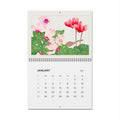
The twelve most celebrated plates from Seiyō Sōka Zufu are gathered in the 2026 Botanical Wall Calendar — one woodblock print for each month of the year, from Aquilegia in January to Iris in December.