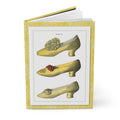
Three Yellow Satin Shoes: T. Watson Greig and the Ladies' Dress Shoes of the Nineteenth Century
In the closing years of the nineteenth century, Captain Thomas Watson Greig of Glencarse looked at his collection of antique ladies' dress shoes and saw something that most collectors prefer not to see: they were crumbling. The satin was fraying, the embroidery unravelling, the delicate heels softening with age. The shoes had survived the decades since their making, but they would not survive indefinitely, and Greig — antiquarian, member of Scottish historical societies, and a man of considerable practical determination — decided to do something about it. In 1900, he commissioned sixty-three hand-coloured aquatint plates, rendered with gold and silver inks to capture the sheen of satin and the glint of metallic embellishment, and published them as Ladies' Dress Shoes of the Nineteenth Century — one of the most refined and unusual documents of Victorian women's fashion ever produced. Plate VI, which shows three yellow satin shoes of the late nineteenth century, is among the most beautiful images in the publication: a record of a moment in the history of women's footwear when the toe was just beginning its transition from square to pointed, when the rosette and the silk bow competed for decorative supremacy, and when a shoe worn on stage by Miss Ada Cavendish could be considered worthy of preservation alongside the finest examples of the collector's art.
Captain Thomas Watson Greig of Glencarse: Antiquarian and Preservationist
Thomas Watson Greig was born in 1837 and died in 1912 — a life that spanned the whole of the Victorian era and extended into the Edwardian period that succeeded it. He was a man of the Scottish landed gentry, associated with Glencarse in Perthshire, and a member of the kind of historical and antiquarian societies that flourished in Victorian Britain: organisations dedicated to the preservation and study of the material culture of the past, from medieval manuscripts to Renaissance furniture to the decorative arts of more recent centuries. His collection of antique ladies' dress shoes was, by any standard, an unusual specialisation — but it was one that reflected both the breadth of Victorian collecting culture and the particular sensitivity to the fragility of material objects that characterised the best antiquarian minds of his generation.
The decision to commission the aquatint plates was not merely a practical response to the deterioration of his collection; it was an act of scholarship, a recognition that the shoes he had gathered were documents of social and cultural history as well as objects of aesthetic interest. The sixty-three plates that resulted from his commission are not simply illustrations of shoes; they are records of the decorative vocabulary of Victorian women's fashion — the materials, the techniques, the ornamental conventions that defined what a lady's dress shoe could and should look like in the decades between 1800 and 1900. As a body of work, they constitute one of the most detailed and reliable visual records of Victorian women's footwear in existence.
The Aquatint Technique: Capturing Satin and Silver
The choice of aquatint as the medium for the plates was not accidental. Aquatint — a printmaking technique that uses acid to bite a resin-coated copper plate, producing areas of tone rather than line — was particularly well suited to the representation of the soft, lustrous surfaces of satin and silk that characterised the shoes in Greig's collection. Unlike engraving, which produces sharp, precise lines, aquatint produces the kind of soft, graduated tones that can suggest the way light falls across a curved surface of fabric — the subtle variations of shade that distinguish the highlight from the shadow on a yellow satin shoe.
The hand colouring that was applied to the aquatint base added another layer of fidelity to the original objects: the colours of the shoes — the luminous yellows, the crimsons, the soft straw tones — were applied by hand, one impression at a time, by skilled colourists working from the original objects or from detailed colour notes. And the gold and silver inks that were used to represent the metallic embellishments — the silver braid, the gilt buckles, the mother-of-pearl centres of the rosettes — gave the plates a quality of material richness that no purely photographic reproduction could have achieved. The result was a set of images that were, in their own way, as much works of art as the objects they recorded.
Plate VI: Three Yellow Satin Shoes
Plate VI presents three distinct styles of late nineteenth-century ladies' dress shoes, all in yellow satin — a colour that was fashionable for evening and theatrical wear in the 1880s and 1890s, associated with the kind of elaborate, carefully considered dress that characterised the social and theatrical life of the late Victorian period. The three shoes document, with remarkable precision, the range of decorative possibilities available to the shoemaker and the wearer at the close of the Victorian era.
The first shoe — the one that carries the most remarkable provenance — reportedly worn on stage by Miss Ada Cavendish, one of the most celebrated English actresses of the Victorian era. It features a notably square toe — a shape that was beginning to give way to the pointed toe that would dominate Edwardian fashion — and a round rosette of satin and silver braid with a mother-of-pearl centre. The rosette is the kind of ornament that appears frequently in the fashion plates of the 1880s: elaborate, carefully constructed, and designed to catch the light of the gas lamps that illuminated the Victorian stage. The second shoe displays a pointed toe — already anticipating the Edwardian silhouette — adorned with silk embroidery, orange-tinted cabochons, and a crimson silk bow: a more overtly decorative approach, in which the embellishment is distributed across the surface of the shoe rather than concentrated in a single ornament. The third, in a softer straw colour, carries a more restrained ribbon embellishment — a reminder that even within the conventions of Victorian evening dress, there was room for restraint and simplicity.
Miss Ada Cavendish and the Victorian Stage
Ada Cavendish (1839–1895) was one of the most admired English actresses of the Victorian era — a performer whose career spanned the 1860s, 1870s, and 1880s, and who was particularly celebrated for her performances in the plays of Wilkie Collins and in the melodramas that were the dominant theatrical form of the period. She was known for the elegance of her stage presence and the care she took with her costumes and accessories — qualities that made her, in the eyes of her contemporaries, a model of theatrical style as well as theatrical talent.
The presence of one of her stage shoes in Greig's collection is a reminder of the way in which the Victorian theatre and the Victorian collecting world intersected: the stage was a space in which fashion was displayed and celebrated, and the objects associated with celebrated performers — their costumes, their accessories, their personal effects — were valued as relics of a kind of secular celebrity. A shoe worn by Ada Cavendish on the Victorian stage was not merely a shoe; it was a document of a performance, a fragment of a theatrical world that was already, by 1900, beginning to recede into history.
A Journal for Fashion Historians and Theatre Lovers

Our Victorian Shoes Journal carries Plate VI from Greig's Ladies' Dress Shoes of the Nineteenth Century across its full wraparound cover — the three yellow satin shoes on the front, the same composition in mirror image on the back, restored by LeBonJournal from the Artvee archive with a cleaned background, illuminated yellow tones, and a framed presentation that does justice to the refinement of the original aquatint.
Inside, 150 perforated lined pages await your fashion notes, theatre journals, research, or daily reflections. The casewrap sewn binding opens completely flat. The matte laminated cover preserves every detail of the hand-coloured aquatint in a finish that rewards close examination.
In 1900, Captain Greig looked at his crumbling collection and decided that some things were worth preserving. Perhaps the pages inside will help you do the same.
References & Further Reading
- Greig, Thomas Watson. Ladies' Dress Shoes of the Nineteenth Century. Privately printed, 1900. [The primary source: sixty-three hand-coloured aquatint plates with descriptive text, commissioned by Greig to preserve his collection.]
- Swann, June. Shoes. Batsford, 1982. [The standard reference for the history of European footwear, covering the Victorian and Edwardian periods in detail.]
- McDowell, Colin. Shoes: Fashion and Fantasy. Thames and Hudson, 1989. [On the cultural history of women's footwear, including the Victorian era and its decorative conventions.]
- de la Haye, Amy & Tobin, Shelley. Chanel: The Couturière at Work. V&A Publications, 1994. [On the transition from Victorian to modern women's fashion, including the role of footwear in defining the female silhouette.]
- Booth, Michael R. Victorian Spectacular Theatre, 1850–1910. Routledge, 1981. [On the Victorian stage and its relationship to fashion and celebrity, including the role of actresses like Ada Cavendish in defining theatrical style.]
- Storey, Neil R. Victorian Fashions for Women. Shire Publications, 2014. [A concise introduction to Victorian women's dress, covering the decorative conventions of the 1880s and 1890s.]
- Cumming, Valerie et al. The Dictionary of Fashion History. Berg, 2010. [The standard reference for the terminology and history of Western fashion, including footwear and accessories.]