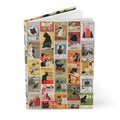
The Cat That Conquered Paris: Steinlen, Le Chat Noir, and the Art of the Belle Époque
Share
In the autumn of 1881, a man named Rodolphe Salis opened a small cabaret in Montmartre and named it after a black cat. He decorated it with medieval armour, stained glass, and the work of the artists who drank there. He charged extravagant prices and insulted his customers with aristocratic wit. He called himself a “gentleman-cabaretier” and his establishment “the most extraordinary cabaret in the world.”
He was not wrong.
Le Chat Noir and the Birth of the Modern Cabaret
Le Chat Noir was the first modern cabaret — the template for every nightclub, music venue, and artistic gathering place that has existed since. It was the place where Aristide Bruant performed his songs of Parisian street life, where shadow puppet theatre was invented, where the poets and painters of Montmartre gathered to drink, argue, and create. It ran from 1881 to 1897, and in those sixteen years it defined the cultural identity of the Belle Époque.
The black cat was its emblem from the beginning. Salis had found a stray black cat on the streets of Montmartre and adopted it as the mascot of his establishment. The cat appeared on the cabaret’s journal, on its posters, on its merchandise. It became, in the hands of the artists who worked there, one of the most potent symbols in the history of graphic art.
Steinlen and the Tournée du Chat Noir
Théophile-Alexandre Steinlen (1859–1923) was a Swiss-born artist who had come to Paris in 1881 — the same year that Le Chat Noir opened — and made Montmartre his home. He was a socialist, a printmaker, and one of the finest poster artists of his generation, and his relationship with the black cat was lifelong.
His 1896 Tournée du Chat Noir poster — created to advertise a touring production of the cabaret’s famous shadow puppet show — is one of the most celebrated works of Art Nouveau graphic design in history. The image is simple: a black cat, silhouetted against a golden ground, its eyes gleaming with an intelligence that seems to contain the entire mystery of Montmartre. It is a poster that has never stopped being reproduced, never stopped being recognised, never stopped being beautiful.
The Black Cat Crosses the Atlantic
The black cat did not stay in Paris. By the 1890s, it had crossed the Atlantic and established itself in American visual culture with the same ease that it had conquered Montmartre.
Nelly Littlehale Umbstaetter’s cover illustrations for The Black Cat Magazine (1895–1922) — the celebrated American short story publication that ran for 27 years — brought the black cat into the homes of middle-class American readers with a sophistication that owed everything to the Belle Époque tradition. Edward Penfield’s About Paris poster (1895) — one of the finest examples of American Art Nouveau design — placed the black cat in a Parisian context that was simultaneously a tribute to Steinlen and a distinctly American interpretation of French bohemian culture.
Together, Steinlen, Umbstaetter, and Penfield document the black cat as a transatlantic symbol: a creature that belonged simultaneously to the cabarets of Montmartre and the magazine stands of Boston, to the fin-de-siècle and the early 20th century, to Art Nouveau and to the popular imagination of an entire era.