The Mineral Kingdom: Henry Sowerby, Popular Mineralogy, and the Victorian Science of Crystals
In the middle decades of the 19th century, the natural world was being systematically catalogued. Geology had recently established itself as a serious scientific discipline — the publication of Charles Lyell’s Principles of Geology in 1830–33 had transformed the field, and the great fossil and mineral collections of the British Museum were drawing both scientists and curious members of the public. Into this moment, Henry Sowerby published Popular Mineralogy in 1850: a visual catalog of the mineral kingdom designed to make geological science accessible to the educated general reader.

The word “popular” in the title was deliberate. Sowerby was not writing for specialists alone. He was writing for the Victorian collector, the amateur naturalist, the reader who kept a cabinet of curiosities in the drawing room and wanted to understand what they were looking at. The book was part of a broader cultural phenomenon: the democratisation of natural history, the idea that science was not the exclusive property of universities and learned societies but something that could be pursued, with the right guides, by anyone with curiosity and a modest budget.
The Art of Geological Illustration
What distinguished Popular Mineralogy was not just its scientific content but its visual ambition. Sowerby came from a family with deep roots in natural history illustration — his father James Sowerby had produced the monumental English Botany and British Mineralogy, and the family name was synonymous with the highest standards of scientific engraving. Henry inherited both the tradition and the technical skill.
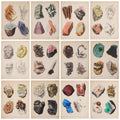
The plates in Popular Mineralogy are studies in the geometry of the natural world. Crystals present a particular challenge to the illustrator: their beauty is inseparable from their structure, from the precise angles at which their faces meet, the way light refracts through them, the relationship between their external form and their internal molecular arrangement. Sowerby’s lithographs capture this with a precision that photography, at that date, could not have achieved — colour reproduction was not yet possible, and the three-dimensional quality of a crystal specimen required the interpretive intelligence of a trained illustrator, not merely the mechanical recording of a lens.
The Victorian Mineral Cabinet
The collecting of minerals and gemstones was a serious pursuit in Victorian Britain. The Great Exhibition of 1851 — held the year after Popular Mineralogy was published — included extensive displays of geological specimens, and the natural history collections of the British Museum were reorganised and expanded throughout the mid-century. Minerals occupied a particular place in the Victorian imagination: they were beautiful, scientifically interesting, and morally unambiguous. Unlike the collecting of living specimens, which raised questions about the disruption of natural habitats, minerals simply were — ancient, stable, formed by processes that operated on geological timescales entirely beyond human intervention.
Sowerby’s catalog gave collectors the vocabulary to understand what they had. Rock crystal, amethyst, lapis lazuli, agate, chalcedony, garnet, heulandite, stilbite, zeolite — each plate was an identification tool, a visual key to the mineral kingdom that could be consulted alongside a specimen and used to name, classify, and contextualise it.
After Sowerby
The tradition of illustrated mineralogy that Sowerby represented did not survive the century intact. Photography transformed scientific illustration in the 1880s and 1890s, and the lavish hand-illustrated geological treatise became increasingly rare. What remained were the plates themselves — documents of a moment when scientific precision and aesthetic ambition were understood as complementary rather than competing values, when the illustration of a crystal was considered worthy of the same care and skill as the illustration of a flower or a bird.
Sowerby’s plates are not merely historical documents. They are, in the most direct sense, beautiful — and that beauty is inseparable from their scientific purpose. The geometry of a crystal is its identity; to render it accurately is to render it beautifully.
The 20 plates from Sowerby’s Popular Mineralogy are available as a digital download — 300 DPI, print-ready, public domain.
References
- Sowerby, Henry. Popular Mineralogy. Reeve & Benham, London, 1850.
- Lyell, Charles. Principles of Geology. John Murray, London, 1830–33.
- Secord, Anne. “Science in the Pub: Artisan Botanists in Early Nineteenth-Century Lancashire.” History of Science 32 (1994).
- Rudwick, Martin J.S. Bursting the Limits of Time: The Reconstruction of Geohistory in the Age of Revolution. University of Chicago Press, 2005.