The Moon Made Legible: Smith’s Illustrated Astronomy and the Victorian Science of Lunar Education
In the autumn of 1849, a schoolteacher named Asa Smith published a small illustrated volume in New York that would become one of the most widely used astronomical textbooks of the mid-19th century. Smith’s Illustrated Astronomy was not a work of original research — it made no new observations, proposed no new theories, discovered no new celestial bodies. What it did was something more immediately useful: it explained the solar system clearly, illustrated it beautifully, and made the mechanics of the heavens accessible to students and amateur astronomers who had no access to university lectures or expensive scientific instruments.
The moon was its central subject.
The Victorian Passion for Popular Science
The mid-19th century was the golden age of popular science. The industrial revolution had created a literate middle class with disposable income and intellectual ambition, and the publishing industry had responded with a flood of illustrated periodicals, educational manuals, and popular scientific works that brought the discoveries of professional science to a general audience. The Great Exhibition of 1851 — held in the Crystal Palace in Hyde Park — was the apotheosis of this moment: a celebration of scientific and industrial achievement that drew six million visitors in five months and demonstrated that science had become a central concern of Victorian culture.
Astronomy occupied a special place in this popular scientific culture. The night sky was accessible to everyone — no laboratory, no expensive equipment, no university training required. The moon, in particular, was an object of universal fascination: large enough to be observed with the naked eye, close enough to show surface detail through even a modest telescope, and governed by a cycle of phases that anyone could track from month to month. To understand the moon’s phases was to understand the solar system itself.
Smith’s Illustrated Astronomy and the Art of Scientific Education
Asa Smith’s genius was pedagogical rather than scientific. He understood that the great obstacle to astronomical education was not the complexity of the subject but the difficulty of visualizing it — of grasping, in the mind’s eye, the three-dimensional geometry of orbiting bodies that could only be observed from a single fixed point on Earth’s surface.
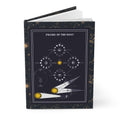
His solution was illustration. Smith’s Illustrated Astronomy was organized around a series of carefully designed diagrams that made the invisible geometry of the solar system visible. The lunar phase diagrams — showing the moon at eight positions in its orbit around Earth, with the illuminated portion of each position corresponding to the phase visible from Earth — were masterpieces of scientific pedagogy. They transformed an abstract geometrical relationship into an image that any student could grasp immediately.
The diagram of apogee and perigee — the moon’s farthest and closest points in its elliptical orbit — explained why the moon appears slightly larger at some times than others, a phenomenon that had puzzled casual observers for centuries. The telescopic view of the five-day-old moon — showing the cratered surface of the waxing crescent with the observational detail that 19th-century astronomy had achieved — gave students a sense of the moon as a physical world, not merely a light in the sky.
The Lunar Cycle and Its Mechanics
The moon’s phases are the most visible astronomical phenomenon in the night sky — a cycle of 29.5 days that has governed human timekeeping since prehistory. The new moon, when the moon is between Earth and Sun and its illuminated face is turned away from us; the waxing crescent, when a sliver of the illuminated face becomes visible; the first quarter, when half the face is lit; the waxing gibbous, as the illuminated portion grows; the full moon, when the entire face is illuminated; and then the waning sequence back to new moon — this cycle was the first calendar, the first clock, the first astronomical instrument.
What Smith’s diagrams made clear was the geometry underlying this cycle: the moon does not change shape, does not grow and shrink. It is always a sphere, always half-illuminated by the Sun. What changes is our angle of view — the proportion of the illuminated hemisphere that faces Earth at any given point in the lunar orbit. The phases are not a property of the moon but of our relationship to it.
The concepts of apogee and perigee — from the Greek apo (away from) and peri (near), combined with gaia (Earth) — describe the elliptical shape of the lunar orbit. The moon is not equidistant from Earth throughout its orbit; it swings between a closest approach of approximately 356,500 kilometers and a farthest distance of approximately 406,700 kilometers. At perigee, the full moon appears approximately 14% larger and 30% brighter than at apogee — the phenomenon now popularly known as the “supermoon,” though Victorian astronomers had no need for such marketing terminology.
The Legacy of Victorian Astronomical Education
Smith’s Illustrated Astronomy went through numerous editions and was used in American and British schools for decades. Its influence can be traced in the astronomical literacy of the Victorian educated public — the ability to explain the phases of the moon, to understand the geometry of eclipses, to read a celestial chart — that distinguished the mid-19th century from any previous era.
The engravings that illustrated Smith’s work belong to a tradition of scientific illustration that the digital age has not replaced but has made newly precious. There is something in the hand-engraved diagram — the careful hatching that suggests the shadow on the lunar surface, the precise geometry of the orbital diagram, the delicate rendering of the telescopic view — that no digital graphic quite replicates. These images were made by human hands, for human eyes, to explain a universe that Victorian science was only beginning to understand.

Our Lunar Journal carries the lunar phase diagrams from Smith’s Illustrated Astronomy — the complete cycle from new moon to full moon, apogee and perigee, and the telescopic view of the five-day-old moon, preserved in a journal you can carry under any sky. References
- Smith, Asa. Smith’s Illustrated Astronomy. Cady & Burgess, New York, 1849.
- Clerke, Agnes M. A Popular History of Astronomy During the Nineteenth Century. Adam & Charles Black, 1893.
- Crowe, Michael J. Modern Theories of the Universe from Herschel to Hubble. Dover, 1994.
- Lankford, John, ed. History of Astronomy: An Encyclopedia. Garland, 1997.