Simonetta Vespucci: The Beauty That Inspired Botticelli
She died at twenty-two, and Botticelli never forgot her. Simonetta Vespucci — born Simonetta Cattaneo in Genoa around 1453, married at fifteen to Marco Vespucci of Florence, dead of tuberculosis in April 1476 — lived a life so brief that its historical record barely fills a page. Yet her face, as Botticelli imagined it, has endured for five centuries: in the Primavera, in the Birth of Venus, in the portrait now in the Gemäldegalerie in Frankfurt, in the Portrait of a Young Woman in the Palatine Gallery in Florence. She is the most painted woman of the Florentine Renaissance, and she was dead before Botticelli painted any of the works for which she is remembered.
The Most Beautiful Woman in Florence
Simonetta arrived in Florence in 1469, when she married Marco Vespucci and entered the social world of the city at the height of its Golden Age. Florence in the 1470s was the most culturally brilliant city in Europe: Lorenzo de' Medici — il Magnifico — had consolidated his family's political dominance and was using the vast Medici fortune to patronize an extraordinary concentration of artistic and intellectual talent. The Platonic Academy, presided over by Marsilio Ficino, was developing the Neoplatonic philosophy that would shape the intellectual life of the Renaissance for a generation. Botticelli, Ghirlandaio, Verrocchio, and the young Leonardo da Vinci were all working in Florence. It was into this world that Simonetta Vespucci arrived, and she captivated it almost immediately.
Contemporary accounts describe her beauty in terms that suggest something beyond the merely physical — a quality of grace and presence that made her the acknowledged queen of Florentine society within months of her arrival. Angelo Poliziano, the poet and humanist who was the closest intellectual companion of Lorenzo de' Medici, celebrated her in verse. Lorenzo himself wrote sonnets in her honor. And Giuliano de' Medici, Lorenzo's younger brother — handsome, athletic, the most celebrated jouster in Florence — fell publicly and passionately in love with her, wearing her colors at the great tournament of 1475 and commissioning a standard bearing her image as Pallas Athena from Botticelli himself.
The Tournament of 1475
The tournament of January 1475 — the Giostra di Giuliano — was one of the great public spectacles of Medici Florence, organized to celebrate the alliance between Florence and Venice and to display the magnificence of the Medici family to the city and to the world. Giuliano de' Medici rode as the champion, and Simonetta Vespucci was his declared donna — the lady in whose honor he competed. The standard that Botticelli painted for the occasion depicted Simonetta as Pallas Athena, goddess of wisdom and beauty, standing in a field of flowers with a shield bearing the Medici device. It was, as far as we know, the first time Botticelli painted her face — and it established the visual language of idealized feminine beauty that he would develop, in the years after her death, into the Venus of the Birth of Venus and the Primavera.
The love of Giuliano for Simonetta was celebrated in verse and song across Florence, but it was almost certainly a courtly love in the Neoplatonic sense — an idealized devotion that expressed itself in public homage rather than private intimacy. Simonetta was a married woman, and the conventions of Florentine society, however permissive in some respects, maintained the forms of propriety. What is certain is that Giuliano's devotion was genuine and public, and that Simonetta's death, fourteen months after the tournament, was mourned by him with a grief that contemporaries found moving and sincere.
Death and Transfiguration
Simonetta Vespucci died on 26 April 1476, of what contemporaries described as a "chest illness" — almost certainly tuberculosis, the disease that killed so many young people in Renaissance Italy. She was twenty-two years old. Lorenzo de' Medici wrote a sonnet mourning her death. Giuliano de' Medici, who would himself be murdered in the Pazzi Conspiracy two years later, is said to have wept publicly at her funeral. And Botticelli, who had painted her face only once in her lifetime, began the process of transforming her into something more than a woman — into an ideal, a symbol, a goddess.
The chronology of Botticelli's great mythological paintings is uncertain, but most scholars believe that the Primavera was painted around 1477–78, shortly after Simonetta's death, and the Birth of Venus between 1484 and 1486, nearly a decade later. Both were commissioned by members of the Medici family — the Primavera almost certainly for Lorenzo di Pierfrancesco de' Medici, a cousin of il Magnifico — and both feature a central female figure whose face, with its distinctive features, flowing golden hair, and expression of serene, otherworldly beauty, is recognizably the same as the face in the portraits that Botticelli painted of Simonetta during her lifetime and in the years immediately after her death.
Venus as Neoplatonic Ideal
The choice of Venus as the subject of Botticelli's most celebrated painting was not merely aesthetic — it was philosophical. The Neoplatonic Academy of Marsilio Ficino had developed a complex theology of beauty in which Venus occupied a central position: not the Venus of carnal desire, but the Venus Coelestis — Heavenly Venus — who represented the divine beauty that, properly contemplated, led the mind upward toward God. In Ficino's system, the contemplation of physical beauty was the first step on a ladder of ascent that culminated in the direct apprehension of divine truth — a Christianized version of the Platonic eros that made the love of beauty a form of spiritual practice.
To paint Simonetta as Venus, therefore, was to make a philosophical claim about her: that her beauty was not merely physical but a manifestation of divine harmony, a visible expression of the Neoplatonic ideal that Ficino and his circle had made the intellectual foundation of Medici Florence. Botticelli's Venus — emerging from the sea on her scallop shell, her golden hair blown by Zephyr's breath, her expression serene and inward — is not a portrait of a woman but an image of an idea: the idea that beauty, at its highest, is a form of truth.
The Eternal Muse
Botticelli is said to have requested, at his death in 1510, to be buried at the feet of Simonetta Vespucci in the church of Ognissanti in Florence. Whether the request was granted is uncertain — the records are incomplete — but the story, true or not, captures something essential about the relationship between the painter and his muse: a devotion that outlasted her life by thirty-four years, and that expressed itself not in words but in the repeated, obsessive, loving recreation of her face in paint.
She died at twenty-two. He painted her for the rest of his life. And the face he gave to Venus — serene, golden, emerging from the sea into a world of spring and roses — has endured for five centuries as one of the most beautiful images in the history of art.
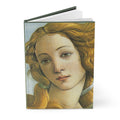
If Simonetta's story and Botticelli's vision of beauty inspire you, our Birth of Venus Journal — Botticelli 1484 Uffizi Renaissance brings the central figure of Venus — Simonetta immortalized — to the cover of a hardcover journal.
References
- Lightbown, R. Sandro Botticelli: Life and Work. Thames and Hudson, 1978.
- Poliziano, A. Stanze per la giostra di Giuliano de' Medici. Florence, c. 1478.
- Ficino, M. De Amore: Commentary on Plato's Symposium on Love. Trans. Sears Jayne. Spring Publications, 1985.
- Hale, J. R. Florence and the Medici: The Pattern of Control. Thames and Hudson, 1977.
- Zöllner, F. Sandro Botticelli. Prestel, 2005.