Shells, Scales, and Watercolour: Kenelm Henry Digby and the Art of Regency Natural History Illustration
In the early decades of the nineteenth century, before photography, before chromolithography, before any mechanical means of reproducing the natural world in colour, the watercolour manuscript occupied a unique position in the history of science. It was at once a scientific document and a work of art — a record of observation rendered with a brush and pigment by a hand trained to see with both precision and sensitivity.
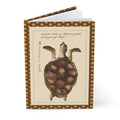
Among the most remarkable of these manuscripts is The Naturalists Companion, compiled by Kenelm Henry Digby between approximately 1810 and 1819. A work of extraordinary ambition and delicacy, it documents the natural world — quadrupeds, birds, fishes, serpents, and reptiles — through watercolour illustrations that combine the scientific rigour of the Linnaean tradition with the artistic sensibility of the Regency period. Its pages on sea and land tortoises are among its finest achievements.
The Tradition of the Natural History Manuscript
The illustrated natural history manuscript has a history stretching back to the medieval herbals and bestiaries of the thirteenth and fourteenth centuries. But it was in the seventeenth and eighteenth centuries, with the systematic expansion of European knowledge of the natural world through exploration and collection, that the genre reached its fullest flowering.
The great cabinets of curiosity — the Wunderkammern of the German princes, the collections of the Royal Society in London, the vast assemblages of Albertus Seba in Amsterdam — generated an insatiable demand for accurate visual documentation. Seba's Locupletissimi Rerum Naturalium Thesauri (1734–1765), with its engraved plates of shells, reptiles, and exotic fauna, established a standard of encyclopaedic natural history illustration that would influence practitioners for a century.
The watercolour manuscript occupied a different register from the engraved plate. Where the engraving was designed for reproduction and wide distribution, the manuscript was intimate, personal, and unique. It was the record of a single observer's encounter with the natural world — a document of looking, as much as of knowing.
Kenelm Henry Digby and The Naturalists Companion
Kenelm Henry Digby (1800–1880) was an English writer and antiquarian best known for his monumental work The Broad Stone of Honour (1822–1829), a celebration of medieval chivalry that became one of the defining texts of the Gothic Revival. But before he turned to chivalry and Catholicism, the young Digby was a naturalist — a careful observer of the living world who documented his observations in watercolour with a skill that belies his youth.
The Naturalists Companion was compiled during Digby's formative years, between approximately 1810 and 1819, when he would have been between ten and nineteen years of age. The manuscript reflects the natural history education of a well-born English boy of the Regency period — systematic, Linnaean in its classification, attentive to the authority of earlier naturalists, and deeply engaged with the visual tradition of natural history illustration.
The manuscript draws on a range of sources. References to Albertus Seba's Thesaurus appear in the tortoise plates, situating Digby's work within the broader tradition of European natural history. The cursive manuscript observations that accompany the illustrations — notes on habitat, behaviour, and classification — reflect the scientific conventions of the period, when natural history was still a discipline in which the educated amateur could make a genuine contribution.
The Watercolour as Scientific Instrument
The watercolour illustrations in The Naturalists Companion are remarkable for their combination of scientific precision and artistic sensitivity. Each plate is a careful study of form, colour, and texture — the carapace of a tortoise rendered with attention to the geometry of its scutes, the skin of a sea turtle captured in the subtle gradations of grey and brown that distinguish its species.
This dual commitment — to accuracy and to beauty — was the defining characteristic of Regency natural history illustration. The great illustrators of the period, from Priscilla Susan Bury to Edward Lear, understood that a scientific illustration that failed to capture the living quality of its subject was, in some fundamental sense, a failure as a document. The creature had to be recognizable not merely as a specimen but as a living thing.
Digby's tortoises achieve this. The land tortoises — among them the Testudo tabulata, the yellow-footed tortoise of South America — are rendered with a solidity and presence that goes beyond mere taxonomic record. The domed carapace, the scaled legs, the patient expression of the ancient face — these are observed with the eye of someone who has looked carefully and long.
Tortoises in the Natural History Tradition
The tortoise occupied a special place in the natural history of the Regency period. As one of the oldest vertebrate lineages on earth — tortoises have existed largely unchanged for more than 200 million years — they carried a weight of symbolic significance that made them compelling subjects for the naturalist and the artist alike.
The great land tortoises of the Galápagos and the Seychelles, the sea turtles of the Atlantic and Pacific, the smaller land tortoises of the Mediterranean and the Americas — all were subjects of intense scientific interest in the early nineteenth century, as European naturalists attempted to classify and understand the extraordinary diversity of reptilian life that exploration was revealing.
Albertus Seba had devoted significant sections of his Thesaurus to tortoises and turtles, establishing a visual vocabulary for their representation that Digby and his contemporaries inherited. The challenge for the watercolourist was to go beyond the engraved plate — to capture in colour and wash what the burin could only suggest in line.
The Legacy of the Manuscript Tradition
The natural history manuscript tradition that Digby worked within did not survive the nineteenth century intact. The development of chromolithography in the 1830s and 1840s, and the subsequent explosion of illustrated natural history publishing, made the hand-coloured manuscript increasingly redundant as a means of scientific communication. By the time Digby turned his attention to chivalry and the Middle Ages, the watercolour manuscript was already becoming a relic of an earlier age.
But as a relic, it has proved extraordinarily durable. The manuscripts of the Regency period — intimate, personal, unique — carry a quality of attention and care that no printed plate can fully replicate. They are documents of a particular kind of looking: slow, patient, and deeply engaged with the particularity of the individual specimen.
In an age of digital images and instant reproduction, there is something quietly radical about a young man sitting down with a brush and a sheet of paper and attempting to capture, in watercolour, the precise shade of a tortoise's carapace. It is an act of attention that the manuscript preserves, and that we can still read, two centuries later, in every careful stroke.
Further Reading
- Seba, A. (1734–1765). Locupletissimi Rerum Naturalium Thesauri Accurata Descriptio. Amsterdam: Janssonio-Waesbergios.
- Digby, K. H. (1822). The Broad Stone of Honour: Or, Rules for the Gentlemen of England. London: F. C. and J. Rivington.
- Blunt, W., & Stearn, W. T. (1994). The Art of Botanical Illustration. Woodbridge: Antique Collectors’ Club.
- Farber, P. L. (1982). The Emergence of Ornithology as a Scientific Discipline, 1760–1850. Dordrecht: D. Reidel.
- Dance, S. P. (1978). The Art of Natural History: Animal Illustrators and Their Work. London: Country Life Books.
- Lack, H. W. (2001). Garden Eden: Masterpieces of Botanical Illustration. Cologne: Taschen.

The Sea & Land Tortoises Journal from LeBonJournal features Kenelm Henry Digby’s watercolour illustrations from The Naturalists Companion (1810–1819). 150 lined pages, hardcover, 5.5 × 8.5 inches. Explore the journal →