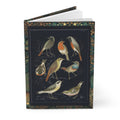
Seven Songbirds from the Victorian Field: G. Lübbert's De Vogelwereld and the Art of Ornithological Illustration
In 1886, the Dutch publisher J.B. Wolters released De Vogelwereld — The Bird World — a landmark ornithological handbook that brought together the lithographic talents of G. Lübbert to document European bird species with a precision that defined Victorian natural history illustration at its finest. More than a scientific reference, De Vogelwereld was a work of art: each plate combined anatomical accuracy with the aesthetic sensibility of an era that believed beauty and science were inseparable companions.
The Lithographer's Eye
G. Lübbert's plates are distinguished by their attention to plumage detail — the warm orange breast of the European Robin, the iridescent blue and chestnut of the Bluethroat, the bold black-and-white contrast of the Stonechat. Working in the chromolithographic tradition, Lübbert rendered each bird not merely as a specimen but as a living presence, capturing the subtle gradations of colour and the fine texture of feathers that made Victorian ornithological illustration so enduring.
De Vogelwereld documented species that were familiar to any European naturalist of the period — the Robin (Erithacus rubecula), the Bluethroat (Luscinia svecica), the Stonechat (Saxicola rubicola), the Northern Wheatear, the Black Redstart, the Chiffchaff (Phylloscopus collybita), the Garden Warbler (Sylvia borin), and the Marsh Warbler (Acrocephalus palustris) — yet treated each with the care of a portrait painter rather than a cataloguer.
A Contemporary Interpretation
The European Songbirds Journal reimagines two of Lübbert's plates through a bold contemporary lens. By setting the original lithographs against a dramatic black background, the design transforms Victorian field guide illustrations into gallery-quality art — giving each bird the visual intensity and graphic presence that a white page could never achieve. The robin's breast glows warmer. The bluethroat's iridescent patch shimmers with greater depth. The warblers' subtle olive and buff tones acquire a richness that reveals the full sophistication of Lübbert's draughtsmanship.
It is a dialogue between centuries: the 19th-century naturalist's precision meeting the 21st-century designer's eye.
Seven Species, Two Covers
The front cover presents four celebrated songbirds — Robin, Bluethroat, Stonechat, and Redstart — the charismatic species that Victorian birdwatchers sought in hedgerows, heathlands, and coastal scrub across Europe. The back cover turns to the warblers: Chiffchaff, Garden Warbler, and Marsh Warbler — subtler in plumage but no less remarkable in their migratory journeys and vocal complexity. Together, the two covers offer a complete portrait of seven European songbird species from one of the 19th century's most distinguished ornithological publications.
Whether you use it to record field observations, sketch species notes, or simply write — the European Songbirds Journal carries with it the legacy of Victorian natural history: the conviction that the natural world deserves to be documented with care, precision, and beauty.