The Crystalline Kingdom: Dr. A. Schleyer and the Chromolithographic Minerals of 1935
There is a particular challenge in illustrating minerals. A butterfly can be pinned and drawn; a plant can be pressed and painted; a bird can be observed and sketched in the field. But a mineral specimen — with its metallic lustre, its crystalline geometry, its play of light across faceted surfaces — resists the illustrator’s hand in ways that other natural history subjects do not. The sheen of galena, the scarlet intensity of cinnabar, the brassy glitter of pyrite in its perfect pyritohedra — these are qualities that depend on light and angle and the physical properties of the mineral surface in ways that a flat printed image struggles to capture. And yet, in the chromolithographic plates of Dr. A. Schleyer’s Mineralogie, published in 1935 as part of the series Das Naturreich in Bildern, something remarkable was achieved: illustrations that used hand-applied metallic finishes and the full resources of the chromolithographic press to render the mineral kingdom with a precision and a visual richness that photography of the era could not match.

Schleyer’s thirty plates — Tafel I through Tafel XXX — document the mineral kingdom systematically, from the native elements through the sulphides, oxides, carbonates, silicates, and beyond. They are images of extraordinary scientific value and considerable visual beauty: images that carry within them the luminous quality of the finest German natural history illustration, and that reward sustained attention in the way that the minerals themselves reward sustained attention — revealing more the longer you look.
Das Naturreich in Bildern: The German Tradition of Natural History Illustration
The series Das Naturreich in Bildern — The Natural Kingdom in Images — was part of a long tradition of German natural history publication that had developed over the course of the nineteenth and early twentieth centuries. German natural history in this period was characterised by a commitment to systematic documentation and visual precision that had produced, by the 1930s, some of the finest illustrated atlases in the history of science. The tradition stretched back to the great naturalists of the Enlightenment — to Georg Rumphius and his Herbarium Amboinense, to Johann Friedrich Gmelin and his revision of Linnaeus — and had been sustained, through the nineteenth century, by a succession of illustrated works that combined scientific rigour with visual ambition.
The publisher G. Löwensohn of Fürth in Bavaria was one of the houses that sustained this tradition into the twentieth century. The Das Naturreich in Bildern series was designed to make the findings of natural history accessible to a broad educated public — to students, teachers, and interested laypeople as well as to professional scientists — through the medium of high-quality chromolithographic illustration. Schleyer’s Mineralogie was one of the volumes in this series, and it brought to the documentation of the mineral kingdom the same combination of scientific accuracy and visual ambition that characterised the best work in the German natural history tradition.
Chromolithography and the Mineral Specimen
The chromolithographic technique that Schleyer used for his mineral plates was, by 1935, a mature and highly developed medium. Chromolithography — printing in multiple colours from a series of lithographic stones or, by the 1930s, zinc plates — had been developed in the 1830s and had become, over the course of the nineteenth century, the dominant technique for the reproduction of colour images in scientific publications. By the time Schleyer’s plates were produced, the technique had been refined over nearly a century of practice, and the chromolithographic printers of Germany and Austria had developed a level of skill and precision that allowed them to reproduce the most complex colour relationships with extraordinary fidelity.
For mineral illustration, the particular challenge was the rendering of metallic lustre — the quality that distinguishes galena from grey clay, pyrite from yellow ochre, cinnabar from red paint. This quality depends on the physical interaction of light with the mineral surface: the way that metallic minerals reflect light specularly, producing highlights and shadows that shift with the angle of view, in a manner that a flat printed image cannot easily reproduce. Schleyer’s solution was the application of hand-applied metallic finishes to the printed plates — a technique that added a physical dimension to the chromolithographic image, giving the mineral specimens a tactile, three-dimensional presence that remains astonishing nearly a century later.
Tafel V: The Metallic Ores — Pyrite, Marcasite, Cobaltite, Nickeline, Arsenopyrite
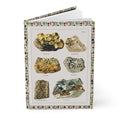
The fifth plate of Schleyer’s Mineralogie — reproduced on the front cover of our journal — documents six metallic ore minerals with the precision and visual richness that characterise the finest plates in the atlas. Each specimen is shown in its characteristic crystal habit, with the metallic finishes applied to capture the specific quality of its lustre.
Pyrite — iron sulphide, FeS₂ — is shown in its classic pyritohedron form: the twelve-faced crystal that gives pyrite its characteristic appearance and that has made it one of the most recognisable minerals in the world. Its brassy yellow colour and metallic lustre have earned it the name “fool’s gold,” but pyrite is far from foolish: it is one of the most abundant sulphide minerals in the earth’s crust, and an important ore of sulphur and, in some deposits, of gold. Marcasite — the orthorhombic polymorph of iron sulphide — is shown in its characteristic cockscomb habit: radiating crystals that form the distinctive fan-shaped aggregates that have made marcasite a favourite of mineral collectors. Cobaltite — cobalt arsenic sulphide — appears in its silver-white metallic habit, a mineral that was historically important as a source of cobalt for the blue pigments used in glass and ceramics. Nickeline — nickel arsenide, the mineral that gives nickel its name — is shown in its characteristic copper-red colour, a mineral that was once mistaken for copper ore by miners who found it unrewarding to smelt. And Arsenopyrite — iron arsenic sulphide — appears in its sharp wedge-shaped monoclinic prisms, a mineral that is the most common arsenic-bearing mineral in the earth’s crust.
Tafel IV: The Sulphide Minerals — Sphalerite, Galena, and Cinnabar
The fourth plate — reproduced on the back cover — documents four of the most important sulphide minerals in the history of metallurgy and chemistry. These are minerals that have shaped human history: the ores from which zinc, lead, and mercury have been extracted for millennia, and whose properties have made them central to the development of technology, medicine, and art.
Sphalerite — zinc sulphide, ZnS — is shown in its characteristic resinous honey-yellow forms: the mineral that is the primary ore of zinc, and whose name derives from the Greek for “treacherous,” because its variable appearance made it difficult to identify in the field. Galena — lead sulphide, PbS — appears in its most characteristic form: brilliant lead-grey metallic cubes with the perfect cubic cleavage that makes galena one of the most geometrically satisfying minerals in the world. It is shown also in a second specimen from Neudorf, in its natural matrix of iron spar and quartz — a reminder that minerals in nature are rarely found in isolation, but in the complex associations that reflect the geological history of their formation. And Cinnabar — mercury sulphide, HgS — is shown in three distinct forms: the vivid scarlet and brick-red colours that have made it one of the most visually striking minerals in the world, and the only major ore of mercury. Cinnabar was historically prized as the pigment vermilion — the brilliant red that appears in Roman frescoes, medieval manuscripts, and Renaissance paintings — and its extraction from mines in Spain, China, and the Americas was one of the most dangerous occupations in the pre-industrial world.
The Science of Crystals: Mineralogy in the Early Twentieth Century
The mineralogy that Schleyer’s plates document was, by 1935, a science in transition. The classical mineralogy of the nineteenth century — based on the systematic description of crystal forms, cleavage, lustre, and colour — had been transformed, in the early decades of the twentieth century, by the development of X-ray crystallography. In 1912, Max von Laue had demonstrated that X-rays could be diffracted by crystal lattices, and William Henry Bragg and his son William Lawrence Bragg had developed the techniques that made it possible to determine the atomic structure of crystals from their X-ray diffraction patterns. The result was a revolution in mineralogy: for the first time, it was possible to understand the crystal forms that Schleyer illustrated — the pyritohedra of pyrite, the cubic cleavage of galena, the rhombohedral forms of cinnabar — in terms of the arrangement of atoms in the crystal lattice.
Schleyer’s plates were produced at the moment when this revolution was transforming the science, but before it had fully displaced the older tradition of descriptive mineralogy. They belong, in this sense, to a transitional moment in the history of the science — a moment when the visual documentation of mineral specimens retained its full scientific value, before the atomic structure of minerals became the primary focus of mineralogical research. They are, in this sense, among the last great works of classical mineralogical illustration: images that document the mineral kingdom as it appeared to the eye and the hand, before the X-ray revealed the invisible architecture within.
A Journal for Those Who Find Beauty in Crystals

Our Mineral Kingdom Journal carries Schleyer’s Tafel V on the front cover and Tafel IV on the back — the metallic ores and the sulphide minerals, pyrite and cinnabar, galena and arsenopyrite, documented with the hand-applied metallic finishes and chromolithographic precision that made these plates extraordinary nearly a century ago and that remain extraordinary today.
Inside, 150 perforated lined pages await your field notes, mineral observations, geological sketches, or whatever form your engagement with the crystalline world takes. The casewrap sewn binding opens completely flat — ideal for drawing alongside your notes. The matte laminated cover preserves every detail of Schleyer’s chromolithographs in a finish that rewards close examination.
In 1935, Dr. A. Schleyer looked at pyrite and cinnabar, galena and arsenopyrite, and documented what he saw with a precision and beauty that has not been surpassed. Perhaps the pages inside will help you look a little more carefully at the crystalline world around you.
References & Further Reading
- Bragg, William Lawrence. The Crystalline State, Vol. 1: A General Survey. G. Bell and Sons, 1933. [The foundational work of X-ray crystallography, published two years before Schleyer’s atlas.]
- Dana, James Dwight. System of Mineralogy. 7th ed., revised by Charles Palache, Harry Berman & Clifford Frondel. Wiley, 1944–1962. [The standard reference work of descriptive mineralogy in the tradition that Schleyer’s plates document.]
- Gribble, C.D. & Hall, A.J. Optical Mineralogy: Principles and Practice. UCL Press, 1992. [On the optical properties of minerals, including the metallic lustre that Schleyer’s hand-applied finishes sought to capture.]
- Lack, H. Walter. Garden Eden: Masterpieces of Botanical Illustration. Taschen, 2008. [On the broader tradition of German natural history chromolithography within which Schleyer’s plates belong.]
- Nesse, William D. Introduction to Mineralogy. Oxford University Press, 2000. [The standard modern introduction to mineralogy, covering the crystal chemistry of pyrite, galena, cinnabar, and the other minerals in Schleyer’s plates.]
- Rickard, David. Pyrite: A Natural History of Fool’s Gold. Oxford University Press, 2015. [A comprehensive account of pyrite’s geology, history, and cultural significance.]
- Weeks, Mary Elvira. Discovery of the Elements. Journal of Chemical Education, 1956. [On the history of the discovery of cobalt, nickel, zinc, lead, and mercury — the elements whose ores appear in Schleyer’s Tafel IV and V.]