The Forest Pantry: Wild Plants, Foraging, and the Scandinavian Tradition of Reading the Landscape
There is a particular kind of knowledge that belongs to the forest. Not the knowledge of books or laboratories, but the knowledge of seasons and smells — of knowing that wild garlic arrives in the birch woods in April, that Siberian chives grow along the edges of streams, that the broad green leaves of Allium ursinum carpeting the forest floor in spring are one of the great gifts the Nordic landscape offers to those who know how to receive it. This knowledge is ancient, accumulated over thousands of years of human habitation in the Scandinavian forests, and it is the foundation on which Emil Korsmo built his 1913 botanical charts — the most comprehensive documentation of Norwegian wild plants ever produced.
The Scandinavian Foraging Tradition
Foraging — the practice of gathering wild plants, fungi, berries, and other foods from the landscape — has deep roots in Scandinavian culture. In Norway and Sweden, the right to forage on public and private land is protected by the principle of allemannsretten — the “everyman’s right” — a legal tradition that guarantees access to the natural landscape for all citizens. This right is not merely a legal technicality but a cultural value: the idea that the forest and its gifts belong to everyone, that the knowledge of wild plants is a common inheritance.
The Scandinavian foraging tradition encompasses an extraordinary range of plants. Wild garlic (Allium ursinum) and Siberian chives (Allium schoenoprasum) are among the most prized, but the Nordic forest also offers lingonberries, cloudberries, chanterelles, wood sorrel, nettles, elderflower, and dozens of other edible species. The seasonal rhythm of foraging — from the first wild garlic of April to the last lingonberries of October — structures the Nordic relationship with the natural world in ways that persist even in an age of supermarkets and global food supply chains.
The Allium Family in Nordic Cuisine and Medicine
The Allium family — which includes wild garlic, Siberian chives, ramsons, and their relatives — occupies a special place in the Scandinavian foraging tradition. Wild garlic (Allium ursinum), known in Norwegian as ramsløk, is perhaps the most celebrated of the Nordic foraged plants. Its broad, intensely fragrant leaves appear in the forest understory in April and May, carpeting the ground beneath birch and oak trees with a vivid green that is one of the most beautiful sights the Nordic spring offers.
Wild garlic has been used in Scandinavian cooking and medicine for centuries. Its leaves can be eaten raw in salads, cooked as a vegetable, made into pesto, or fermented into a condiment. Its bulbs, harvested in autumn, have a milder flavour than cultivated garlic and can be used in the same ways. In traditional Nordic medicine, wild garlic was used as a treatment for digestive complaints, high blood pressure, and respiratory infections — a folk pharmacopoeia that modern research has partially validated.
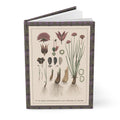
Siberian chives (Allium schoenoprasum) — the species documented in Plate 78 of Korsmo’s 1913 charts — are equally versatile. Native to the subarctic regions of Europe and Asia, they grow wild along stream banks and in mountain meadows throughout Scandinavia, and their delicate purple flowers are as beautiful as they are edible. The cultivated chive of the modern kitchen is a direct descendant of this wild species, domesticated from the same Nordic and Alpine populations that Korsmo documented.
Emil Korsmo and the Science of Wild Plants
Emil Korsmo (1863–1953) was Norway’s greatest agricultural botanist — a scientist whose comprehensive weed identification guides transformed Scandinavian farming practice in the early 20th century. His 1913 charts, illustrated by Knut Quelprud, documented the wild plants of the Norwegian landscape with a taxonomic precision and visual clarity that made them essential tools for farmers, botanists, and educators for generations.
Korsmo’s approach to wild plants was shaped by the dual perspective of the agricultural scientist and the naturalist. He understood that the plants he was documenting were simultaneously weeds — competitors for the crops that Norwegian farmers depended on — and members of a rich ecological community that had its own value and logic. His charts documented not merely the identifying features of each species but its ecology, its distribution, and its relationship to the agricultural landscape.
The Allium charts — Plate 78 documenting Siberian chives, and the companion plate documenting wild garlic — are characteristic of Korsmo’s best work: scientifically rigorous, visually beautiful, and pedagogically effective. They gave Norwegian farmers and botanists the tools to identify and understand the Allium species of their landscape, and they gave subsequent generations a visual record of the wild plant communities of early 20th-century Norway.
Writing the Foraged Landscape
The forager’s journal is one of the oldest forms of nature writing. Before the printed field guide, before the botanical chart, the knowledge of wild plants was recorded in personal notebooks — observations of where specific species grew, when they appeared, how they tasted, what they could be used for. These notebooks were practical tools, but they were also something more: records of attention paid to the natural world, of a relationship between a person and a landscape that was built up over years of careful observation.
Korsmo’s charts are the scientific version of that tradition — the forager’s notebook elevated to the level of institutional knowledge, made available to everyone. The Allium journal carries that tradition forward: a place to record your own observations of the wild plants of your landscape, in the company of Korsmo’s meticulous illustrations.

Our Emil Korsmo Allium Charts Journal carries Plate 78 and the wild garlic chart from Korsmo’s 1913 Norwegian botanical series — the Allium family documented with the precision of Scandinavian agricultural science and the beauty of Knut Quelprud’s botanical illustration.
References
- Korsmo, Emil. Ugras i nutidens jordbruk. Oslo, 1925.
- Mossberg, Bo & Lennart Stenberg. Den nya nordiska floran. Wahlström & Widstrand, 2003.
- Mabey, Richard. Food for Free. Collins, 1972.
- Zachos, Ellen. Backyard Foraging: 65 Familiar Plants You Didn’t Know You Could Eat. Storey Publishing, 2013.