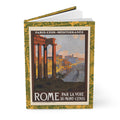
Rome and the Modern Grand Tour: Dorival, Kiepert, and the Eternal City
Rome has always been two cities at once. There is the living city — the city of markets and churches, of traffic and coffee, of the neighbourhoods that have grown up over two millennia on and around the ruins of the ancient world. And there is the historical city — the city of the Forum and the Colosseum, of the Palatine and the Capitoline, of the aqueducts and the roads that once connected the empire. For the traveller arriving in Rome, the challenge has always been to hold both cities in mind simultaneously: to see the ancient beneath the modern, and the modern growing out of the ancient. Two documents from the early twentieth century capture this double vision with particular clarity: Géo Dorival’s travel poster of 1920 and Heinrich Kiepert’s map of ancient Rome of 1914.
The Grand Tour and Its Modern Heir
The tradition of travelling to Rome as an act of cultural formation has deep roots in European history. The Grand Tour — the extended journey through France, Switzerland, and Italy that became a standard part of the education of young English aristocrats in the seventeenth and eighteenth centuries — had Rome as its essential destination. To have seen the Forum, to have stood before the Pantheon, to have walked the Via Appia — these were experiences that marked a person as educated, as cultured, as a full participant in the European humanist tradition. The Grand Tour produced some of the finest travel writing in the English language, from Joseph Addison’s Remarks on Several Parts of Italy (1705) to Edward Gibbon’s account of the moment, sitting among the ruins of the Capitol in 1764, when he conceived the idea of writing the Decline and Fall of the Roman Empire.
By the early twentieth century, the Grand Tour in its original aristocratic form had long since given way to a more democratic version of cultural travel. The railways had transformed the journey: what had once taken weeks by carriage could now be accomplished in days by train, and the opening of the Mont-Cenis tunnel in 1871 — the first railway tunnel through the Alps — made the journey from Paris to Turin, and thence to Rome, faster and more comfortable than it had ever been. A new class of travellers — middle-class professionals, artists, writers, teachers — could now make the journey to Rome that had once been the exclusive preserve of the wealthy.
Géo Dorival and the Art of the Travel Poster
It was to attract these new travellers that the railway companies commissioned the travel posters that are among the most beautiful examples of commercial graphic art of the early twentieth century. Géo Dorival (1879–1968) was one of the most prolific and accomplished of the French travel poster artists, producing work for the major French railway companies — the PLM (Paris-Lyon-Méditerranée), the Nord, the Est — as well as for shipping lines and tourist boards. His poster for the Rome via Mont-Cenis route, produced around 1920, is characteristic of his approach: a dramatic composition centred on the ruins of the Roman Forum, rendered in the warm ochres and terracottas of the Italian landscape, with the ancient columns and arches rising against a luminous sky.
The choice of the Forum as the central image was deliberate and significant. The Forum Romanum — the civic heart of ancient Rome, the space where the Senate met and the law courts sat and the great public ceremonies of the Republic and Empire were conducted — had been, since the Renaissance, the defining image of Rome as a historical destination. By Dorival’s time, it had been extensively excavated — the work of clearing the Forum of the medieval and Renaissance buildings that had accumulated over the ruins had been underway since the early nineteenth century — and it presented to the visitor a landscape of extraordinary evocative power: columns and arches standing in isolation against the sky, the ground level of the ancient city exposed below the level of the modern streets, the whole space suffused with the melancholy beauty of things that have survived the fall of the civilisation that created them.
Heinrich Kiepert and the Cartography of Ancient Rome
If Dorival’s poster represents the romantic, emotional response to Rome — the city as image, as atmosphere, as destination — then Heinrich Kiepert’s map of ancient Rome represents the scholarly, analytical response: the city as historical problem, as object of systematic study, as a space to be understood through the patient accumulation of evidence. Kiepert (1818–1899) was one of the greatest cartographers of the nineteenth century, professor of geography at the University of Berlin and the author of a series of historical atlases that set the standard for the cartographic representation of the ancient world. His Roma Urbs — published in its definitive form in 1914, in a revised edition prepared after his death by his son Richard Kiepert — is a reconstruction of the city of Rome at the height of the Empire, showing the streets, monuments, aqueducts, and buildings of the ancient city with a precision and completeness that had never been achieved before.
The map is a work of scholarship as well as cartography. Every street, every building, every monument shown on it represents a decision based on the available archaeological and literary evidence — the excavation reports, the ancient sources, the surviving fragments of the Forma Urbis Romae, the great marble map of Rome carved in the early third century CE that has been painstakingly reconstructed from its surviving fragments. To read Kiepert’s map alongside Dorival’s poster is to see Rome from two complementary angles: the emotional and the analytical, the image and the argument, the city as it appears to the traveller and the city as it is understood by the scholar.

If Rome — ancient and modern, romantic and scholarly — resonates with you, the Rome Travel Journal brings Dorival’s 1920 Forum poster and Kiepert’s 1914 map of ancient Rome to a hardcover journal — 150 lined pages, ready for travel notes, architectural sketches, or whatever the Eternal City inspires.
References
- Addison, J. Remarks on Several Parts of Italy. London, 1705.
- Gibbon, E. Memoirs of My Life. London, 1796.
- Kiepert, H. and Kiepert, R. Roma Urbs. Berlin, 1914.
- Casson, L. Travel in the Ancient World. Johns Hopkins University Press, Baltimore, 1994.
- Buzard, J. The Beaten Track: European Tourism, Literature, and the Ways to Culture, 1800–1918. Oxford University Press, 1993.