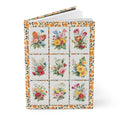
The Language of Flowers: Robert Tyas and the Victorian Art of Floral Symbolism
In Victorian England, flowers were not merely decorative. They were a language — a system of symbolic communication so widely understood that a carefully composed bouquet could convey declarations of love, friendship, grief, or reproach that polite society would not permit to be spoken aloud. A red rose meant love; a yellow one, jealousy. Forget-me-nots spoke of true love and remembrance; marigolds of grief and despair; white lilies of purity; ivy of fidelity. The practice — known as floriography, from the Latin for flower and the Greek for writing — was one of the most distinctive cultural phenomena of the Victorian era, and it produced some of the most beautiful illustrated books of the nineteenth century.
The Origins of Floriography
The association of flowers with specific meanings has roots that stretch back far beyond the Victorian era — to the classical world, to medieval herbalism, to the Persian and Ottoman traditions of selam, the practice of sending messages through arrangements of objects including flowers. But it was in the early nineteenth century, and above all in England, that floriography became a systematic cultural practice with its own published dictionaries, its own etiquette, and its own considerable commercial infrastructure of florists, publishers, and gift-book producers.
The first English-language flower dictionary is generally credited to a translation of a French work, Le langage des fleurs by Charlotte de Latour, published in 1819. The genre quickly established itself as one of the most popular forms of gift book in the Victorian period — small, beautifully illustrated volumes that could be given as tokens of affection and consulted as guides to the symbolic vocabulary of the flower garden. By the middle of the nineteenth century, dozens of competing flower dictionaries had been published in England alone, each with its own slightly different assignments of meaning to individual flowers, its own illustrative style, and its own claim to authority.
Robert Tyas and The Language of Flowers
Robert Tyas (1811–1873) was an English clergyman, writer, and editor who produced several works on natural history and botany, including a series of flower books that combined botanical information with the symbolic meanings of the floriographic tradition. His The Language of Flowers, or, Floral Emblems of Thoughts, Feelings, and Sentiments was first published in the 1840s and went through numerous editions over the following decades, with the 1896 edition — the one from which the illustrations on this journal are taken — representing the work in its most fully developed and beautifully illustrated form.
What distinguished Tyas’s work from many of its competitors was the quality of its illustrations. The bouquet plates that appear in the 1896 edition are characteristic of the best Victorian botanical illustration: each arrangement is rendered with careful attention to the individual flowers that compose it, their petals and leaves drawn with the precision of a naturalist and coloured with the chromatic richness that late nineteenth-century printing technology could achieve. But the bouquets are also compositions in the artistic sense — arrangements designed to be beautiful as well as informative, to demonstrate the aesthetic possibilities of the floriographic tradition as well as its symbolic vocabulary.
The Mosaic of Bouquets
The nine bouquet illustrations that appear on each cover of the journal are arranged in a symmetrical mosaic pattern that reflects the kaleidoscopic abundance of the Victorian flower garden. Each bouquet is distinct — different flowers, different arrangements, different colour palettes — but together they form a harmonious whole, a portrait of the Victorian floral imagination in its full variety and richness.
This mosaic format is itself a kind of floriographic statement: just as a Victorian bouquet communicated meaning through the combination of individual flowers, each with its own symbolic value, the mosaic communicates through the combination of individual bouquets, each a complete composition in itself. The whole is greater than the sum of its parts — which is, perhaps, the deepest truth that the language of flowers has to teach.
The Persistence of Floriography
The systematic practice of floriography — the careful composition of bouquets according to a shared symbolic code — did not survive the Victorian era as a living social practice. By the early twentieth century, the elaborate etiquette of the flower dictionary had given way to simpler and more direct forms of floral communication: red roses for love, white flowers for weddings and funerals, and little else by way of systematic symbolism. The flower dictionaries continued to be published, but increasingly as historical curiosities rather than practical guides.
What has persisted is something deeper: the intuition that flowers mean something, that the choice of a particular flower for a particular occasion is not arbitrary, that the natural world offers a vocabulary of beauty and significance that human beings have always found ways to read and to use. Robert Tyas understood this, and his 1896 Language of Flowers — with its exquisite bouquet illustrations and its careful cataloguing of floral meanings — remains one of the most beautiful expressions of that understanding ever committed to print.

If Robert Tyas and the Victorian language of flowers resonate with you, the Floral Bouquets Journal brings his 1896 bouquet illustrations to a hardcover journal — 150 lined pages, ready for garden notes, botanical sketches, or whatever the flower garden inspires.
References
- Tyas, R. The Language of Flowers, or, Floral Emblems of Thoughts, Feelings, and Sentiments. London, 1896.
- de Latour, C. Le langage des fleurs. Paris, 1819.
- Seaton, B. The Language of Flowers: A History. University Press of Virginia, Charlottesville, 1995.
- Goody, J. The Culture of Flowers. Cambridge University Press, 1993.
- Pavord, A. The Naming of Names: The Search for Order in the World of Plants. Bloomsbury, London, 2005.