Raoul Dufy and the Art of Parisian Joy
There is a quality in Raoul Dufy's paintings that is almost impossible to describe without sounding naive: they are happy. Not cheerful in a forced or commercial way, not optimistic in the manner of propaganda, but genuinely, effortlessly happy — as if the world Dufy painted was the world as it actually felt on the best days, when the light was right and the music was playing and the colours of everything were slightly more vivid than usual. He painted regattas and racecourses, concert halls and Riviera beaches, and he painted Paris — always Paris — with a joy that never became sentimental and a sophistication that never became cold.

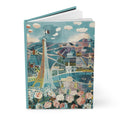
His 1925 Panorama de Paris, from the series Le Printemps en France, is one of the defining images of the decade: the Eiffel Tower and the Arc de Triomphe and the Panthéon and Sacré-Cœur, all gathered together in a single festive composition, wreathed in exuberant flowers, rendered in the vivid colours and fluid lines that were entirely his own. It is not a realistic portrait of Paris. It is something better: a portrait of what Paris means.
From Le Havre to Paris
Raoul Dufy was born in Le Havre in 1877, the third of nine children in a musical family — his father was an amateur organist, and music would remain a lifelong passion that shaped his understanding of colour and rhythm. He began drawing as a child and won a scholarship to the École des Beaux-Arts in Le Havre at the age of fifteen, before moving to Paris in 1900 to study at the École nationale supérieure des Beaux-Arts.
His early work was Impressionist in manner — competent, pleasant, and entirely without the quality that would make him famous. The transformation came in 1905, when he saw Henri Matisse's painting Luxe, Calme et Volupté at the Salon des Indépendants. The encounter was, by Dufy's own account, a revelation: “In front of this picture,” he wrote later, “I understood all the new reasons for painting. Impressionist realism lost its charm for me as I contemplated this miracle of the imagination introduced into design and colour.” He became a Fauvist — one of the group of painters, including Matisse, Derain, and Vlaminck, who used colour not to describe the world but to express it, with an intensity and freedom that shocked and delighted in equal measure.
The Discovery of a Style
Fauvism gave Dufy his colours, but it did not give him his style. That came gradually, through a decade of experimentation that took him through Cubism — which he found intellectually interesting but temperamentally uncongenial — and through a crucial encounter with the decorative arts. In 1909, the couturier Paul Poiret commissioned Dufy to design fabric prints, and the experience of working with pattern, repetition, and the flat surface of textile transformed his approach to painting. He began to develop the technique that would define his mature work: a fluid, calligraphic line that described forms with the economy of a sketch, laid over washes of colour that did not follow the line but floated freely around it, creating a shimmering, luminous effect that was entirely his own.
The technique was deceptively simple in appearance and extraordinarily difficult in execution. The line and the colour had to work together without coinciding — the colour suggesting atmosphere and light, the line providing structure and wit. When it worked, as it did consistently from the mid-1910s onward, the result was paintings of extraordinary vivacity: images that seemed to vibrate with energy, that captured not just the appearance of a scene but its feeling, its rhythm, its joy.
Paris in the 1920s
The Paris that Dufy painted in the 1920s was the Paris of the Années Folles — the Crazy Years, the decade of post-war euphoria and creative explosion that followed the catastrophe of the First World War. Paris in the 1920s was the most exciting city in the world: Picasso and Braque were reinventing painting, Stravinsky and Satie were reinventing music, Chanel and Poiret were reinventing fashion, and the cafés of Montparnasse were full of American expatriates — Hemingway, Fitzgerald, Gertrude Stein — who had come to Paris because it was the only place where the future seemed to be happening.
Dufy was at the centre of this world, and he painted it with the insider's ease of someone who belonged there completely. He painted the Paris Opera, the Longchamp racecourse, the beaches of Deauville and Nice, the regattas at Henley and Cowes. He painted the Eiffel Tower dozens of times, from every angle and in every light, always finding something new in its iron lattice — a symbol of modernity that he loved with the uncomplicated enthusiasm of a man who genuinely believed that the modern world was a good place to be.
Le Printemps en France
The Le Printemps en France series was conceived in the early 1920s as a celebration of France's cultural identity in the aftermath of the war — a series of decorative works that would present France, and Paris in particular, as a place of beauty, vitality, and joy. The series included posters, decorative screens, and textile designs, all sharing the same festive vocabulary: monuments, flowers, vivid colour, and the fluid Dufy line that made everything look as if it were dancing.
The 1925 Panorama de Paris was created as a decorative screen in collaboration with the designer André Groult — a large-scale work (227 × 264 cm) that brought together the city's most emblematic monuments in a single composition. The Eiffel Tower rises at the centre, flanked by the Arc de Triomphe and the Panthéon; Sacré-Cœur crowns the composition from Montmartre. Around and between the monuments, flowers bloom in extravagant abundance — not the precise botanical flowers of scientific illustration but Dufy's own flowers, stylised and exuberant, more like the idea of flowers than any particular species.
The work was exhibited at the Exposition Internationale des Arts Décoratifs et Industriels Modernes of 1925 — the exhibition that gave Art Déco its name — and it exemplifies everything that made that movement distinctive: the marriage of fine art and decorative craft, the celebration of modernity and luxury, the conviction that beauty was not a luxury but a necessity, and that the applied arts — furniture, textiles, ceramics, screens — were as worthy of serious artistic attention as painting and sculpture.
The Painter of Joy
Dufy continued to paint with extraordinary productivity through the 1930s and 1940s, despite the increasing severity of the rheumatoid arthritis that eventually crippled his hands. He developed a treatment with cortisone in the early 1950s that gave him some relief, and he continued to work until his death in 1953. His last major work, La Fée Électicité (The Electricity Fairy), painted in 1952 for the Paris Electricity Board, is a vast mural — sixty metres long, ten metres high — that celebrates the history of electricity with the same joy and vivacity that he brought to everything he painted. It is now in the Musée d'Art Moderne de la Ville de Paris, and it is one of the great works of twentieth-century decorative art.
Dufy's reputation suffered somewhat in the decades after his death, when the critical consensus favoured the more austere and conceptually demanding art of Abstract Expressionism and its successors. A painter who made happiness look easy was not, in that climate, taken entirely seriously. But his work has endured, and it endures because it does something that is genuinely difficult: it captures the feeling of being alive on a good day, in a beautiful place, with music playing and light on the water and the sense that the world is, on balance, a remarkable and joyful thing.

Our Paris Journal reproduces Dufy's 1925 Panorama de Paris from Le Printemps en France — the Eiffel Tower, Arc de Triomphe, Panthéon, and Sacré-Cœur wreathed in exuberant flowers, in the vivid colours and fluid lines of the painter who made the 1920s sing.
References
Bruzeau, M. (1989). Raoul Dufy. Harry N. Abrams.
Crespelle, J. P. (1975). La Vie quotidienne à Montmartre au temps de Picasso. Hachette.
Dufy, R. (1920). Le Printemps en France. Paris: Musée d'Art Moderne.
Lassaigne, J. (1954). Dufy: Biographical and Critical Study. Skira.
Warnod, J. (1981). Raoul Dufy. Bonfini Press.