The Blueprint and the Locomotive: R. Menzel's Science Boards and the Art of German Technical Education, 1908
There is a particular kind of beauty in a technical drawing. It is not the beauty of a landscape or a portrait — not the beauty of something observed and rendered with feeling. It is the beauty of clarity: the beauty of a complex system made legible, of hidden mechanisms revealed, of the relationship between parts and whole made visible in a single image. The great technical illustrations of the nineteenth and early twentieth centuries — the cross-sections of steam engines, the diagrams of anatomical structures, the cutaway views of ships and bridges and machines — are beautiful in this way: they are images that teach, and in teaching, they achieve a kind of aesthetic satisfaction that is inseparable from their function.
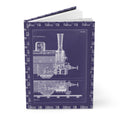
R. Menzel's 1908 diagram of a steam locomotive — the Lokomotiv plate from his series of educational Science Boards — is one of the finest examples of this tradition. Rendered originally as a two-page cross-section showing the complete internal anatomy of a steam locomotive, it was designed to hang in German technical schools and universities, to teach a generation of engineering students how a locomotive worked. Reimagined in classic blueprint style — white lines on deep blue — it is also one of the most visually striking images in the history of industrial illustration.
Germany and the Golden Age of Steam
By 1908, Germany had established itself as the leading nation in railway engineering. The German railway network, which had expanded rapidly in the second half of the nineteenth century, was by the early twentieth century one of the most extensive and technically sophisticated in the world. German locomotive manufacturers — companies like Borsig in Berlin, Maffei in Munich, and Henschel in Kassel — were producing machines of extraordinary power and precision, and German railway engineering was studied and imitated across Europe and beyond.
This technical supremacy was not accidental. It was the product of a systematic investment in technical education that had begun in the mid-nineteenth century and had, by 1908, created one of the most effective systems of engineering training in the world. The German Technische Hochschulen — technical universities — combined theoretical instruction with practical training in a way that produced engineers of exceptional competence. And the educational materials used in these institutions — textbooks, laboratory equipment, and, crucially, the large-format wall charts and diagrams that hung in lecture halls and workshops — were of correspondingly high quality.
It was into this educational ecosystem that R. Menzel's Science Boards were born. Designed as large-format teaching aids — printed on heavy paper and intended to be displayed on the walls of classrooms and workshops — the boards covered a wide range of technical subjects: mechanical engineering, physics, chemistry, and the various branches of applied science that formed the curriculum of the German technical school. The locomotive diagram was among the most important of these boards, because the steam locomotive was, in 1908, the most complex and powerful machine in everyday use — the machine that, more than any other, defined the industrial age.
Reading the Locomotive: A Cross-Section in Two Pages
The Lokomotiv diagram is, at its core, an act of revelation. The steam locomotive, as it appeared to the observer on a railway platform, was a largely opaque object: a massive, noisy, smoke-producing machine whose internal workings were hidden behind boiler casing and running plates. What Menzel's diagram did was to remove that casing — to show, in precise detail, what was happening inside.
The cross-section reveals the complete anatomy of the locomotive: the firebox at the rear, where coal was burned to produce heat; the boiler, a long cylindrical vessel filled with water and heated by the fire; the flue tubes running through the boiler, carrying hot gases from the firebox to the smokebox at the front; the steam dome, where steam collected before being directed to the cylinders; the cylinders themselves, where the pressure of steam was converted into the reciprocating motion of the pistons; and the complex system of valve gear that controlled the admission and exhaust of steam, allowing the driver to regulate the locomotive's speed and direction.
Each component is labeled with precision; the relationships between parts are shown with clarity; the flow of energy through the system — from coal to fire to steam to motion — can be traced through the diagram from left to right. It is a masterwork of technical communication: an image that makes a complex system comprehensible without sacrificing accuracy or detail.
The original diagram spanned two pages, allowing the complete locomotive to be shown at a scale that made the individual components legible. Our journal adapts this design for the wraparound cover: the forward section of the locomotive on the front, the rear section on the back, together forming the complete engine. The reimagining in blueprint style — white lines on deep blue, in the tradition of the architectural and engineering drawings that were the standard medium of technical communication in the early twentieth century — gives the image a visual drama that the original, with its yellowish background and black lines, did not quite achieve.
The Blueprint Tradition
The blueprint — the cyanotype print that reproduced technical drawings as white lines on a blue background — was one of the defining visual technologies of the industrial age. Developed in the 1840s by the astronomer and photographer John Herschel, the cyanotype process was quickly adopted by architects and engineers as a cheap and reliable method of reproducing technical drawings. By the late nineteenth century, the blueprint had become the standard medium for communicating engineering designs: every building, every machine, every bridge and ship and railway locomotive was documented in blueprints before it was built.
The visual language of the blueprint — the deep Prussian blue of the background, the crisp white of the lines, the precise lettering of dimensions and labels — became, over the course of the late nineteenth and early twentieth centuries, one of the most recognisable visual codes of industrial modernity. To look at a blueprint was to look at the future: at a machine or a building that existed, as yet, only as a set of lines on paper, waiting to be realised in metal or stone or wood.
Menzel's locomotive diagram was not originally a blueprint — it was a printed educational chart, designed for display rather than for use in the workshop. But the reimagining of the diagram in blueprint style is not merely aesthetic. It connects the image to the broader tradition of engineering drawing, to the culture of technical precision and visual clarity that produced both the blueprint and the educational wall chart. It is a reminder that the diagram and the blueprint share a common purpose: to make the invisible visible, to reveal the hidden logic of the machines that shaped the modern world.
Menzel's Science Boards and the Tradition of Technical Education
R. Menzel's Science Boards were part of a broader tradition of educational wall charts that flourished in the late nineteenth and early twentieth centuries. The wall chart — a large-format printed image designed to be displayed in a classroom or lecture hall — was one of the primary teaching technologies of the period, used across a wide range of subjects from natural history to geography to technical education.
The tradition of the educational wall chart had its roots in the natural history illustrations of the eighteenth century, but it reached its fullest development in the second half of the nineteenth century, when improvements in printing technology — particularly chromolithography and later photolithography — made it possible to produce large-format, high-quality images at relatively low cost. Publishers across Europe and North America produced series of wall charts covering every subject in the school curriculum, and the charts became ubiquitous features of the educational environment.
In Germany, the tradition of the technical wall chart was particularly well developed. The German commitment to technical education — the belief that a modern industrial nation required a workforce trained in the principles of engineering and applied science — created a strong demand for high-quality technical teaching materials, and publishers like the one that produced Menzel's Science Boards responded to this demand with series of charts that combined scientific accuracy with visual clarity and aesthetic quality.
Menzel's locomotive diagram exemplifies the best qualities of this tradition. It is accurate enough to serve as a genuine technical reference; it is clear enough to be understood by a student encountering the subject for the first time; and it is visually compelling enough to hold the attention of a classroom full of students who might otherwise find the subject dry. It is, in the fullest sense, a teaching image — an image that does its work through the quality of its visual communication.
The Steam Locomotive as Cultural Icon
The steam locomotive occupied a unique place in the culture of the early twentieth century. It was, simultaneously, the most powerful machine in everyday use and the most familiar: seen daily at every railway station, heard from miles away, felt in the vibration of the ground as it passed. It was a symbol of industrial progress, of the conquest of distance and time, of the transformation of the world by human ingenuity and mechanical power.
It was also, for many people, an object of genuine aesthetic fascination. The steam locomotive combined power and precision in a way that few other machines achieved: the massive driving wheels, the gleaming connecting rods, the rhythmic exhaust of steam, the controlled violence of the pistons — all of these contributed to an aesthetic experience that was quite different from the purely functional appreciation of a machine as a tool. Locomotive enthusiasts — the predecessors of today's railway preservationists and heritage railway volunteers — were already a significant cultural phenomenon by 1908, and the steam locomotive had already begun to acquire the nostalgic aura that would intensify as diesel and electric traction gradually displaced it in the decades after the Second World War.
Menzel's diagram captures the locomotive at the height of its cultural moment — in 1908, before the internal combustion engine had begun to challenge its dominance, before the aeroplane had begun to transform the experience of long-distance travel, before the world that the steam locomotive had helped to create began to be superseded by the world it had made possible. It is a document of a specific technological moment, as well as a work of technical illustration.
A Journal for Engineers and Dreamers

Our R. Menzel Locomotive Blueprint Journal carries this 1908 diagram across its full wraparound cover — the forward section of the locomotive on the front, the rear section on the back, the complete engine revealed in blueprint blue and white. It is a journal for those who find beauty in technical drawings, who understand that a cross-section diagram is also a kind of portrait, who appreciate the tradition of precision and clarity that produced both the blueprint and the educational wall chart.
Inside, 150 perforated lined pages await your engineering notes, technical sketches, railway observations, or whatever form your engagement with the world of machines takes. The casewrap sewn binding opens completely flat — ideal for technical drawing. The matte laminated cover preserves every line of Menzel's diagram in a finish that rewards close examination.
In 1908, the steam locomotive was the most powerful machine in the world. Menzel drew it so that students could understand it. Perhaps the pages inside will help you understand something equally complex.
References & Further Reading
- Buchanan, R. A. The Power of the Machine: The Impact of Technology from 1700 to the Present. Viking, 1992. [On the cultural and economic impact of steam technology.]
- Cardwell, Donald. The Fontana History of Technology. Fontana Press, 1994. [Comprehensive history of technological development including railway engineering.]
- Faith, Nicholas. The World the Railways Made. Bodley Head, 1990. [On the social and cultural transformation wrought by the railway age.]
- Herschel, John. On the Action of the Rays of the Solar Spectrum on Vegetable Colours. 1842. [Primary source on the development of the cyanotype/blueprint process.]
- Rolt, L. T. C. Red for Danger: A History of Railway Accidents. Bodley Head, 1955. [Classic account of railway history and engineering.]
- Simmons, Jack & Biddle, Gordon (eds.). The Oxford Companion to British Railway History. Oxford University Press, 1997.
- Westwood, J. N. Locomotive Designers in the Age of Steam. Sidgwick & Jackson, 1977. [On the engineers who designed the machines that Menzel illustrated.]