The Zodiac Goes Psychedelic: Astrology and Graphic Design in the Counterculture Era
The zodiac is old. Its twelve signs — Aries, Taurus, Gemini, Cancer, Leo, Virgo, Libra, Scorpio, Sagittarius, Capricorn, Aquarius, Pisces — have their roots in Babylonian astronomy of the first millennium BCE, were systematised by Greek and Hellenistic astrologers, transmitted through Arabic scholarship to medieval Europe, and have been part of the visual and intellectual culture of the Western world ever since. What changed in the late 1960s was not the zodiac itself, but the way it was drawn.

The counterculture of the late 1960s and early 1970s produced one of the most immediately recognisable visual languages in the history of graphic design. Its characteristics are familiar even to those who did not live through the era: the bold black outlines, the flat saturated colour, the sinuous Art Nouveau-inflected lettering, the tendency toward dense, all-over pattern and kaleidoscopic repetition. It was a visual language shaped by the technologies and economics of the underground press — the offset-printed newspapers and magazines that circulated outside the mainstream publishing industry — and by the influence of psychedelic experience on the perception of colour, pattern, and form.
Astrology was one of the subjects that this visual language transformed most completely. The zodiac signs, which had been represented in Western art in a variety of styles from the medieval to the academic, were reimagined by a generation of graphic artists who brought to them the full repertoire of the psychedelic idiom: the bold outline, the flat colour, the tendency toward mosaic-like repetition that turned a single image into a pattern and a pattern into something approaching a visual mantra.
Astrology and the Counterculture
The embrace of astrology by the counterculture was not accidental. The late 1960s saw a widespread turn, particularly among young people in Europe and North America, toward forms of knowledge and experience that lay outside the mainstream of Western rationalism — Eastern philosophy, indigenous spiritual traditions, occultism, and astrology among them. The question “what’s your sign?” became a genuine form of social introduction, a way of locating oneself in a cosmic order that felt more meaningful, or at least more interesting, than the social categories of the mainstream world.
This was not, for most of its practitioners, a matter of literal belief in the predictive power of the stars. It was something more like a shared symbolic language — a way of talking about personality, temperament, and the patterns of human experience that drew on an ancient tradition while remaining, for most people, playful and provisional. The zodiac was a vocabulary, and the psychedelic artists of the late 1960s and early 1970s made it visually unforgettable.
The Visual Language of the Zodiac Mosaic
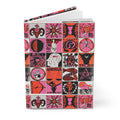
The mosaic design that appears on the covers of this journal — all twelve zodiac signs arranged in a repeating kaleidoscopic pattern, drawn in bold black lines and coloured in vibrant pink and red — is characteristic of the graphic style that flourished in counterculture magazines and underground publications between approximately 1968 and 1975. The artist is unknown, as is the case with much of the graphic production of the underground press, where individual authorship was often subordinated to the collective project of the publication.
What the design demonstrates is the particular genius of the psychedelic approach to pattern: the way that repetition transforms individual images into something larger than themselves, the way that flat colour and bold outline create a visual energy that seems to vibrate on the page, the way that the ancient symbols of the zodiac — the ram, the bull, the twins, the crab — become, in this treatment, simultaneously more abstract and more vivid than they are in any more naturalistic representation.
A Visual Document of an Era
For those who grew up in the late 1960s and 1970s, this kind of image carries a particular charge — the charge of a visual culture that was genuinely new, that felt like it was inventing a way of seeing the world rather than inheriting one. The psychedelic aesthetic was everywhere: on record covers and concert posters, in underground newspapers and counterculture magazines, on the walls of bedrooms and community centres, in the illustrations that accompanied horoscope columns in publications that took astrology seriously as a form of self-knowledge even when they did not take it literally.
That visual culture is now historical — a document of a specific moment in the cultural history of the twentieth century, as precisely located in time as the hand-colored copper engravings of Volkamer or the chromolithographic plates of Adolphe Millot. What it shares with those earlier traditions is the conviction that visual beauty and the communication of knowledge are not separate projects — that the way something looks is part of what it means.

If the visual culture of the counterculture era and the graphic reinvention of the zodiac resonate with you, the Psychedelic Zodiac Journal brings this kaleidoscopic mosaic of all twelve signs to a hardcover journal — 150 lined pages, ready for whatever your days and nights require.
References
- Draper, R. Rolling Stone Magazine: The Uncensored History. Doubleday, New York, 1990.
- Goffman, K. & Joy, D. Counterculture Through the Ages. Villard, New York, 2004.
- Warlick, M.E. Art Nouveau and the Occult. In: The Spiritual in Art: Abstract Painting 1890–1985. Los Angeles County Museum of Art, 1986.
- Campion, N. A History of Western Astrology, Volume II: The Medieval and Modern Worlds. Continuum, London, 2009.
- Pichon, J. Psychedelic: Optical and Visionary Art since the 1960s. San Antonio Museum of Art / MIT Press, 2010.