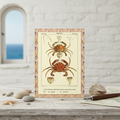
The Creatures of the Shore: Polydore Roux and the Crustaceans of the Mediterranean
The Mediterranean coast in the early nineteenth century was, for the naturalist, a place of inexhaustible richness. Its rocky shores and sandy bottoms, its tide pools and deep channels, harboured a marine fauna of extraordinary variety — crustaceans of every form and size, from the tiny porcelain crabs that sheltered under stones to the great spiny lobsters that prowled the deeper reefs. To document this fauna systematically, with the precision that science required and the beauty that the subject deserved, was the ambition of Polydore Roux.
Polydore Roux (1792–1833) was a French naturalist and pharmacist who spent most of his working life in Marseille, where his proximity to the Mediterranean gave him unparalleled access to the marine fauna of the French coast. He was a member of the Société Linnéenne de Paris and a correspondent of the Muséum National d’Histoire Naturelle in Paris, and his work was conducted within the tradition of systematic natural history that Linnæus had established in the previous century and that French naturalists — Cuvier, Lamarck, Latreille — had developed into one of the most productive scientific programs of the early nineteenth century.
His masterwork, Crustacés de la Méditerranée et de son littoral, was published in Marseille between 1828 and 1830, in a series of fascicles that together constituted the most comprehensive study of Mediterranean crustaceans that had yet been attempted. The work described and illustrated more than a hundred species, many of them new to science, with a combination of taxonomic precision and illustrative quality that set it apart from anything previously available. The plates — hand-colored copperplate stipple engravings, with scientific names given in both French and Latin — were produced under Roux’s direct supervision and reflect his own intimate knowledge of the specimens they depict.
The Art of the Copperplate Stipple Engraving
The technique used for the plates of the Crustacés de la Méditerranée — copperplate stipple engraving, hand-colored after printing — was the dominant method of scientific illustration in the early nineteenth century, and it was particularly well-suited to the depiction of crustaceans. Stipple engraving — in which the image is built up from thousands of tiny dots rather than continuous lines — allowed the engraver to render the subtle gradations of tone and texture that characterise the surface of a crustacean’s carapace: the tubercles of a swimming crab, the spines of a squat lobster, the delicate banding of a shore crab’s legs. The hand-coloring, applied after printing by skilled colorists working from the naturalist’s own specimens or from his instructions, added the chromatic information that the engraving alone could not convey.
The result, in the best examples of the genre, was an image that combined the precision of a scientific diagram with the visual richness of a watercolor — an image that was useful to the taxonomist who needed to identify a species and beautiful to the general reader who simply found the creatures of the sea extraordinary. Roux’s plates achieve this combination with particular success: the specimens they depict are rendered with sufficient anatomical detail to be scientifically useful, and with sufficient care for color and composition to be genuinely pleasurable as images.
Portunus Tuberculatos and Galathea Strigosa
Among the most striking plates in the Crustacés de la Méditerranée are Plate 32, depicting Portunus tuberculatos (the tuberculated swimming crab), and Plate 19, depicting Galathea strigosa (the spiny squat lobster). Both species are characteristic of the Mediterranean fauna that Roux documented, and both illustrate the range of form and adaptation that makes crustaceans such a rewarding subject for the naturalist.
Portunus tuberculatos is a swimming crab — a member of the family Portunidae, distinguished by the modification of the last pair of legs into flattened paddles that allow it to swim actively through the water column rather than simply walking along the bottom. Its carapace is covered with small tubercles — the feature that gives it its specific name — and its coloring, rendered in Roux’s plate with careful attention to the gradations of brown and cream that characterise the living animal, is both cryptic and beautiful.
Galathea strigosa is, despite its common name of spiny squat lobster, not a true lobster at all — it belongs to the infraorder Anomura, which makes it more closely related to hermit crabs and porcelain crabs than to the clawed lobsters of the family Nephropidae. It is a striking animal: its carapace and abdomen are covered with transverse ridges and spines, and its coloring — vivid red with blue transverse stripes — makes it one of the most visually dramatic crustaceans of the Mediterranean. Roux’s plate captures this drama with evident pleasure, the blue stripes rendered with a precision that suggests direct observation of freshly collected specimens.
A Mediterranean Legacy
Polydore Roux died in 1833, at the age of forty-one, before he could complete the full program of work he had planned for the Mediterranean fauna. But the Crustacés de la Méditerranée that he did complete stands as a monument to what sustained attention to a particular place and its creatures can achieve. The Mediterranean coast that Roux documented from Marseille in the 1820s is still there — changed, diminished in some respects by two centuries of human pressure, but still home to the swimming crabs and squat lobsters and shore crabs that he drew with such care. His plates remain the visual record against which the present state of that fauna can be measured.
They are also, simply, beautiful — images that reward the viewer who knows nothing of taxonomy or marine biology as much as the specialist who can read every anatomical detail they contain. The creatures of the Mediterranean shore, rendered in stipple and watercolor by Roux and his engravers nearly two centuries ago, have lost none of their power to astonish.

If the marine life of the Mediterranean and the art of early nineteenth-century zoological illustration resonate with you, the Polydore Roux Crustacean Journal brings Plates 19 and 32 from the Crustés de la Méditerranée to a hardcover journal — 150 lined pages, ready for field notes, coastal observations, or whatever your days require.
References
- Roux, P. Crustacés de la Méditerranée et de son littoral. Marseille, 1828–1830.
- Holthuis, L.B. FAO Species Catalogue, Vol. 13: Marine Lobsters of the World. FAO, Rome, 1991.
- Manning, R.B. & Holthuis, L.B. “Two New Genera and One New Species of Geryonid Crabs.” Proceedings of the Biological Society of Washington, 1981.
- Adler, K. (ed.) Contributions to the History of Herpetology. Society for the Study of Amphibians and Reptiles, 1989.
- Nobre, A. Crustacés Décapodes et Stomatopodes du Portugal. Porto, 1936.