Petrov and the Art of the Fabric Collage
In the spring of 1940, a fashion illustrator working for The Australian Women's Weekly did something that no one in the history of fashion illustration had done before: he built his image not from paint or pencil, but from real fabric. Geoffrey Claude Turton — who signed his work as Petrov — cut pieces of actual textile, arranged them on the page with the precision of a couturier, and produced a cover illustration of such tactile richness and visual sophistication that it stopped readers in their tracks. The technique was entirely his own. The result was unlike anything else in Australian publishing.

The Man Behind the Name
Geoffrey Claude Turton was born in 1916 and worked as a commercial artist and illustrator in Australia during the 1930s and 1940s — a period of extraordinary creative energy in Australian graphic arts, when the growth of mass-market magazines created a sustained demand for skilled illustrators who could work quickly, accurately, and with a strong sense of visual style. He adopted the pseudonym Petrov for his fashion illustration work, a name that carried a faint exoticism and a certain artistic authority in the context of Australian popular culture of the period.
Turton worked extensively for The Australian Women's Weekly, which had been founded in 1933 and had rapidly become the most widely read magazine in Australia. By the late 1930s, the Weekly had a circulation of several hundred thousand copies and an editorial ambition that matched its commercial success: it covered fashion, home economics, fiction, current affairs, and the practical challenges of wartime life with equal seriousness, and it invested in illustration and design with a generosity that was unusual for Australian publishing of the period.
The Fabric Collage Technique
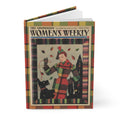
The cover published on April 27, 1940 represents the fullest expression of Petrov's fabric collage technique. The subject is a fashionable woman in a striking plaid coat — red, green, and yellow tartan wool — with a matching hat, holding a leash for a black dog as autumn leaves fall around her. The background repeats the same plaid pattern, creating a cohesive, textile-rich composition of remarkable visual sophistication.
What makes the image extraordinary is its material reality. The coat, the hat, the background — these are not painted representations of fabric. They are fabric: actual pieces of plaid wool, cut with scissors and arranged on the page with the care and precision that a tailor brings to cutting a pattern. The figure's silhouette, the drape of the coat, the fall of the lapels — all of these are achieved not through the illusionistic techniques of conventional illustration but through the physical properties of the textile itself: its weight, its weave, its colour, its texture.
The technical challenges of this approach were considerable. Fabric does not behave like paint. It frays, it shifts, it resists the precise edges that illustration requires. To cut a piece of plaid wool to the exact shape of a coat lapel, and to have it lie flat and true on the page, required a combination of tailoring skill and illustrator's eye that was entirely Petrov's own. The result, when it worked — and in the April 1940 cover it worked magnificently — was an image of a kind that had never been seen before in fashion publishing: an illustration that you could almost feel.
Fashion Illustration in Wartime Australia
The April 1940 cover appeared at a pivotal moment in Australian history. The Second World War had been underway for seven months. Australian troops were already serving overseas. The home front was beginning to feel the pressures of wartime — rationing, shortages, the anxiety of separation — and the role of women's magazines in maintaining morale and a sense of normal life was understood by editors and readers alike.
Fashion illustration in this context was not a trivial pursuit. It was a form of cultural maintenance — a reminder that beauty, creativity, and elegance were worth preserving even in difficult times, and that the skills and pleasures of dressing well were not incompatible with the demands of wartime life. The Australian Women's Weekly navigated this tension with considerable skill, balancing practical advice about making do and mending with aspirational fashion coverage that kept its readers connected to the wider world of style.
Petrov's fabric collage technique was, in this context, more than a formal innovation. It was a statement about the value of craft and material skill — a reminder that the most sophisticated art can be made from the simplest materials, and that the patience and precision required to cut a piece of plaid wool to the exact shape of a coat lapel is not so different from the patience and precision required to navigate the challenges of wartime life.
A Technique Ahead of Its Time
Petrov's fabric collage technique anticipates, by several decades, developments in contemporary art and design that would not become mainstream until the 1960s and beyond. The use of found and real materials in visual art — the incorporation of actual objects and textures into two-dimensional compositions — is associated in art history with movements like Pop Art and assemblage, which emerged in the late 1950s and 1960s. Petrov was doing something recognisably similar in 1940, in the context of commercial fashion illustration, without the theoretical framework or the institutional support that later artists would bring to comparable work.
This is not to claim too much for Petrov. He was a commercial illustrator working within the constraints of a mass-market magazine, and his fabric collage technique was developed in the service of fashion communication rather than artistic experimentation. But the technique itself — the decision to use real fabric rather than painted representation, to let the material speak for itself — reflects an artistic intelligence of a high order, and the results, at their best, are genuinely beautiful objects that deserve to be better known.
The Legacy
Geoffrey Claude Turton continued to work as an illustrator and commercial artist until his death in 1981. His fabric collage covers for The Australian Women's Weekly remain among the most distinctive and innovative works in the history of Australian graphic arts — a body of work that deserves wider recognition both as fashion illustration and as a contribution to the broader history of collage and assemblage in twentieth-century art.
The April 27, 1940 cover is the finest single example of his technique: a work of such material richness, visual sophistication, and historical resonance that it repays close attention more than eighty years after it was made. To look at it carefully — to see the individual fabric pieces, the precise cutting, the way the plaid pattern is matched across the seams of the composition — is to understand something important about the relationship between craft and art, between commercial work and creative ambition, between the constraints of a brief and the freedom of a genuine technique.

Our Fashion Journal reproduces Petrov's April 1940 fabric collage cover for The Australian Women's Weekly across its covers — the full composition on the front, a revealing detail on the back.
References
Cadzow, A. (2001). The Australian Women's Weekly: A History. National Library of Australia.
Heathcote, C. (1995). A Quiet Revolution: The Rise of Australian Art 1946–1968 Maynard, M. (1994). Fashioned from Penury: Dress as Cultural Practice in Colonial Australia. Cambridge University Press.
Sayers, A. (2001). Australian Art. Oxford University Press.
Willis, A. M. (1993). Illusions of Identity: The Art of Nation. Hale & Iremonger.