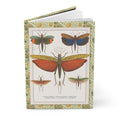
Perty's Delectus: The First Scientific Portrait of Brazilian Insect Life
Share
In 1817, the Bavarian naturalists Johann Baptist von Spix and Carl Friedrich Philipp von Martius set out on one of the most ambitious scientific expeditions of the 19th century — a three-year journey through Brazil that would transform European understanding of South American biodiversity. They returned with thousands of specimens: plants, animals, fish, reptiles, and insects that had never before been seen by science.
The insects fell to Maximilian Perty, a young Munich entomologist, who spent years describing and illustrating the collection. The result was Delectus animalium articulatorum (1830–1834) — the foundational work of South American entomology, its hand-coloured plates introducing the world to creatures of extraordinary variety and evolutionary ingenuity.
Plates 23 and 24: A Theatre of Adaptation
Plate 24 is dominated by Tropidacris latreillei, one of the largest grasshoppers in the world — its enormous red wings fully spread, native to South American forests and exceeding 10 cm in length, illustrated here for the first time in scientific literature. Alongside it: Acrydium crista flammea, whose name means 'flame crest', and Mastax tenuis, a monkey grasshopper of the family Eumastacidae.
Plate 23 is a masterclass in evolutionary strategy. The Cerberodon viridis — a predatory katydid named after Cerberus for its ferocious mandibles — shares the plate with mole crickets whose perfect shovel-like forelegs are among the most specialised digging tools in the insect world; the Mantis hyaloptera, the glass-winged South American praying mantis; and the Scaphura katydids, mimicking wasps in colour and form — one of the earliest documented examples of Batesian mimicry, named decades before Darwin formalised the theory.
The Expedition That Changed Natural History
The Spix and Martius expedition (1817–1820) remains one of the great scientific journeys of the 19th century. Perty's Delectus was its entomological legacy — a record of a biodiversity so extraordinary that it took decades to fully describe, and that continues to astonish scientists today.
—
Explore the insects of the Spix and Martius expedition in the Brazilian Insects Journal — Perty Delectus 1830, featuring Plates 23 and 24 printed on a hardcover journal with 150 lined pages.